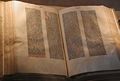
I’ve been reading Alister McGrath’s Christianity’s Dangerous Idea: The Protestant Revolution- A history from the sixteenth century to the twenty-first. It’s an interesting book and even though I haven’t quite finished it yet, it has gotten me thinking about the “dangerous idea”.
The dangerous idea according to McGrath is that “all Christians have the right to interpret the Bible for themselves” (2). McGrath explores this idea historically, looking at the causes and outcomes of the reformation. He also examines how this idea has shaped belief, worship, church polity, the arts and sciences. The last part of the book considers Protestantism in the 21st century and beyond.
As McGrath points out, Protestants decided to prioritize Scripture and individual interpretation partially out of a reaction to church structure and teaching authority. But the move away from giving certain individuals or organizations interpretive authority created a whole other set of problems.
 Right from the start of the Reformation there were differences of opinion about what certain passages of Scripture meant. One of the famous early disagreements, the Marburg Colloquy, was between Luther and Zwingli and their followers over the meaning of “is” in Christ’s statement at the Last Supper, “Take, eat; This is my body.” (Mathew 26:26). Luther believed that Christ’s body is really present in the bread of the Lord’s Supper. Zwingli believed the bread signifies Christ’s body. The problem is, of course, who decides if Luther or if Zwingli is correct?
Simply put, for Protestants differences over interpretation of Scripture resulted in differences in belief and practice. And that divided us into the “too numerous to count” number of Protestant denominations we have to day. It’s a problem we have never solved.
In some respects it is unsolvable. If we believe that all Christians should read and therefore interpret the Bible for themselves, we will have a variety of opinions. If there is no central authority to decide or at least strongly suggest which interpretation is the most appropriate, we are left to persuade each other. And each of us thinks we are right, because we have all thought carefully and worked very hard to be right. And sadly yet predictably, discussion turns into debate which turns into argument and then a church splits.
So what can we do? It seems to me there are at least a couple of things. The first is to remember, as the reformers remind us, there are a few things central to our faith that we must agree on. At the same time, there are many things not as crucial where sincere, faithful people can have different opinions. In these areas tolerance and respect, not division into factions is what we should do. Of course we have the problem of getting everyone to agree on what is essential and what is not. But remembering and honoring what we hold in common would seem to be helpful, particularly in times of disagreement. I also think we have to be patient, much more patient that we want to be. Moving from disagreement to agreement on issues that are important to us can take time. It also means that we all need to be willing to trust each other. And more importantly to trust That God will be present in the movement from disagreement to resolution.
I would also suggest that being correct is not as important as we tend to think it is. Perhaps what is most important for Christians is not doctrinal correctness but rather loving God and our neighbor. Maybe part of the work of the church is to figure out how to live together in spite of disagreement. And not just tolerate each other but truly live and flourish together. We all know it’s one thing to agree we should all get along, and it’s quite another to actually get along. It can be really difficult work. It can be a seemingly impossible task. And yet, more and more, I think it’s important work we are called to do. How do we do this? I don’t know. My church, the PCUSA, has as much trouble with this as anyone. But my hunch is, humility and trusting God is key.
I’d like to know, what do you think?
For more on Martin Luther, Wikipedia, the Internet Encylopedia of Philosophy, and PBS.
For more on Huldrych Zwingli, Wikipedia, The Columbia Encyclopedia, and Christian History and Biography
For more information on the Marburg Colloquy, including some interesting eyewitness accounts go here on the CCEL site.
For a Presbyterian suggestion on resolving church conflict click here. Please feel free to share your church’s way of resolving conflict and disagreement with the rest of us.

 Conversation in Faith
Leave a comment