 It’s a familiar story, Luke’s story Mary and Martha. It has been told countless times to prioritize study/contemplation/prayer (you can pick your favorite) versus action. It’s a story that has been used to denigrate “women’s work”- the idea that Martha was concerned about was simply getting dinner on the table- while Mary valued the more masculine life of the mind. But when you consider the rest of the New Testament, including the “Good Samaritan” story that immediately precedes Mary and Martha, prioritizing study and prayer over action doesn’t hold up. Jesus, Paul and James ( and the OT prophets) are pretty clear, our actions matter. They matter more than our words.
Is there more here than meets the eye?
The word translated in verse 40 as task or work or serving is diakonia. It’s the word we get our word “deacon” from. While it can be used to mean the serving of meals, it is most often used about the work of the church in caring for people and bringing people to faith. It seems a better translation might be service or ministry. Martha could well be asking for help, not with dinner, but with her ministry.
We need to be a little careful as we read this story to remember that the “church” doesn’t exactly exist yet. Jesus, Mary and Martha are first century Jews. Never the less what we understand as the traditional work of deacons, caring for the needs of others, particularly the poor and marginalized was part of being a Torah observing Jew.
I want to suggest this story isn’t a squabble between two sisters over who cooks the dinner. Martha doesn’t say, “Tell Mary to get in here and help me with the fried chicken.” So why does Luke tell us this story? I think Luke passes this story on to help the followers of Jesus see that their (and our) focus has to shift. The story of Mary and Martha comes right after the story of the good Samaritan and right before a section on prayer. It helps to read the story of Mary and Martha in this larger context.
In the “Good Samaritan” story, actions are important. It’s a story about who acts and doesn’t act in ways that fulfill the command of Torah and Jesus to love our neighbors. But the commandment isn’t fulfilled by Temple and Torah ( Priest and Levite) any more. Something odd and unexpected happened. The world of the Chosen people has become much, much larger. How followers of Jesus are to act has become much more complex and much more disturbing. Living in this new world of Jesus is likely to leave one “distracted” and “anxious” and “troubled”.
Martha isn’t told to abandon her diakonia, her work. She is invited to ground her work in the one necessary thing, Jesus, his teaching and his presence.
Immediately after this story, Luke tells us about Jesus teaching his followers about prayer.
Stories of action and prayer frame the Mary and Martha story. If we don’t hold these three stories together we might mistakenly prioritize one over the other. If we read the “Good Samaritan” story and don’t finish the chapter we might prioritize action. If we read the “Mary and Martha” story alone we might elevate study or contemplation.
It seems to me the story of “Mary and Martha” and the stories that frame it help us hold together what we tend to divide, prayer, study and action. It’s not a ladder to climb from less worthwhile to more valued. There is no hierarchy here. It is a circle of reinforcing, reinvigorating relationships. Prayer, study, action we need each and we need them all if we are to form a life that follows Jesus.
Jesus doesn’t tell Martha to give up her life of service, her ministry. He reminds her that unless her work is grounded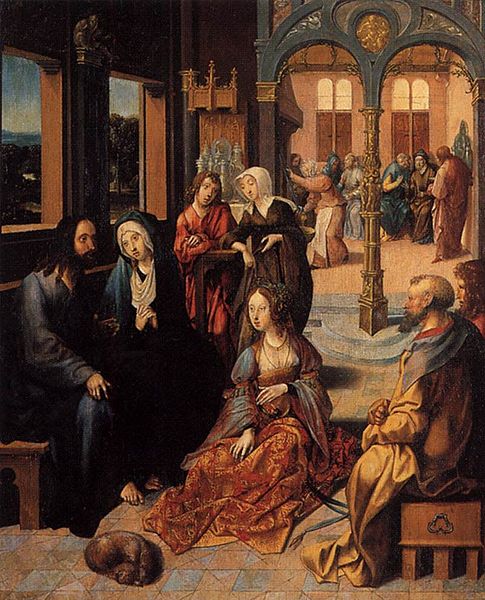 in Jesus, his teaching and his presence, the tasks will be overwhelming. She will live an anxious and worried life. The burden is too great to carry alone. Anxious, worrying hospitality isn’t the better part. In the Messiah we find the life of service and learning unaccompanied by anxiety and care. Notice I didn’t say it was easy, and I’m not saying there aren’t sleepless nights. But as a way of life, a pattern of being, a norm, it’s not an anxious life.
I’d like to know, what do you think?
**********
One other point (you know reflection on Biblical texts isn’t limited to a single point). Many commentators point out that it’s unusual ( although according to the Women’s Bible Commentary not impossible) for women to be disciples, and students. It seems to me for the original audience, the fact that both “characters” are women would be surprizing if not disorienting. Sort of like the identity of the “hero” of the previous story, a Samaritan. It seems to me very appropriate to also read this text as one that affirms that women have full and equal status and responsibility in the church. Women have a place in study and learning and service and hospitality (remember hospitality is much more than just serving coffee and cake. ) Women have a place in the entire life of the church.


 Conversation in Faith
Leave a comment