“Give to Caesar what is Caesar’s and to God what is God’s” This may be one of Jesus’ most famous sayings.You may also have heard at least two different interpretations of it’s meaning. Like many things Jesus said, at first it seems clear enough- until you start to think through how to actually do this. Do we pay taxes or not?
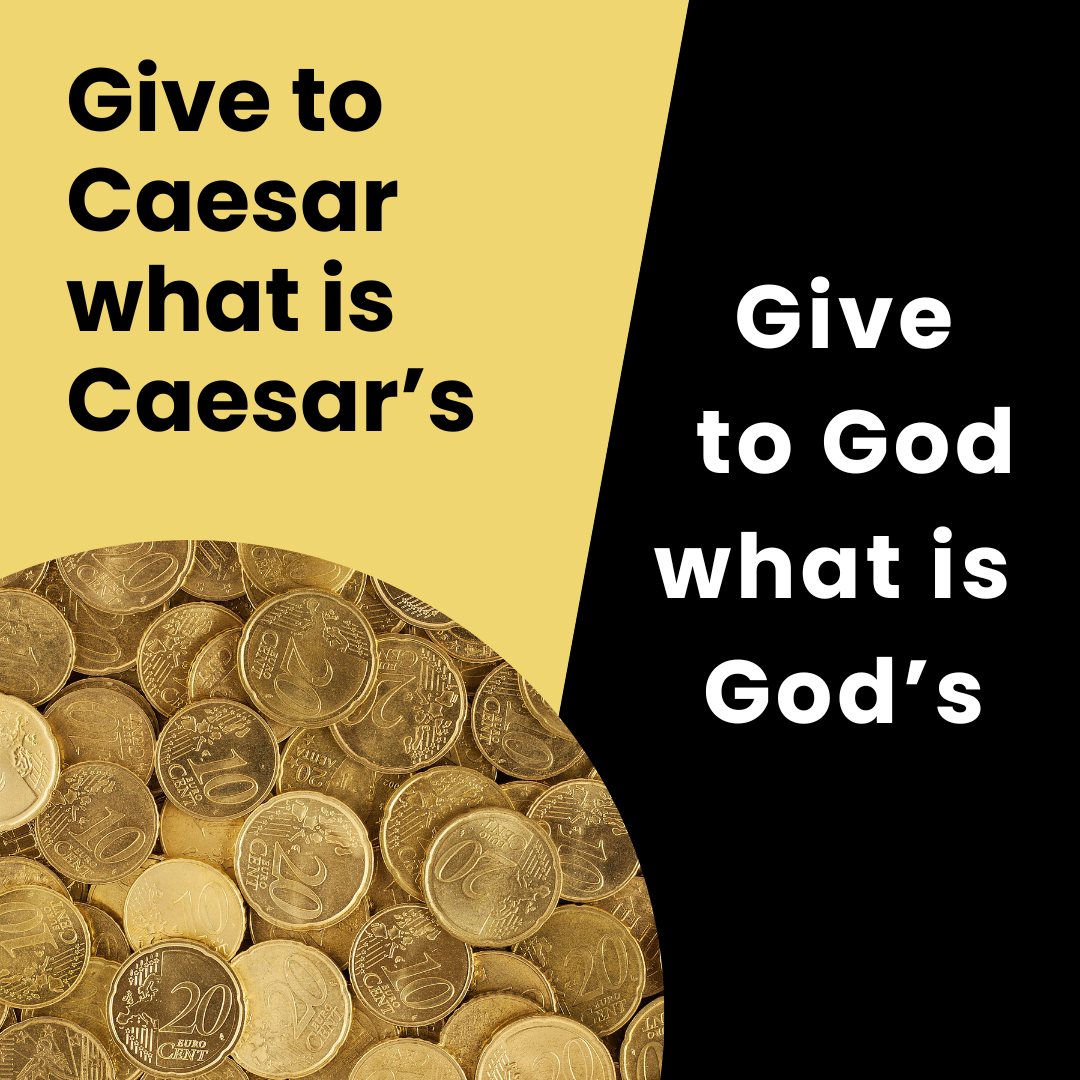
As always our first step in thinking through this statement is to put it back into its original context. Jesus is not giving a free standing teaching on the separation of church and state. To read it that way is to import our current Western context into the story. Religion and government were not separate entities in the ancient world. Roman emperors were divine or the son of a divinity1. Roman coins reflected this belief by bearing inscriptions such as “Tiberius Caesar, august son of the divine Augustus, Pontifix maxumus (high priest).”2 A blasphemous statement for faithful Jews. Taxes that were paid to Rome were imposed by an occupying government. Before and after Jesus’ time there were uprisings and revolts against the Roman Empire.
The story is found in Matthew 22:15-22. These are the days between his entry into Jerusalem and his crucifixion. The author of the gospel recounts a series of confrontations between Jesus and the Temple elite during this time. So far Jesus has told three parables3 warning the elites that they are not doing the will of God. After hearing these parables the elites leave and make a plan to trap Jesus (v15). The elites send others (their disciples and the Herodians) to carry out their plan. Why do you think they did that? Are they attempting to disguise who is behind the question?
The words the elite’s disciples use (v16-17) seem to be designed to flatter Jesus and are (unintentionally?) true. Jesus doesn’t fall for the trap. In fact he calls it out, “You hypocrites, why are you trying to trap me?” (NIV v. 18). Then he asks to see the coin used to pay the tax.
Let’s pause and consider some things before we go on. The question they ask Jesus, “Is it lawful to pay taxes to the emperor, or not” is not about Roman law but about Jewish law. The question isn’t what should Roman subjects do, but rather, what should faithful Jews do?
Israel had a long history of struggle and negotiation with Rome about how “obedient” they needed to be to the Roman Empire. Israel’s self understanding is that they are to be a nation, not an occupied territory. One of the expectations of the messiah was that they would, somehow, free Israel from the Roman occupation. Given the history of Jewish resentment and revolts about taxes this was likely a topic of debate in Jesus’ time. This was not a made up controversy. People would have been listening with interest to Jesus answer.
The way the question is framed implies there were only two possible answers. The choices appear to be pay or don’t pay; capitulation or resistence. This is not a situation where genuously curious and sincere people are asking Jesus for guidance about taxes. If Jesus said to not pay taxes, he would have challenged Rome’s authority and was a threat to the empire. If he said to pay taxes he would be seen as collaborating with the Empire and lose influence with many Jews. Either response would get Jesus in trouble with someone. The flaw in their thinking was assuming that Jesus was actually concerned about getting in trouble or worried about what people thought about him.
There is much more we could say about the social, political, and religious concerns and controversies of the time. But given what we have mentioned here, what does Jesus mean with this answer, ” Give therefore to the emperor the things that are the emperor’s and to God the things that are God’s”?
What things belong to the emperor? From the emperor’s view, essentially everything.
What things belong to God? For the faithful, the answer is everything.
How can they resolve this? Is Jesus suggesting that the emperor is doing God’s will and therefore taxes should be paid? Or is he suggesting that because everything belongs to God they should not pay anything? Or is there another option? Is Jesus suggesting that taxes can be paid while also recognizing God’s greater authority? Can they pay taxes to Roman empire while working to establish the empire of God?Jesus didn’t didn’t advocate for violence but he also didn’t submit to the empire’s agenda.
I wonder, in addition to evading the trap that was set for him, if Jesus isn’t tossing this question right back to them. A few days before this encounter Jesus entered Jerusalem in a way that pointedly contrasts with the Roman Imperial presence. He has just told three parables to the Jerusalem elite accusing them of not serving God. and warning of their impending replacement. Perhaps Jesus is suggesting that the Pharisees, the Heroidians and their disciples ought to ask themselves the question, what belongs to God and what belongs to the emperor. Stop the tricks and think about who you are and what you are doing.
This is an invitation to serve God and not the emperor in the distinctive way of Jesus. He didn’t submit to the empire’s agenda but his resistance was non violent. Everything that Jesus did and said pushed back against the empire. Everything about Jesus embodied the reign of God. The way of mustard seeds and yeast; sown seeds and hidden pearls. A way that offered life to all, not the violence and death of war and insurrection.
While we live in a different time and place, Jesus response asks us to consider what belongs to God and what to the empire. Just as with the original audience Jesus doesn’t give a simple answer. Rather we are invited to ponder and wrestle with the question. How do we divide what belongs to whom? Can it even be divided? How do we embody the reign of God in our time? These are hard questions. Jesus doesn’t give us an easy answer but invites us to struggle with the questions. When we do, we will grow in the wisdom needed to live faithful lives in our times.
- Cult of Emperor ↩︎
- coin image ↩︎
- See here, here, and here. ↩︎
 Conversation in Faith
Leave a comment