This Sunday, is “Christ the King” or “Reign of Christ” Sunday1.
The lectionary, for the past several weeks, has been encouraging us to be ready for the coming reign of Christ. Using a string of parables2 Jesus offers images about how disciples are to wait for the coming reign of God by using their time well and wisely. This Sunday’s gospel reading3 is the concluding statement of this section of Jesus’ teaching4 in this gospel. Next the gospel moves on to the Last Supper, Jesus’ betrayal, arrest, trial, crucifixion, and resurrection.
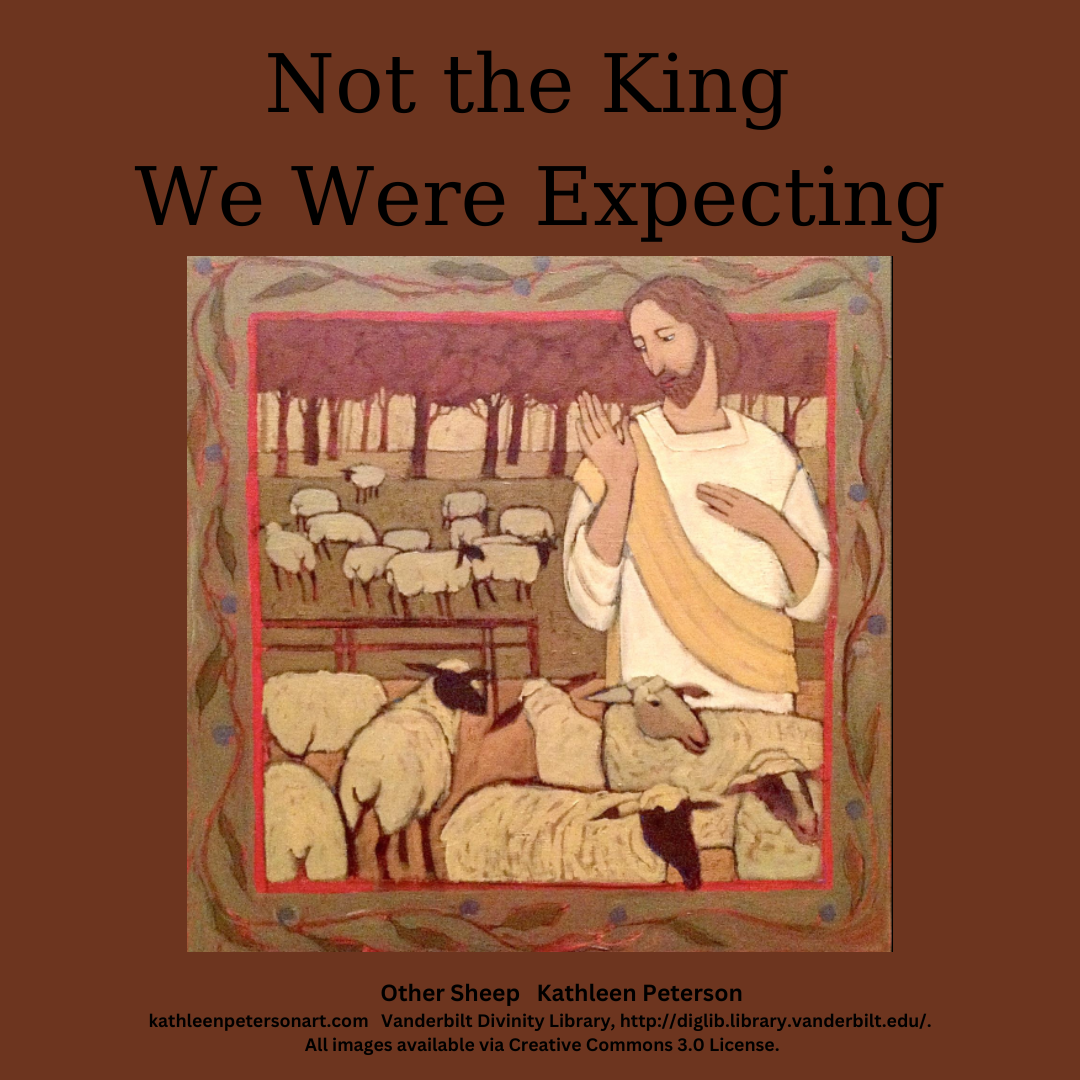
Matthew 25: 31-46 5 talks about sheep and goats and judgment. It addresses how the coming king expects disciples to be using their time and efforts and why this matters. Earlier the disciples were told to use their time wisely. Now they are told what wise use of their time looks like and its consequences. Jesus turns out to not be the sort of king the disciples and we expect and this king’s criteria for judgement is also not what the disciples and we expect.
Even those of us who don’t live in kingdoms know some things about how kings act and how they are to be treated. We know that kings demand loyalty and public declarations of allegiance. This story of judgement, of a king separating their people into loyal and not loyal is not surprising. It is what we expect. What is surprising are the king’s criteria. There is no demand for a pledge of loyalty. There are no public declarations of allegiance. No demand for a confession of faith. No “sinner’s prayer”.
Now before some of you get upset about this, let’s be clear, no single set of 15 verses can tell us everything about salvation and judgment. But these verses emphasize something crucial and important, particularly for our times. Many Christians prioritize a verbal confession of faith, and an acceptance of a particular set of beliefs about doctrine. Those are not necessarily bad things. And we need to take what Matthew 25 has to teach us seriously.
This king does not require anyone to say “Jesus is Lord”. This king requires us to live and act as people who know that “Jesus is Lord”. That knowing informs and shapes how we live. In God’s kingdom, how we act and what we do are the things that matter. Notice these are actions that include, not exclude. There are no criteria for which hungry or thirsty person is cared for. There is no criteria about which stranger is welcomed. And there is no expectation that we will teach, correct, reprove, or convert those who are welcomed, fed, clothed, or visited. There is no expectation here about “making disciples”. This is a strong counterbalance to the ways many of us engage the world around us. We need to take Matthew 25 seriously.
Liberation theologians talk about “God’s preferential option for the poor” which is a fancy way of saying what these verses tell us. Jesus is with, among, and at one with the poor and marginalized in a real and particular manner. If we want to meet Christ, this is where we go, this is who we spend time with. That is not to say that Christ isn’t in other places and with other people. But I do think we can say that Jesus wants to meet us, prefers to meet us, among the poor and marginalized. If we have been paying attention as we read Matthew’s gospel, we should not be surprised. Matthew has been telling us this the whole time.
Another thing we all know about kings is they are the center of attention wherever they are. People notice kings. There is a certain amount of pomp and ceremony when a king shows up. The king’s presence is openly acknowledged. But this king seems hard to spot. The righteous haven’t seen him. The righteous actually have to ask, “When? When was it that we saw you?”
This is not the king anyone was expecting. Yet he is the king we have, a king who is focused on others and not their royal selves.
This is a word of encouragement for us. I don’t always see Jesus in others or see Jesus as he stands alongside others. To be honest, sometimes I don’t even try to see Jesus, I just see others. But I also know what Jesus wants me to do. My attitude, my insight, my level of spiritual awareness are not as important as my doing what Jesus asks me to do. I don’t have to feel holy, or spiritual or inspired or even happy. I simply need to be doing what Jesus asks me to do.
Years ago, in my campus ministry days, we started doing “random acts of lunch” as a local university. We periodically brought in a free lunch, for any student, faculty or staff who wanted it. We started doing this for a few reasons. Food insecurity exists on college campuses and every meal helps. Feeding students is a tried and true way to help students learn about your ministry. It was a no strings attached meal. We had a sign telling students who was providing the food, but we didn’t ask for names or contact information. People were simply invited to have lunch.
As you might expect, people lined up for food. We served the meal in an open atrium area. As I stood on the open stairwell overlooking the space, I saw the table of food and the students eating. All of a sudden, I realized I was looking at a tiny in breaking of the kingdom of God. There it was, right before my eyes. “Then people will come from east and west, from north and south, and will eat in the kingdom of God6.” All I was trying to do was feed some students and meet some students, and Jesus showed up. Almost in spite of me. He was present in his typical unassuming way with students as they ate lunch and chatted about their classes. Holy ordinary things for holy ordinary people.
I don’t worry so much about whether I see Jesus in and with folks these days. His presence isn’t dependent on me. He’s there whether I recognize him or not. Jesus has told me what to do. John Wesley sums it up for us:
Do all the good you can, By all the means you can, In all the ways you can, In all the places you can, At all the times you can, To all the people you can, As long as ever you can.
- Christ the King Sunday is the last Sunday of the church year. Next Sunday, the first Sunday of Advent is the start of the new church year. ↩︎
- We’ve looked at many of those parables in earlier posts. ↩︎
- https://bible.oremus.org/?ql=567849024 This text is not a parable, it is an apocalyptic text.They are an uncommon genre. They are odd. While parables start with very familiar, commonplace scenes, apocalyptic texts start with strange scenes. These strange scenes have fairly constant features within apocalyptic texts. There are judges, angels, the gathering of people to be judged, the separation of the people, reward for the righteous and punishment for the wicked and God’s empire is established. Usually apocalyptic texts are written from the perspective of the marginalized and oppressed. The lowly are raised up and the powerful are brought down. They are meant to be an encouragement to the oppressed to persevere, to remain faithful. ↩︎
- Jesus’ fifth teaching discourse is chaptes 24 and 25. ↩︎
- https://bible.oremus.org/?ql=567849024 This is a complex text and Bible scholars have some differences of opinion about what’s being described. There is some debate about who the “nations” are. Are they Jews, Gentiles, both? Is it everyone or just disciples? Who does the phrase “the least of these who are members of my family” or” my brothers and sisters” refer to? Is it disciples or everyone?
I think we should take the most inclusive interpretation. The nations are everyone, both corporately and as individuals. In scripture, the persistent theme is inclusion- from Genesis where Abram and his descendants are blessed to be a blessing to the nations through the end of Matthew when the disciples are sent to make followers of Jesus of all the nations. As for Jesus family? It’s the same thought process. Jesus has reframed and reconfigured “family” throughout the gospel. ↩︎ - Luke 13:29 ↩︎
 Conversation in Faith
Leave a comment