Shepherds and angels are part of every nativity scene and play. It’s a familiar part of Luke’s nativity story. Because it’s so well known, we may not recognize it as the startling text that is it. Remember that the nativity stories function as prelude and parable.1 They set out major ideas and themes.
So we should ask ourselves why does Luke tell us this story and why does he tell it in this way?
While they [Mary and Joseph] were there, the time came for her to deliver her child. And she gave birth to her firstborn son and wrapped him in bands of cloth, and laid him in a manger, because there was no place for them in the inn.
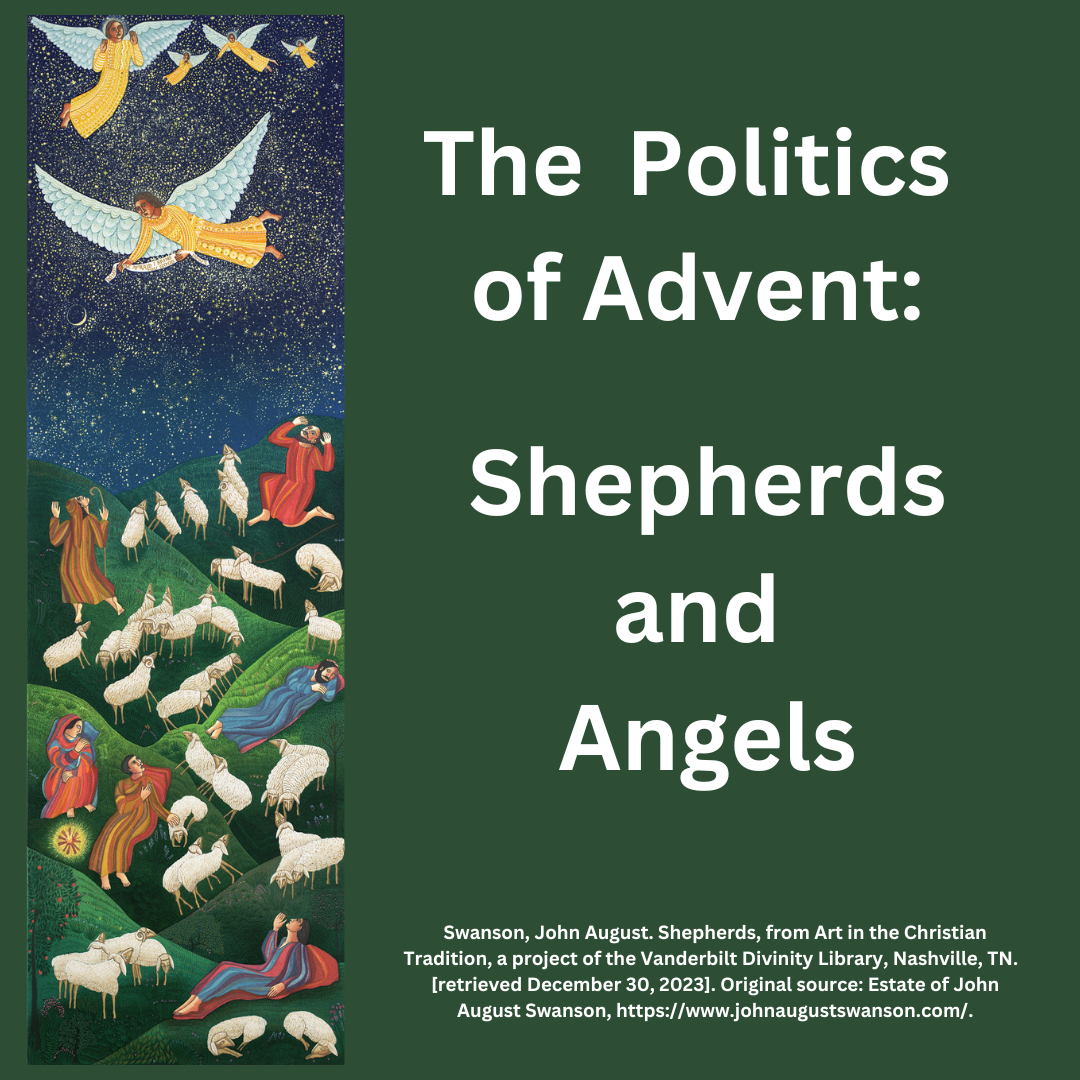
In that region there were shepherds living in the fields, keeping watch over their flock by night. Then an angel of the Lord stood before them, and the glory of the Lord shone around them, and they were terrified. But the angel said to them, ‘Do not be afraid; for see—I am bringing you good news of great joy for all the people: to you is born this day in the city of David a Savior, who is the Messiah, the Lord. This will be a sign for you: you will find a child wrapped in bands of cloth and lying in a manger.’ And suddenly there was with the angel a multitude of the heavenly host, praising God and saying,
‘Glory to God in the highest heaven,
and on earth peace among those whom he favors!’
When the angels had left them and gone into heaven, the shepherds said to one another, ‘Let us go now to Bethlehem and see this thing that has taken place, which the Lord has made known to us.’ So they went with haste and found Mary and Joseph, and the child lying in the manger. When they saw this, they made known what had been told them about this child; and all who heard it were amazed at what the shepherds told them. But Mary treasured all these words and pondered them in her heart. The shepherds returned, glorifying and praising God for all they had heard and seen, as it had been told them.
Luke 2:7-20 NRSV
Our first wondering might be, why would angels speak to shepherds? On the one hand, angels have already appeared to the rural priest Zechariah and to Mary, of whose family and background we know nothing about. And now shepherds. We should ask ourselves, what do these repeated angelic visits to average, ordinary people mean?
Shepherds are an unlikely group of people to be the first to receive an announcement about the birth of a king. Mary and Elizabeth knew, and presumably Zechariah and Joseph also knew, but no one else has been told. Here’s a clue about where God’s focus is. It’s not in the halls of power but with the regular folks.
Scripture echoes and rhymes, especially these nativity stories. When we hear about shepherds we should also recall the shepherd stories of the Bible. Remembering how God is described as a shepherd. How King David starts out as a shepherd.
What’s most astonishing though, is what the angel says. As modern readers we have lost the cultural context that gives this announcement its impact.
Remember that our assumptions about the separation of religion and state are modern ideas. In the ancient world state and religion overlapped. Kings and emperors ruled because the gods willed it. Rulers represented the gods and made the god’s presence, favor and blessings available to the nation. There was, over time, a move from recognizing the emperor as a representative of the divine, to declaring the emperor a god after their death, (which, by the way, makes their heir the son of a god) to declaring the emperor a god during his lifetime. Monuments and temples to the emperor were built all over the empire.Throughout the Roman Empire, festivals that celebrated Caesar as lord and savior of the world were held in every town and city of any significance. Worship of the emperor helped hold the empire together.
The language the angel used to announce Jesus’ birth were also words used in the Roman Empire about Caesar. The words “good news”, and “savior” and “lord”along with the content of the angelic announcement would remind the original audience of announcements about the emperor. The emperor was the one who brought peace.
Here are some examples of how people wrote about the emperor. Notice how familiar some of the language is to us as readers of the New Testament.
Since the providence that has divinely ordered our existence has applied her energy and zeal and has brought to life the most perfect good in Augustus, whom she filled with virtues for the benefit of mankind, bestowing him upon us and our descendants as a savior – he who put an end to war and will order peace, Caesar, who by his epiphany exceeded the hopes of those who prophesied good tidings [euaggelia], not only outdoing benefactors of the past, but also allowing no hope of greater benefactions in the future; and since the birthday of the god first brought to the world the good tidings [euaggelia] residing in him…For that reason, with good fortune and safety, the Greeks of Asia have decided that the New Year in all the cities should begin on 23rd September, the birthday of Augustus…2
(It is a question whether) the birthday of the most divine Caesar is more pleasant or more advantageous, the day which we might justly set on par with the beginning of everything, in practical terms at least, in that he restored order when everything was disintegrating and falling into chaos and gave a new look to the whole world, a world which would have met destruction with the utmost pleasure if Caesar had not been born as a common blessing to all. For that reason one might justly take this to be the beginning of life and living, the end of regret at one’s birth…. It is my view that all the communities should have one and the same New Year’s Day, the birthday of the most divine Caesar, and that on that day, 23rd September, all should enter their term of office.
(It is a question whether) the birthday of the most divine Caesar is more pleasant or more advantageous, the day which we might justly set on par with the beginning of everything, in practical terms at least, in that he restored order when everything was disintegrating and falling into chaos and gave a new look to the whole world, a world which would have met destruction with the utmost pleasure if Caesar had not been born as a common blessing to all. For that reason one might justly take this to be the beginning of life and living, the end of regret at one’s birth…. It is my view that all the communities should have one and the same New Year’s Day, the birthday of the most divine Caesar, and that on that day, 23rd September, all should enter their term of office. 3
The most divine [Lord]…we should consider equal to the Beginning of all things. For when everything was falling into disorder, he restored order once more and gave to the whole world a new aura. Caesar, the common Good Fortune of all,..[t]he beginning of life and vitality…[A]ll the cities unanimously adopt the birthday of the divine Caesar as the new beginning of the year…Whereas the Providence which has regulated our whole existence…has brought our life to the climax of perfection in giving to us the emperor Augustus, whom Providence filled with virtue[power] for the welfare of humankind and who, being sent to us and our descendants a our Savior, has put an end to war and has set all things in order; and whereas, having become god-manifest, Caesar has fulfilled all the hopes of earlier times…in surpassing all the benefactors who preceded him…; and whereas the birthday of the god[Augustus] has been for the whole world the beginning of the gospel concerning him,[therefore let a new era begin from his birth].4
The angels are much less wordy but they take the empire’s key ideas and words and completely change their focus. When the angels appear to the shepherds in the this gospel Luke is making it clear–this is not the gospel according to Caesar.
But the angel said to them, “Do not be afraid; for see- I am bringing you good news of great joy for all the people; to you is born this day in the city of David a Savior, who is the Messiah, the Lord.
And suddenly there was with the angel a multitude of the heavenly host,praising God and saying,” Glory to God in the highest heaven, and on earth peace among those whom he favors! (Luke 2:10-11,13-14)
Do you see what Luke has done?
The good news is not in the imperial capital, Rome but in the city of David, Bethlehem.
Born to you shepherds, regular people, not powerful people.
“a Savior 5[imperial title], who is the Messiah6 [Jewish title]”.
The good news is the birth of the true Savior who is not a Roman emperor but the Messiah.
Do you see it? To say that Jesus is Lord7 is to say that Caesar is not Lord.
Do you see it? The reign of God is not found in the reign of human empires.
This is a bold political, religious and social statement.
Luke wants to be sure we understand this is not politics as usual.
One last thing to notice. The multitude of heavenly host
When the heavenly host appear, they are hard to miss or dismiss. The heavenly host is “bible talk” for an army of angels; God’s army of angels. The shepherds and the early followers of Jesus knew all too well what armies do. They had plenty of experience with armies. Armies kill, burn your home and crops, rape and enslave and crucify. So yes the shepherds were terrified.
But. But.
This army doesn’t kill. This army sings.
This army doesn’t sing about itself and its power and glory. This army sings about God.
“Glory to God in the highest heaven,
and on earth peace among those whom he favors.”
Beloved, this is a song about the reign of God – not the reign of Caesar – not the reign of fill in the blank dictator, emperor, great leader, prime minister, or president. This is a song about the way the world is supposed to be.
Swords into plowshares
Armies into choirs
Imagine if the armies of the world, the armies now and every army that ever was, imagine them all singing together,
Glory to God in the highest heaven,
and on earth peace among those whom he favors.
That’s part ( and only just part) of what we wait for.
O come O come Emanuel and ransom us who are held captive – in a violent world.
Come Prince of Peace, come.
- see the first post in this series, https://wordpress.com/post/conversationinfaith.com/7176 ↩︎
- The First Christmas, Marcus Borg and John Dominic Crossan, HarperOne, 2007, page 160 quoting the League of Asian Cities in 9 BCE. Italics added by authors ↩︎
- The First Christmas, Marcus Borg and John Dominic Crossan, HarperOne, 2007, page 159-160 quoting Paullus Fabius Maximus proconsul of Asia on proposing beginning the new year on Augustus’ birthday. ↩︎
- Orientis graeci inscriptions selectae, Vol 2, ed. W. Dittenberger (Leipzig, 1903-5), no. 458. quoted in Horsley, Christmas Unwrapped: 116) ↩︎
- Savior is not a commonly used title in the gospels for Jesus. Luke uses it twice, John once. ↩︎
- “Messiah” is, of course, a Jewish word for God’s anointed. By Jesus’ time the Messiah was expected, one way or another, to rescue Israel from Roman oppression and rule. Particularly the poor people were looking for a Messiah to deliver them. ↩︎
- In the Hebrew Bible “Lord” referred to God. But the Romans also used that word to describe Caesar. ↩︎
 Conversation in Faith
Leave a comment