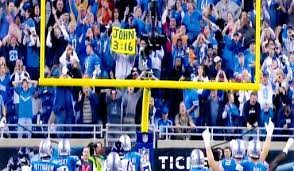
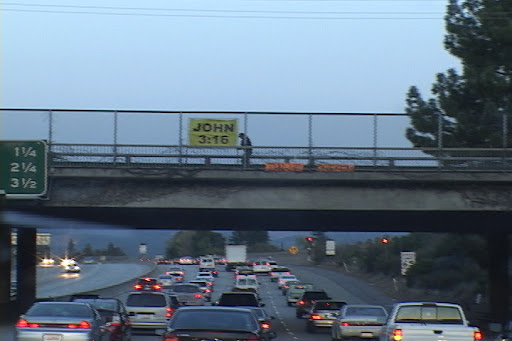
John 3:16 may be the most displayed Bible verse ever. You see it on billboards, at sporting events, on home decor and bumper stickers.


This week’s lectionary reading is John 3:14-21 which includes the (in)famous verse 16. What you might not recall, is that these verses belong to the story of Nicodemus visiting Jesus. The Nicodemus story also contains the nearly as famous quote “You must be born again”. It’s insightful to read these 21 verses together. Often we break them into 3:1-13 and 3:14-21. Take a moment and read them as one unit1.
John’s gospel is different from the other three gospels.2 The gospel of John often employs dualistic language (light/dark for example) most likely to clearly make his point. But John also has several stories where people are confused by language that has multiple possible interpretations. Jesus says one thing and the other person misunderstands (for example Nicodemus and also the Samaritan woman), so that the author can make their point.
But also there are words that in Greek hold a greater variety of meaning than they do in English. Translators then, need to make a decision about what the author intended and what English word best captures that intended meaning. Often the alternative meanings are placed in a footnote. I think it’s always helpful to try to hold several of the meanings together when we read, otherwise we lose the richness of the original language.
In John 3:1-21 there are several instances of this. The first two may be familiar to you.
born again/ born from above/ born anew: This plurality of meaning is what confuses Nicodemus.
Spirit/wind; wind/Spirit: Try reading verse 8 with both meanings in mind. Does anything shift or expand for you?
The next two may be less familiar: and so let’s spend some time with them.
believe/entrust: Believe is a verb. In John’s gospel it is also used to describe someone’s identity, such as “one who believes”. Because believe is a verb, it is not a “thing” we know. It is something we do, an action or the expression of our identity. Believe also includes the concept of “entrust”. For example, John 2:23-24 the same Greek verb is translated differently in English- “many believed in his name because they saw the signs that he was doing. But Jesus on his part would not entrust himself to them.” The italicized words are the same word in Greek. It doesn’t make sense to say that Jesus “would not believe himself”. But “many entrusted (themselves) to his name” brings out another aspect of the word. 3
eternal life/ age to come/ life of the age: For us, “eternal” usually means something like “unending time”. The phrase “Eternal life” is often thought to mean something like, a future life in heaven or life after death. But the Greek word eternal can also be translated as “age”. In this sense we would use it more like “age of empires” or “age of enlightenment” or the “age of elves”. This is a way to talk about history and where we are in it. There is the present age and the age to come. The age to come/life of the age/ eternal life, isn’t just what happens after we die. John is talking about the time, the occasion, when God’s purpose for all creation is fulfilled. Eternal life isn’t simply unending time, it is a distinct kind of life. It is life lived in the age of the reign of God. This kind of life isn’t confined to the future. This is life that is lived in God’s presence right now. 4 Jesus brings or inaugurates life in this age. Notice how in the verses after 3:16, Jesus explains and expands what he said in 3:16. This is not solely an event that happens after death. The eternal life/ life of age starts now. Those who entrust themselves to Jesus live in and into that age.
So now, if I may be so bold as to expand the translation of John 3:16, For God so loved the world that he gave his only Son, so that everyone who believes/entrusts themselves in him may not perish but may have eternal life/ life in the age of God.
Read Eugene Peterson’s paraphrase of John 3 from The Message. 5
Sometimes John 3:16-21 gets flattened into God sent Jesus to save you. If you don’t believe you are condemned. But I think it says something else.
The Son comes out of love to invite all into life in the age of God. God does not condemn us. We separate ourselves from God by not entrusting ourselves to God’s ways, by loving the “darkness”, doing evil. We entrust ourselves to the way of God by doing “deeds that have been done in God”. This is an invitation to entrust ourselves to the way of Jesus, living faithful lives and thereby having life in the age of God., living and participating in God’s good purposes for the world. We live free from what opposes God’s good purposes for the world.
- It is always helpful to read before and after any particular set of verses, just to orient ourselves in the text. Often what comes before and after helps illuminate a particular text. Here, just before Nicodemus’ visit, John tells the story of Jesus overturning the tables in the Temple. Just after the Nicodemus story, John places the story of the Samaritan woman at the well. How do each of these stories, in their own way, help us understand Nicodemus’ visit and his conversation with Jesus? ↩︎
- Matthew, Mark, and Luke are sometimes called the synoptic gospels because they have a similar ( although not identical focus). John’s gospel is quite different. There are stories about Jesus that only John tells. John’s chronology is different from the other gospels. The writing and language he uses can be different. ↩︎
- See Warren Carter’s book, John: Storyteller, Interpreter, Evangelist, (Hendrickson Publishers, Inc: 2006) page 93-101 for a more full discussion of this topic.
Also the little Greek word, eis can be translated as into, to, toward, for, among. ↩︎ - See Warren Carter’s book, John: Storyteller, Interpreter, Evangelist, (Hendrickson Publishers, Inc: 2006) pages 99-101. Understanding “eternal life” as “life in the kingdom of God” or the “age of God” has significantly reshaped my understanding and reading of the Bible. ↩︎
- https://www.biblestudytools.com/msg/john/3.html ↩︎
 Conversation in Faith
Leave a comment