
What follows today and tomorrow are short reflections on people who appear in Mark’s Holy Week narrative. These are not meant to be exhaustive or definitive articles. Rather they are some of what I have been pondering this Holy Week.
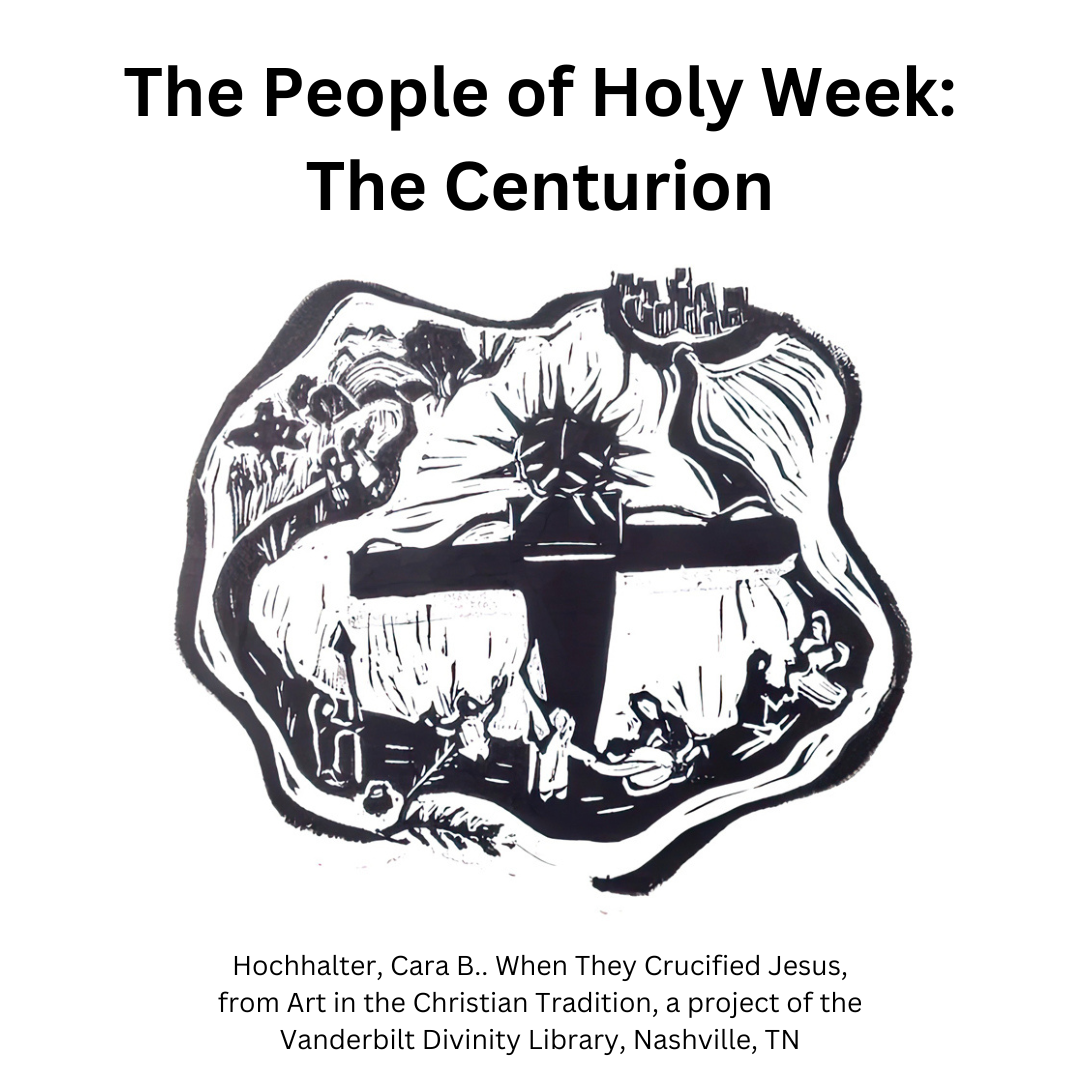
When it was noon. darkness came over the whole land until three in the afternoon. At three o’clock Jesus cried out with a loud voice, ‘Eloi, Eloi, lema sabachthani?” which means, ‘My God, my God, why have you forsaken me?’ When some of the bystanders heard it, they said, ‘Listen, he is calling for Elijah’. And someone ran, filled a sponge with sour wine, put it on a stick, and gave it to him to drink, saying, ‘Wait, let us see whether Elijah will come to take him down.’ Then Jesus gave a loud cry and breathed his last. And the curtain of the temple was torn in two, from top to bottom. Now when the centurion, who stood facing him, saw that in this way he breathed his last, he said, ‘Truly this man was God’s Son!’ Mark 15:33-39 NRSV
The Centurion. What made him say “Truly this man was God’s Son!”? He could not have known about the temple curtain. This was not likely to have been his first crucifixion. It may have been his job. Surely others being crucified has wondered if God had abandoned them. So what was different this time?
He didn’t see a miracle or have a vision. He didn’t see angels come to rescue Jesus. He didn’t see Jesus removed from the cross by some divine power. He didn’t hear a voice from a cloud declaring Jesus was the Beloved Son. So what was different this time?
What was it in Jesus’ death, not his resurrection, his death, that caused the centurion to say this? It is an amazing statement. And a dangerous thing to say out loud.
To say, “Truly this man was God’s Son” was a dangerous thing for anyone to say. The Roman emperor cult and the Roman state declared that Caesar was God’s Son. Loyal Romans also made this declaration. To declare Jesus was God’s Son was to declare that the Emperor was not. And that was a dangerous thing to say. Especially, I imagine, if you are a centurion who is employed by the state to enforce the decrees of the state.
Mark tells us the centurion stood facing Jesus. Did he see something in Jesus’ face? In his eyes? I wonder. Or was it something else? Have you had the experience of looking at something or experiencing something and knowing that “more” was happening? Of realizing that there was a depth and importance far beyond what appeared on the surface?
We don’t know what caused the centurion to say this. We don’t know what happens to the centurion after this. The Gospel writer just gives us this extraordinary moment. And it causes me to pause and ponder faith and belief.
.
 Conversation in Faith
Leave a comment