What do you know about the story of Philip and the Ethiopian Eunuch? What have you heard preached? What have you been taught? How does this story fit with the larger narrative in Acts and the rest of Scripture?
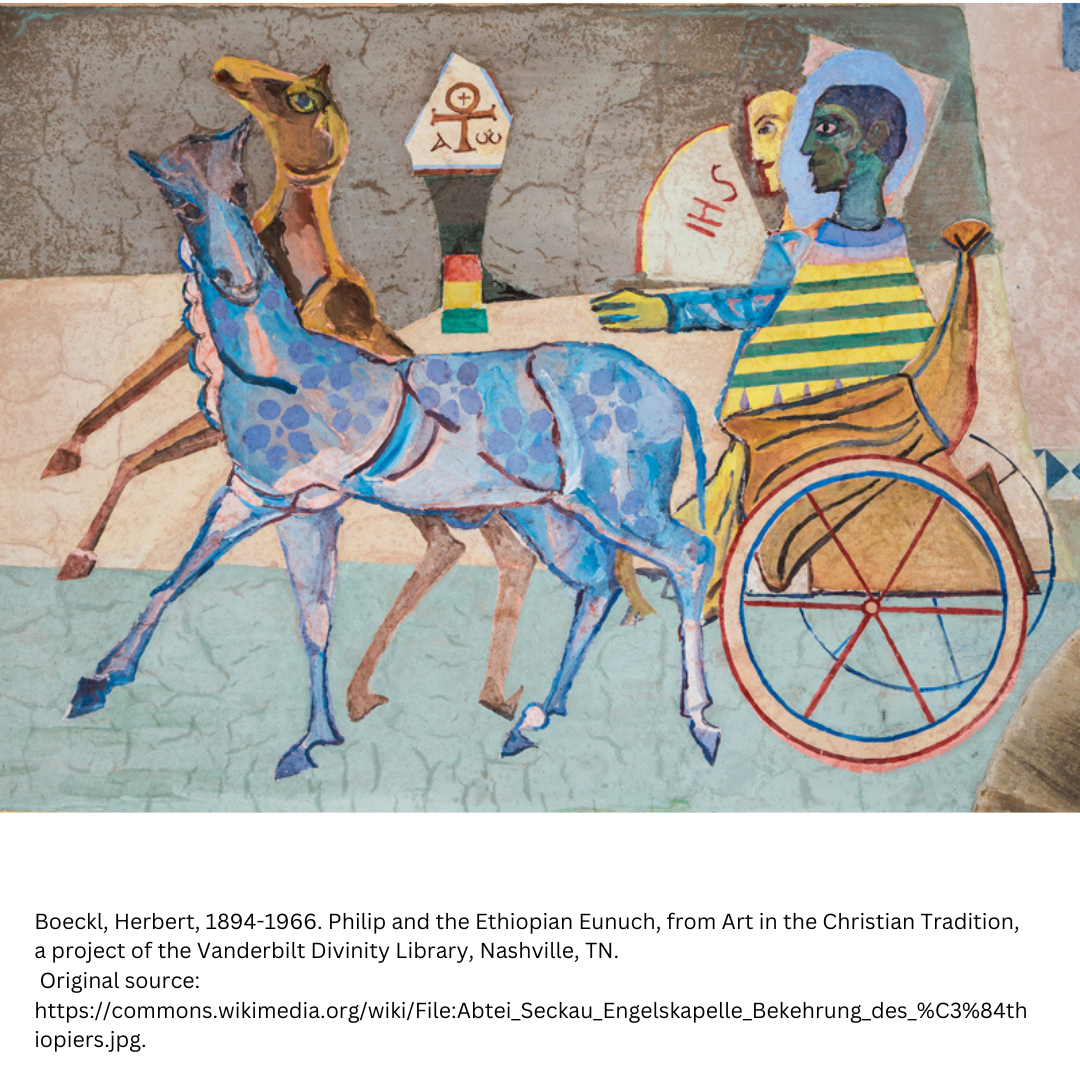
Before you read the story there are some things to keep in mind. You may have been told that eunuchs were only castrated males. Scholars now think that the term “eunuch” was the term used for any sexual minority/gender non conforming person. “Ethiopian” in the story is not from the modern nation of Ethiopia. It was a nation generally south of Egypt, that historically was also known at Cush1 or Nubia and was not part of the Roman Empire. Scholars hold various opinions about whether this person was Jewish or a Gentile.
In Acts there are several stories about disciples preaching the gospel. A major theme in Acts is the variety of persons and the unpredictability of who the Spirit includes. Just before this story, Philip goes to the Samaritans and preaches the good news. Samaritans and Jews, while closely related theologically, nevertheless had significant differences. These differences caused a high degree of suspicion, distrust, and dislike between them. Shortly after the story of the Ethiopian Eunuch, is the story of Peter’s vision about clean and unclean foods and the conversion of the Gentile Centurion Cornelius. Each one of these three stories helps interpret the others.
You can read the story here.
This story has some similarities to the other stories and some differences from the other stories. Typically the disciples are sent to a place. For example, Philip goes to Samaria. Or they are sent to a person, as Peter is sent to Cornelius. In this story Philip is sent to a road- not a town, and not a person. The road is described as a wilderness road. Evidently it isn’t literally a wilderness road. So right away hearers of this story may be wondering about this. Why call this road a wilderness road? It’s a clue for us about what’s going to happen. In the Bible, important things happen in the wilderness. Strange things. Dangerous things. LIfe changing things. People encounter God in the wilderness. Let the reader pay attention.
The eunuch had gone to Jerusalem to worship and now was returning home. They are, if not Jewish, someone who believes in the God of Israel. We can wonder if they heard anything about Jesus while they were there. This is a long journey2. To travel this far requires planning and commitment.

Philip and the eunuch talk. The eunuch requests baptism and is baptized. Philip is then “snatched” away by the Spirit, not unlike the way the prophets Elijah (1 Kings 18, 2 Kings 2) and Ezekial (Ezek 11) are carried away by the Spirit.
These three stories demonstrate the disciples faithfulness to Jesus’ command to “go into the world”. To Samaria. To the Roman Empire. To Ethiopia3. And to the gender non conforming.
The Ethiopian eunuch is not named. Which could be seen as depersonalizing them. On the other hand, isn’t it interesting that the text makes a repeated point of the person’s gender/sexuality? Perhaps, the author wants to be sure we don’t miss the point of inclusion of a queer person.
LIke so many LGBTQ people, the Ethiopian eunuch is serious about their faith. Philip doesn’t ask or require the Ethiopian eunuch to change, to be anyone different than they already are. What, indeed, prevents them from being baptized? The text’s response is nothing and no one.
One of the threads that runs through both testaments is the movement to ever increasing justice and inclusion. This includes gender non conforming, sexual minorities also.
To very briefly4 show the arc of inclusion for gender non conforming persons and sexual minorities, take a look at these four passages. The passages move from Torah, to the Prophets, to the Gospel, to Acts. Read the Isaiah passage carefully. “For my house shall be called a house of prayer for all peoples” is in the context of the inclusion of gender nonconforming, and sexual minority persons.
Deuteronomy 23:1 “No one whose testicles are crushed or whose penis is cut off shall be admitted to the assembly of the Lord.”5
Isaiah 56:3- 8 “Do not let the foreigner joined to the Lord say, “The Lord will surely separate me from his people”; and do not let the eunuch say, “I am just a dry tree.” For this says the Lord: To the eunuchs who keep my Sabbaths, who choose the things that please me and hold fast to my covenant, I will give, in my house and within my walls, a monument and a name better than sons and daughters; I will give them an everlasting name that shall not be cut off. And the foreigners who join themselves to the Lord, to minister to him, to love the name of the Lord, and to be his servants, all who keep the Sabbath, and do not profane it, and hold fast my covenant- these I will bring to my holy mountain, and make them joyful in my house of prayer: their burnt offerings and their sacrifices will be accepted on my alter; for my house shall be called a house of prayer for all peoples. Thus says the Lord God, who gathers the outcasts of Israel, I will gather others to them besides those already gathered.”
Matthew 19: 10-12 His disciples said to him, “If such is the case of a man with his wife, it is better not to marry. But he [Jesus] said to them. “Not everyone can accept this teaching, but only those to whom it is given. For there are eunuchs who have been so from birth, and there are eunuchs who have been made eunuchs by others, and there are eunuchs who have made themselves eunuchs for the sake of the kingdom of heaven. Let anyone accept this who can.”
And then this passage in Acts of the Ethiopian eunuch- baptized into the kin dom of God
The good news of the gospel always moves this way. By now, we have all heard of the so called “clobber passages” used to keep LGBTQ persons out of the church. But if we read carefully, and faithfully, texts of inclusion are found throughout the Bible.
- About the Kingdom of Kush, https://en.wikipedia.org/wiki/Kingdom_of_Kush
About the Candice/Kandake https://en.wikipedia.org/wiki/Kandake
Recall, Noah’s son Ham who is cursed by Noah, is the “father” of Cush, Egypt, Put, and Canaan and consider how this might bring meaning to the story. ↩︎ - This is a Google Maps map, and so this is not (probably) the route that the person took. But it does give us a sense of the distance they traveled. BYW Google maps estimates this is a 25 day walk. It doesn’t tell us about chariot travel times. ↩︎
- The Christian church in Ethiopia is very old. Some think that the Ethiopian eunuch brought the gospel to the area. https://en.wikipedia.org/wiki/Ethiopian_Orthodox_Tewahedo_Church, and https://en.wikipedia.org/wiki/Christianity_in_Ethiopia#:~:text=The%20Ethiopian%20Orthodox%20Tewahedo%20Church%20is%20one%20of%20the%20largest,the%20Coptic%20Church%20of%20Egypt. ↩︎
- This is not an exhaustive review. But it demonstrates how Scripture moves from separation to inclusion. ↩︎
- There are other physical differences that exclude one from the “assembly of the Lord”, see also Lev 21:17-23. And note this is exclusion from religious practice ( bad enough) and not exclusion from the community. ↩︎

 Conversation in Faith
Leave a comment