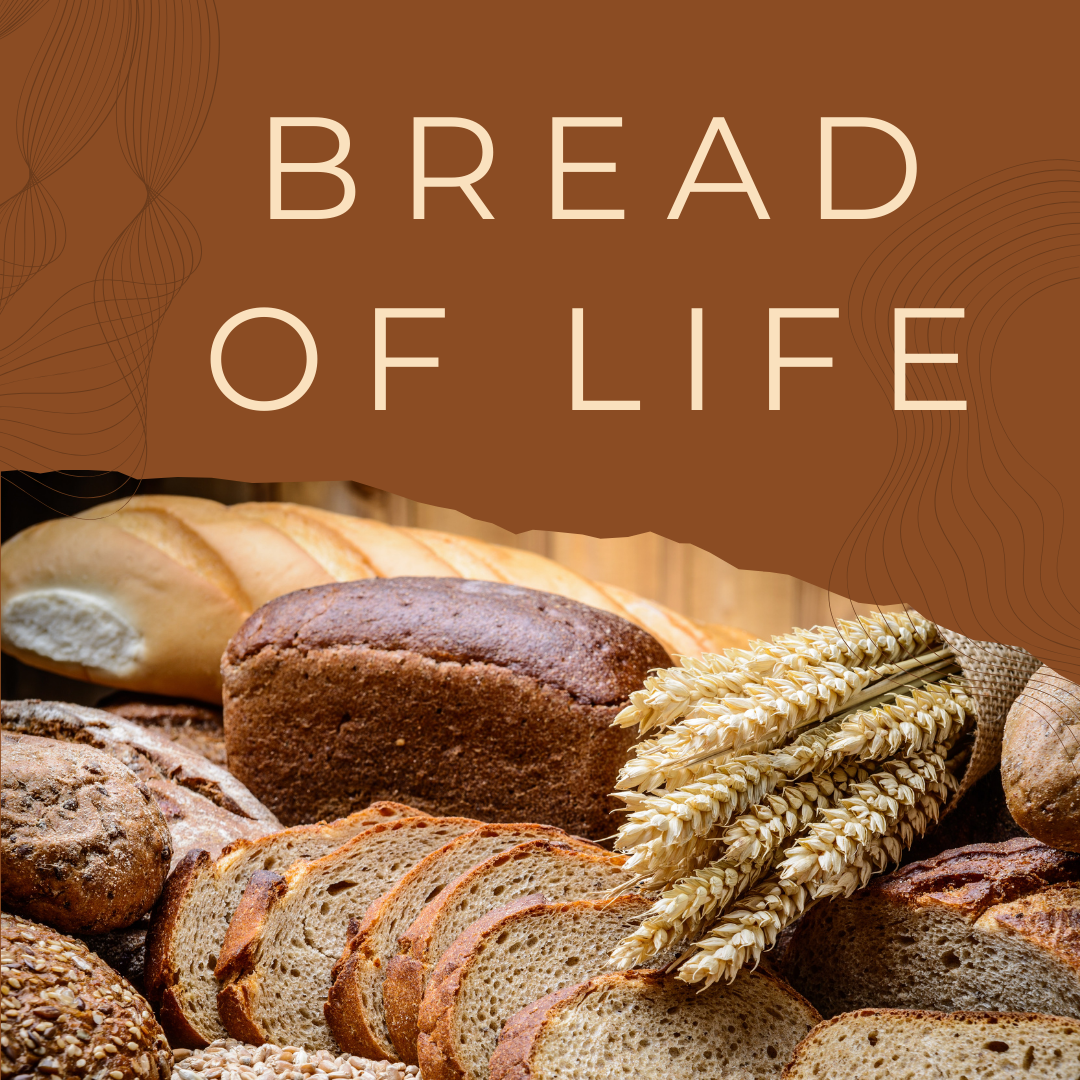
What does Jesus mean when he says he is the bread of life? Or says he is the living bread? Or says he is the bread from heaven? The Christian church has had a variety of answers- and that’s good. The images that Jesus uses are too complex, too rich to be reduced to a single answer. What do you think Jesus means?
We are in the midst of a few weeks in which the lectionary spends time with John chapter 6. In this chapter Jesus uses multiple images of bread. The chapter begins with the sign of the feeding of the five thousand followed by Jesus walking on water. Then there is a lengthy section of dialogue between Jesus and his audience, “the crowd”. The lectionary1 skips over verses 36-40 of that dialogue. I have included them in a footnote.2
Before you read this text, we need to make this clear- when the text says “the Jews” it does not mean all Jews who lived during Jesus’ time. It certainly does not mean Jews who lived since Jesus’ time. When we notice how the author uses the phrase, “the Jews”, we see that it is a phrase used to name a certain subset of powerful Jewish leaders, mostly based in Jerusalem. Remember, nearly everyone in the gospels is Jewish, including Jesus and the disciples.
John’s gospel has some distinctive features and recognizing them can help us better understand what John is trying to tell us. I mentioned some of them last week and you can find them here. Another technique of John’s is his habit of repetition. Jesus has some long discourses in the gospel. To modern readers they can seem repetitive. This chapter is an example of that. There is the story of the sign and then there are 46 verses of talking about it. There’s a sort of spiral structure that John uses. We have the topic, in this case, Jesus as bread of heaven. Jesus explores that topic from several similar but also different aspects. If you are a linear thinker, this structure can feel confusing, and vague. It might feel as if Jesus can’t decide what it is, exactly, he wants to say. But what Jesus is doing is giving us a rich collection of related and connected but not identical meanings.
In the previous posts3 about the feeding of the five thousand, I suggested that Jesus is talking about real, physical hunger and a real world confrontation of empires.
In the verses the lectionary skips over, Jesus explains that he has been sent, and it is God’s will that no one is turned away who comes to Jesus.
This week, Jesus shifts his explanation of the bread of heaven image to a slightly different but still connected discussion of who he is. Read verses 35; 41-51 and notice how what Jesus says is similar to what he has been saying and also different.
Jesus said to them, “I am the bread of life. Whoever comes to me will never be hungry, and whoever believes in me will never be thirsty…
Then the Jews began to complain about him because he said, “I am the bread that came down from heaven.” They were saying, “Is not this Jesus, the son of Joseph, whose father and mother we know? How can he now say, ‘I have come down from heaven?” Jesus answered them, “Do not complain among yourselves. No one can come to me unless drawn by the Father who sent me, and I will raise that person up on the last day. It is written in the prophets, ‘And they shall all be taught by God.’ Everyone who has heard and learned from the Father comes to me. Not that anyone has seen the Father except the one who is from God; he has seen the Father. Very truly, I tell you, whoever believes has eternal life. I am the bread of life. Your ancestors ate the manna in the wilderness, and they died. This is the bread that comes down from heaven, so that one may eat of it and not die. I am the living bread that came down from heaven. Whoever eats of this bread will live forever, and the bread that I will give for the life of the world is my flesh.” John 35th, 41-51 NRSV
It seems to me there are a couple of points to focus on here. First, Jesus continues to talk about what it means to “come to me”, to believe, to entrust oneself to Jesus. When he says, ” It is written in the prophets”, many commentators think this is a reference to Isaiah 54:134. “All your children shall be taught by the Lord…” It might also be a reference to Jeremiah 31:33-34 “But this is the covenant that I will make with the house of Israel after those days, says the Lord. I will put my law within them, and I will write it on their Hearts; and I will be their God, and they shall be my people. No longer shall they teach one another, or say to each other, “Know the Lord,” for they shall all know me, from the least of them to the greatest, says the Lord; for I will forgive their iniquity, and remember their sin no more.” Coming to Jesus is a collaborative action, involving God the Father, Jesus, and the believer.
Jesus is also, throughout the gospel, telling us what the Messiah will be like. “The Jews” struggle with Jesus’ claim in large part because Jesus isn’t special enough. He’s not different enough. They know his parents. They know him. Who does he think he is making these very grand claims? How can God’s Messiah be an ordinary and poor person? They apparently are expecting a different sort of Messiah. One who comes from somewhere else, outside, away, above. Someone with resources and clout. One who comes and takes charge. One who fixes what’s wrong. A strong leader. A strong man. A strongman. An emperor.
We shouldn’t blame them. We have those same tendencies. Many of us would rather have someone take care of things and not involve us. We would rather not be asked to do too much. Or to change too much. We prefer effortless improvements. If someone could fix the roads without me having to use a detour. If someone would just fix racism without me having to change. If someone could address climate change without me having to live differently. And so on and so on.
We too, just like all other humans, are susceptible to claims of “I can fix it” rather than “we can fix it”. And that’s not, as far as I can tell, how the kingdom of God works.
When Jesus feeds the five thousand, it starts with a child offering their lunch. Over and over again in all the gospels, Jesus does not impose. Jesus does not compel. Jesus invites. “Come and see.” Jesus asks. “What do you want me to do?” “What are you looking for?” Jesus doesn’t give up on us. In the gospels he shows and tells the disciples again and again. Jesus does the same for us.
The kingdom of God doesn’t crash land down on earth, crushing whatever is in the way. The kingdom of God shows up like yeast, and like seeds. The kingdom of God shows up like a child sharing their lunch. The kingdom of God shows up as vine, and shepherd, and gate, and light. Like a Samaritan caring for a wounded stranger. The kingdom emerges and interweaves, with us and all that God created and loves. Jesus invites us into a way of life that reveals God’s purposes, and embodies God’s love, as God continues to redeem so that no one is lost.
- Here is information about what the Revised Common Lectionary is, how it works, and who developed it, ↩︎
- Jesus said to them, ‘I am the bread of life. Whoever comes to me will never be hungry, and whoever believes in me will never be thirsty. But I said to you that you have seen me and yet do not believe. Everything that the Father gives me will come to me, and anyone who comes to me I will never drive away; for I have come down from heaven, not to do my own will, but the will of him who sent me. And this is the will of him who sent me, that I should lose nothing of all that he has given me, but raise it up on the last day. This is indeed the will of my Father, that all who see the Son and believe in him may have eternal life; and I will raise them up on the last day.’ Then the Jews began to complain about him because he said, ‘I am the bread that came down from heaven.’ John 6:35-41 ↩︎
- https://conversationinfaith.com/2024/07/26/how-does-he-jesus-do-it/ and https://conversationinfaith.com/2024/08/02/bread-of-heaven/ ↩︎
- This is part of a larger song of assurance to exiled Israel. ↩︎
 Conversation in Faith
Leave a comment