More talk about bread! This is the fourth of five weeks that the Lectionary devotes to John chapter 61. This is a long chapter, 71 verses, with one main image- bread. Jesus talks about bread as actual bread, as a sign of the kingdom of God, and of himself as living bread from heaven. It may be helpful for us to look at a very simple recap of the chapter so we can see where we are and perhaps gain some understanding of what Jesus is doing.
The chapter2 moves from Jesus physically feeding people.Bread is necessary for life in this world. Then Jesus speaks more metaphorically about bread. Bread from heaven gives life in the coming kingdom of God. Next Jesus claims that he is the bread from heaven, sent to those who entrust themselves to him. People are confused. How can Jesus make this claim? They know him and they know his family. Jesus again claims to be living bread sent by God from heaven.
Next are verses 51-58, where things get more confusing and even become weird. Remember that one characteristic of John’s gospel is that people misunderstand Jesus. They take him literally when he is speaking metaphorically. And Jesus often speaks in riddles that confuse as much as they clarify.3
There is another thing we need to remember. The Bible has multiple audiences. The first is the original audience- Jesus and the people he was talking to. Then there is John’s description of what happened.4 John is writing for a particular audience, probably sometime in the 90s CE. And finally there is us, in 2024 with two thousand years of theological reflection and experience that both illuminate and confuse things. Which audience you are shapes how you understand the text. Verses 51-58 are thought by some scholars to be a reference to the Eucharist. Would the original audience with Jesus have thought this? Or would John’s later audience have thought this? What about us? Your thoughts will be shaped by your understanding of the Lord’s Supper. Is it a sacrament or an ordinance? No one piece of writing can fully explore this text and so we’re not going to talk about that today.. But realize how many things shape John’s writing and, your and my reading of the text.
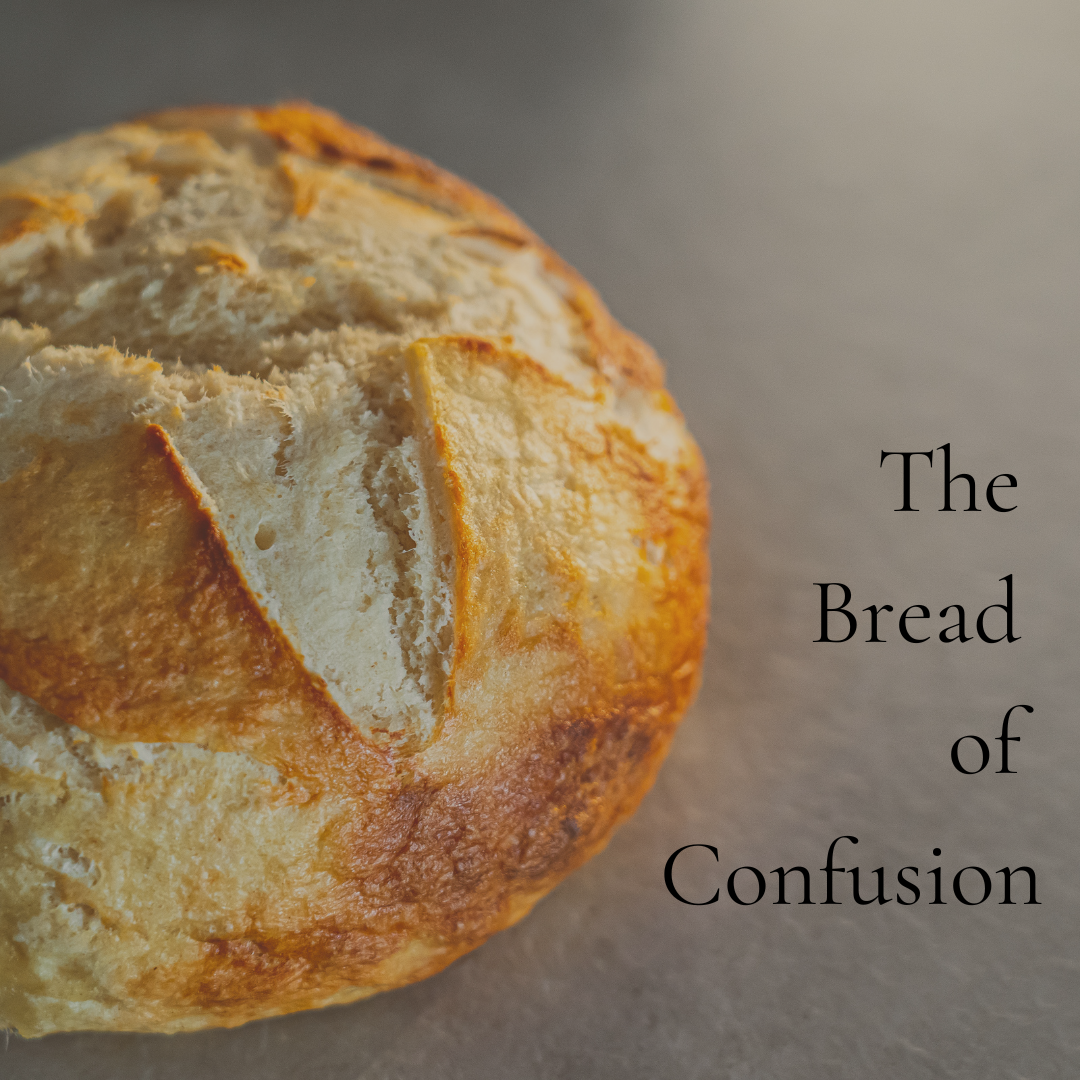
“I am the living bread that comes down from heaven. Whoever eats of this bread will live forever, and the bread that I will give for the life of the world is my flesh.” The Jews then disputed among themselves, saying, “How can this man give us his flesh to eat?” So Jesus said to them, “Very truly, I tell you, unless you eat the flesh of the Son of Man and drink his book, you have no life in you. Those who eat my flesh and drink my blood have eternal life, and I will raise them up on the last day, for my flesh is true food, and my blood is true drink. Those who eat my flesh and drink my blood abide in me and I in them. Just as the living Father sent me and I lived because of the Father, so whoever eats me will live because of me. This is the bread that came down from heaven, not like that which the ancestors ate, and they died. But the one who eats this bread will live forever.” John 6:51-58 NRSV
What is Jesus doing here? Jesus talks about giving his life, his flesh for the life of the world and people take him literally. He takes the metaphor of himself as living bread from heaven and after being questioned about it, goes a step farther. They had just been talking about actual bread as God’s provision for them. Then Jesus shifts and speaks more metaphorically calling himself living bread. And then he shifts the metaphor again from bread to flesh. The people misunderstand and Jesus just keeps going with the imagery and it is shocking.
To a pre resurrection crowd, this was shocking and offensive language. John’s post resurrection community has previously listened to several stories in John’s gospel where Jesus uses language that is misunderstood by the people he is talking with. There are several times when Jesus says something ambiguous and people take his statement literally rather than metaphorically.5
From the gospels of Mark and Matthew we have examples of Jesus using graphic examples to make a point. People looking at a woman with lust should “pluck their eye out”. People should cut off their hand if it causes them to sin or their foot if it causes them to stumble6.
I think it is reasonable to believe that Jesus used unsettling language to make the point that he, himself, is the Messiah, God’s anointed one. Jesus has deliberately moved the discussion from actual food to life in the reign of God where there is abundant food. And then he shifts images, talking about how he embodies, actually brings to them the reign of God. Jesus doesn’t bring the kingdom in an abstract way. Jesus isn’t offering a set of theological ideas to discuss and believe. The kingdom he brings is physical and spiritual- they are not divided. His entire self, mind, soul and body- flesh and blood bring the kingdom. Those who believe, who entrust themselves to him also need to participate physically in Jesus’ work. Jesus is not asking that we mentally or spiritually think that he is the Messiah. Following Jesus requires an embodied response, just as Jesus faithfulness to the Father requires his embodied response.
KIngs and emperors control the bodies of their subjects. They can compel people to carry burdens for soldiers. They take food and control land. They impose fees and taxes. They compel people to fight and work for the king. They create emperor cults to try to control people’s allegiance. Subjects bodies belong to the king. Jesus reverses this. He gives his body, his flesh and blood to others for the kingdom of God.
In the feeding of the five thousand, a new economy is demonstrated. It is collaborative and marked by abundance. As the living bread, who gives his life for the people, a new kingship is demonstrated. A king who gives themself rather than takes the bodies of the people.
Remember that John has a non linear, spiraling way of writing. Those of us who are more linear thinkers will find these verses confusing. There isn’t a straight logical line from feeding hungry people as a demonstration of the alternate kingdom of God to “Unless you eat the flesh of the Son of Man and drink his blood, you have no life in you.” It’s a head spinning, disorienting exploration of living in the unending, eternal reign of God and Jesus role as God’s Messiah.
I’m not sure we can think our way to clarity about this. It may be more helpful to sit with the kaleidoscope of images, to wander about the metaphors, ponder the empire of this world and the empire of God and what it means to live in each one. Think about the people who suffer from hunger and thirst. Those who work for poor wages, who live in unhealthy and unsafe environments. Think about people trapped in war zones. Think about people who flee for their lives and the lives of their children. Think about how the empires of this world demand our flesh and our blood.
Then think about the Messiah who gives their own self for the life of the world.
- Here is the entire chapter, https://bible.oremus.org/?ql=590757444 ↩︎
- Here is a simple outline, 6:1-15 the feeding of the five thousand, 6:16-24 Jesus walks on water, 6:25-34 dialogue between Jesus and the crowd, 6:35-42 Jesus first discourse and the crowds’ response, 6:43-52 Jesus second discourse and the crowds’ response, 6:53-59 Jesus’ third discourse, 6:60-71 dialogue between Jesus and the disciples ( from The New Interpreter’s Bible Commentary Vol IX, page 598) ↩︎
- If you want to know a little more ( or review), the earlier posts about John chapter 6 have some short discussions of the literary characteristics of John. ↩︎
- John was not likely to have been an eyewitness, but scholars debate this. To say that John was not an eyewitness does not mean the gospel doesn’t contain historical events. But gospels are first theological statements that are told via the medium of history. As a rule of thumb, theology first, historical accuracy second. The gospels are written to explain the significance of Jesus and they are written primarily for believers. ↩︎
- One of the most well known examples of this is the story of Nicodemus and being “born again/anew”. ↩︎
- Matthew 5:27-30, Mark 9:42-48. ↩︎
 Conversation in Faith
Leave a comment