Most Christians will agree that we should love God and love our neighbor. The difficulty, as always is, what exactly does love look like in our world?1
One of the scribes came near and heard them disputing with one another, and seeing that he answered them well he asked him, “Which commandment is the first of all?” Jesus answered, “The first is, ‘Hear, O Israel: the Lord our God, the Lord is one; you shall love the Lord your God with all your heart and with all your soul and with all your mind and with all your strength.’ The second is this, ‘You shall love your neighbor as yourself.’ There is no other commandment greater than these.” Then the scribe said to him, “You are right, Teacher; you have truly said that ‘he is one, and besides him these is not other’; and ‘to love him with all the heart and with all understanding and with all the strength’ and ‘to love one’s neighbor as oneself’–this is much more important than all whole burnt offerings and sacrifices.” When Jesus saw that he answered wisely, he said to him, “You are not far from the kingdom of God.” After that no one dared to ask him any question. Mark 12:28-34 NRSV2
“Which commandment is the first of all?” This question comes as part of a series of challenges to Jesus’ authority that occurred in the Temple.3 In Mark’s gospel, however, this question isn’t a “gotcha” trick question as it is in Matthew and Luke. Wondering and discussing which commandment was the greatest, was not an uncommon practice in Jesus’ time. This scribe appears to be sincerely asking Jesus’ opinion.
Jesus’ answer to his question is not at all controversial. Other teachers had given similar responses. Jesus first quote comes from Deuteronomy 6:4 -5. The second comes from Leviticus 19:18. It’s worth reading Lev 19:1-184 to put Jesus statement in context. Verse 18 is the culmination of a series of ethical requirements about how to treat one’s neighbor. It’s also worth reading a bit farther in Leviticus, to 19:33-34. “When an alien resides with you in your land, you shall not oppress the alien. The alien who resides with you shall be to you as the citizen among you; you shall love the alien as yourself, for you were aliens in the land of Egypt: I am the Lord your God.”
Love of God and love of neighbor is prioritized over all else. In fact, if we understand this, we “are not far from the kingdom of God.”
Jesus interaction with this scribe is interesting and instructive. He has been challenged by the religious authorities several times. They have sent people to “trap him in what he said” (12:13). And yet, he is able to engage this scribe on his own merits. Jesus treats him as an individual and not as part of the group. He directly answers the question. He doesn’t challenge this person, as he does the previous questioners. Jesus answers the question and then waits for the scribe’s response. Again the scribe shows that he is sincerely asking the question and that he understands Jesus’ answer. And then Jesus tells him “You are not far from the kingdom of God.” – something he did not say to the others.
This exchange is an example of how hospitality works. Hospitality means, as Henri Nouwen writes, “primarily the creation of a free space where the stranger can enter and become a friend instead of an enemy. Hospitality is not to change people, but to offer them space where change can take place.”5
Jesus holds this free space around himself. People enter his space as they are. Most of the religious elites in Mark chapters 11 and 12 enter the space around Jesus as opponents and remain opponents. But not this scribe. In spite of a series of oppositional encounters, Jesus does not put up a barrier against the next person. The scribe comes to Jesus and is received as he is a stranger who is, perhaps surprisingly, near to the kingdom.
The capacity to hold that free space around us as we move through the world is a challenge. I believe we can learn how to do it. It takes a certain amount of self assurance that comes from knowing who we are, God’s beloved. We also have to remember that everyone else is also God’s beloved. Whom we need to meet where they are, as they are with curiosity and love. This doesn’t mean we become best friends with everyone we meet. Some people are not safe for us or our loved ones. Our initial encounter with someone offers them space to be who they are, and space for us to be who we are. If and how that meeting develops is open to exploration and depends on both parties.
Because we take Jesus words seriously we wonder, what does Jesus’ command to love look like in our time?
Sadly, Christians do not agree on what Christian love looks like or acts like. You may have come across Christians who feel compelled in the name of love to inform LGBTQ people they are going to hell if they don’t change who they are. You may have come across Christians who, in the name of love, feel the need to tell you that “you are not a Christian if…” you don’t read the correct version of the Bible, or worship differently, or interpret the Bible differently. Currently some Christian Nationalists would argue that love of God and love of nation are inseparable6.
How do we take this command to love God and our neighbors seriously, when we live is a time and place and culture that is so different from Jesus’? In spite of the distance of time, culture, and place, people are still people. We act and react today as people did in the first century. And because people are people, we can look to Jesus as we try to love as he commanded. This doesn’t mean we return to first century rules and actions. It does mean we think intentionally and seriously about how and what Jesus did. And then we try to act in a similar way. We notice how Jesus spoke to people, how he treated people, and how he acted in various situations. Then we think about the people around us and the situations we find ourselves in and consider how Jesus would respond. We are called to discernment and wisdom.
The command to love God and love our neighbor is impossibly big and broad. We will do it imperfectly. But we can learn and we can do better. And we can help and support each other. We can offer each other the holy free space for others to be who they are. Then one day, we will realize that we are not so far away from the kingdom of God.
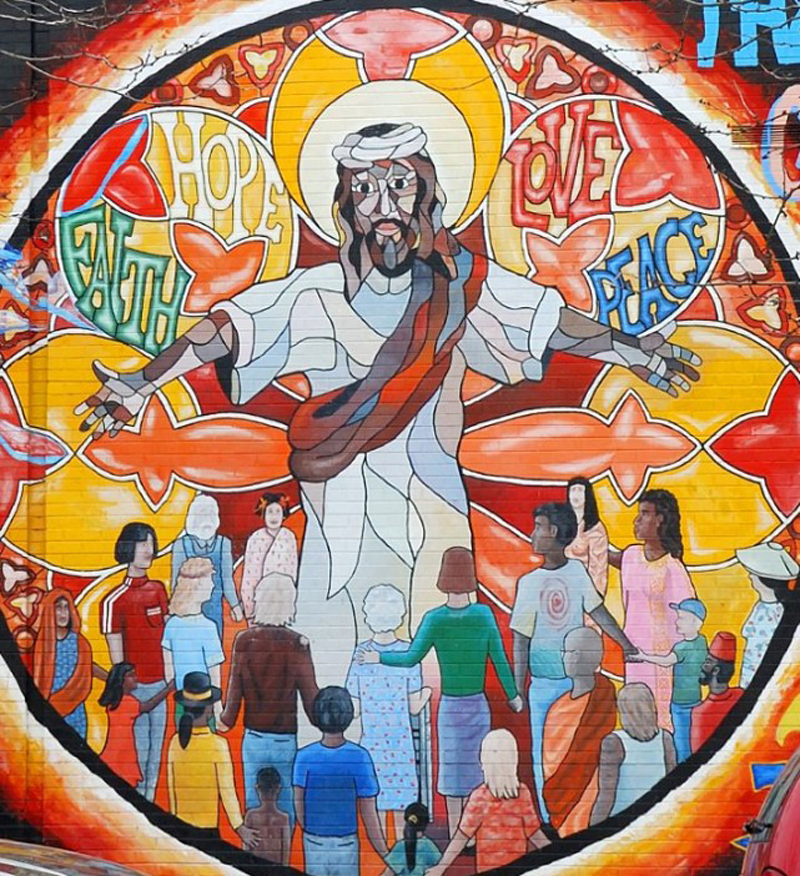
- The picture is “Jesus Mural of Faith, Hope, Love, and Peace, Chicago.
Jesus Mural of Faith, Hope, Love, and Peace, from Art in the Christian Tradition, a project of the Vanderbilt Divinity Library, Nashville, TN. ↩︎ - This story appears in all three synoptic gospels. In Matthew and Luke the question is presented as a test. Mark’s gospel, which is probably the source for this story in Matthew and Luke, does not present this question as a test. The story of the good Samaritan follows this story in Luke and is only told in Luke’s gospel. ↩︎
- The challenges begin at Mark 11:27 and go through Mark 12:44. ↩︎
- Lev 19:1-18 ↩︎
- Nouwen, Henri, Reaching Out: The Three Movements of the Spiritual Life, Image:New York) page 56 ↩︎
- For example, see this letter to the editor, ↩︎
 Conversation in Faith
Leave a comment