If you are a regular reader of this blog, you may have correctly guessed that I am disappointed about the results of the Nov 5, 2024 election. There have been plenty of “think pieces” and “hot takes” about what happened this week. I have decided not to comment, just yet. So we will continue to follow and think about the lectionary texts, which in and of themselves are incisive social commentary.
The way that the gospels are written is not an accident and is not casual. Each gospel writer tells the stories in a particular way and organizes the stories in their gospel to make particular theological claims. We sometimes focus on individual stories and that is good and helpful But it also is important to put individual stories in conversation with the other stories around them. This week, the lectionary put two stories together that are often kept apart. Each story informs the other. You may have heard the second story of the poor widow’s offering told by itself. Perhaps as part of a stewardship message, that encouraged “sacrificial giving”. I think we can make a case that sacrificial giving is not the only thing this story is about.
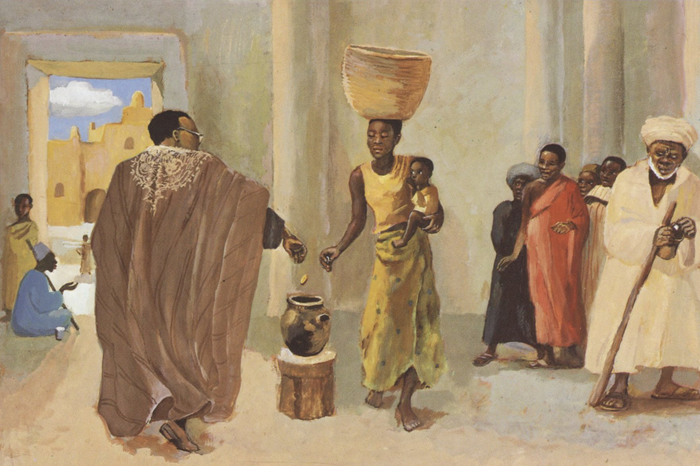
As he [Jesus] taught, he said, “Beware of the scribes, who like to walk around in long robes and to be greeted with respect in the marketplaces and to have the best seats in the synagogues and places of honor at banquets! They devour widows’ houses and for the sake of appearance say long prayers. They will receive the greater condemnation.”
He sat down opposite the treasury and watched the crowd putting money into the Treasury. Many rich people put in large sums. A poor widow came and put in two small copper coins, which are worth a penny. Then he called his disciples and said to them, “Truly I tell you, this poor widow has put in more than all those who are contributing to the Treasury. For all of them have contributed out of their abundance, but she out of her poverty has put in everything she had, all she had to live on.” Mark 12:38-44 NRSV
This text comes after Jesus’ entry into Jerusalem and is part of a large section of teaching in the Temple that includes some discussion between Jesus and the religious elites. What links the two stories are “widows”. We need to read the story of the widow’s offering while thinking about the charge that the elites “devour widows’ houses”. We also need to remember that then there was no social safety net like we have today. There were no government programs for the poor. It was one of the functions of the Temple, one of the responsibilities for people of faith, to care for the poor, the widows, and the orphans. This is a repeated refrain in Torah, the prophets and the gospels.
The two copper coins the widow gave were a fraction of what a day laborer would make for a day’s work. The two copper coins that are “all she had to live on” are in fact not enough to live on. We can wonder why she is so desperately poor and why she donates to the very organization that should be supporting her. We can wonder why there is such a gap between the rich people who give out of their abundance and the poor who only have two copper coins to give. We can wonder how the religious and social system that was designed to reduce income inequalities and social inequality ends up devouring widows’ houses and women only having two coins to live on. This is not a story to encourage sacrificial giving as much as it is a story condemning unjust social and religious practices.
And before we start patting ourselves on the back and congratulating ourselves on how we are not like this- we should remember that while history does not repeat itself, it does rhyme and echo.
And now we need to ask ourselves, who likes to walk around in fancy clothes? Who craves respect and recognition in society? Who desires to be the center of attention in church and society? Who is honored at banquets? Who lives a Christian lifestyle so others can recognize their piety? Who makes their donation, who walks around doing their good deeds and does not notice the poor among them and the contribution the poor make?
Gospel stories have multiple audiences. There is the original experience of Jesus and the disciples. There is the first audience who heard the story told. There is the gospel writers later audience. We can, and should ask ourselves what they understood this story to be about.
And then there’s us. What do we understand this story to be about? We can read this as an individual and ask, where am I in this story? Which is important to do and mostly should make us uncomfortable. Most of us give out of some level of “abundance”. While some of us have more “abundance” than others of us, few of us give all that we have to live on. (I am beginning to think there are very few stories in the Bible which are not intended to make me uncomfortable.) We can also read this story and see how it fits in our society. Who is the center of attention and respect and who are the poor? Why does such extreme income inequality exist? What, as Christians, are we called to do about it? How do we, as a society, care for and properly support the poor?
I think we need to do both. Read this and examine our own lives. And hold this story up to our society as a text that is as critical of us as it was of the society in Jesus’ time.
And then, what? These are not easy questions. They are uncomfortable questions. What do we do? What changes do you and I make in our personal lives? What about the societal changes the gospel calls for? What does that look like? And how do we make that happen? Do we have the moral will to make changes?
 Conversation in Faith
Leave a comment