We are in a time of epiphanies.
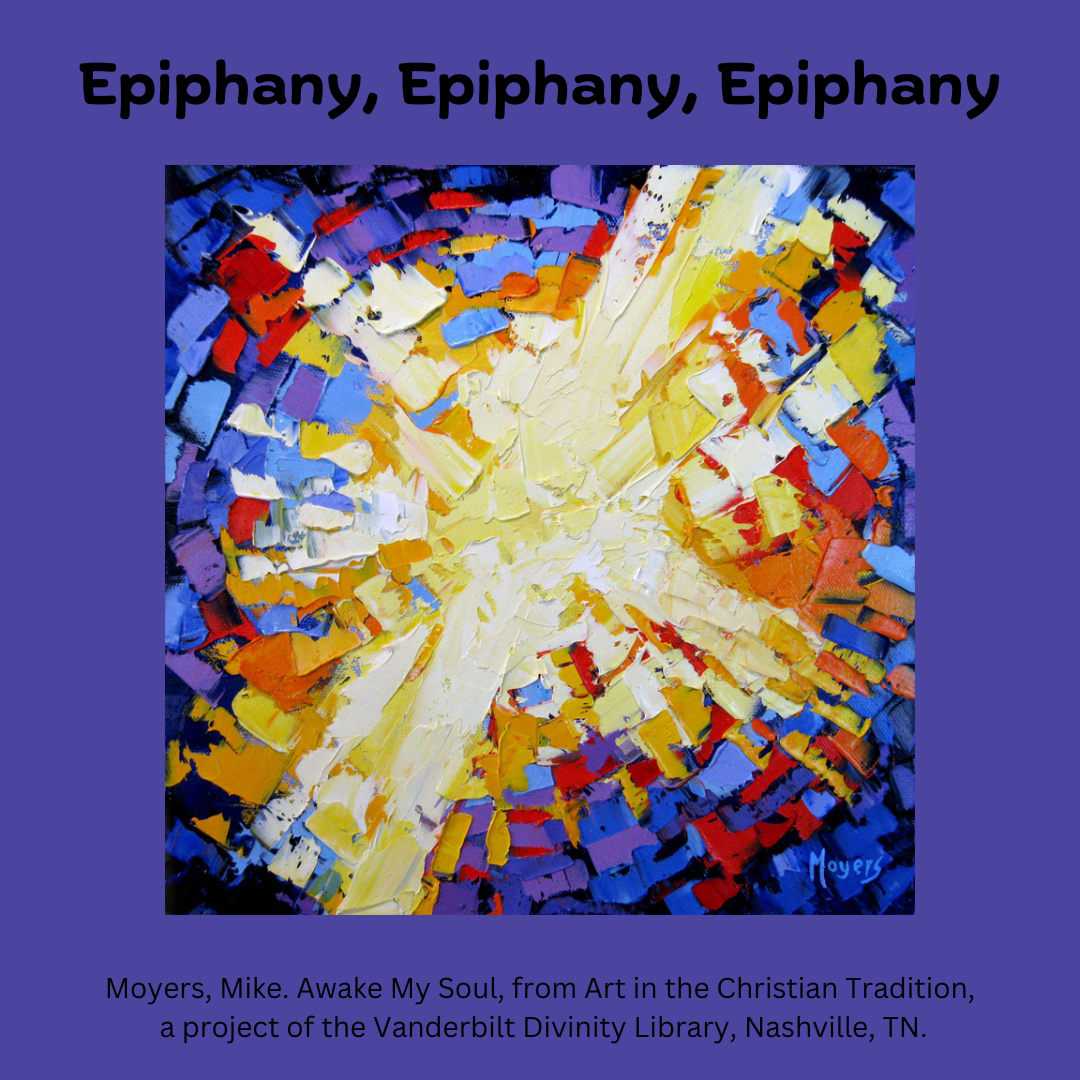
In general usage, an epiphany is a revelation. As the Merriam-Webster dictionary says1, “a usually sudden manifestation or perception of the essential nature or meaning of something: an intuitive grasp of reality through something (such as an event) usually simple and striking: an illuminating discovery, realization, or disclosure: a revealing scene or moment”.
The Christian festival of Epiphany, depending on the particular liturgical year, celebrates the visit of the Magi, the baptism of Jesus or the miracle at Cana when Jesus turned water into wine. Each of these events in their own way reveal who Jesus is. This year’s Epiphany reading was about the visit of the Magi2.
Each year for the past few years, January 6 is both the festival of Epiphany and the anniversary of the January 6 Insurrection.
The January 6 Insurrection was an epiphany about our nation and about a significant form of Christianity- Christian nationalism.
This coming Sunday is the day we commemorate the baptism of Jesus3, also an epiphany, that helps us understand who Jesus is.
This week of epiphanies- the coming of the Magi, January 6, and the baptism of Jesus, each gives us the opportunity to ponder the reality of Jesus as God’s Messiah. We consider the way of Jesus as it is revealed in scripture. We remember the January 6 insurrection with its Christian images and prayers during an armed attack on the Capital. We need to ask ourselves which Jesus we have followed?
Which Jesus will we follow?
The Jesus who lays down his life for the sake of the world? The Jesus who calls us to the way of love of neighbor and love of enemy? Or the distorted image of Jesus on Jan 6, a savior who imposes his will on others? Or the contorted view of Jesus that results in violence and domination?
The visit of the Magi is an epiphany about Jesus and the world. Jesus, not the Roman emperor, not any other ruler, is the savior of the world. He is not the savior of a single nation nor of a single kind of people, not Israel and not the United States. The Empire sees Jesus as a threat. It realizes it cannot co-opt this Messiah. It cannot tame this Messiah, turning him into a champion of the empire.
On Sunday we will remember Jesus’ baptism. In the synoptic gospels4, Jesus baptism occurs among a crowd of people. His baptism isn’t a private event, he is baptized along with others. Jesus joins with us in baptism then and now. At his baptism, the Spirit descends upon him and God’s voice is heard saying , “You are my Son, the Beloved: with you I am well pleased.” (Luke 3:22 NRSV)
If we read the gospels with open eyes and an open heart, everything in the gospels is an epiphany. Over and over again, the gospels reveal who Jesus is.
After his baptism, Jesus goes into the wilderness5 where he is tempted and tested. One of the temptations is to dominate all the kingdoms of the world. “To you”, the devil says, “I will give their glory and all their authority; for it has been given over to me, and I will give it to anyone I please. If you, then, will worship me, it will all be yours.” (Luke 4:6-7). Jesus turns that option down. “It is written, ‘Worship the Lord your God, and serve only him.’” (Luke 4:86)
Throughout his life Jesus continued to reveal the kind of Messiah he is. Jesus avoided people and crowds who wished to make him king. “When Jesus realized that they were about to come and take him by force to make him king, he withdrew again to the mountain by himself.” (John 6:15)
During his arrest, he refused the way of violence. “Put your sword back into its place; for all who take the sword will perish by the sword. Do you think that I cannot appeal to my Father, and he will at once send me more than twelve legions of angels?” (Matthew 26:52-53)7 The resurrected Jesus doesn’t return with vengeance. He doesn’t overthrow the empire. He eats with his disciples, even cooking them a meal.
The epiphany of Jesus, the revelation of who he truly is, is difficult for us to believe. Jesus’ way of being is so different from what we expect. We see who Jesus is… and then we lose sight of him. Having lost the vision, we make Jesus into our own image. It’s all too easy to see Jesus as a white American. We may not do this explicitly but functionally and often unintentionally we do. Worse, sometimes we deliberately do so. You can find plenty of Christians who claim Jesus was a capitalist. Or if not a capitalist himself, he blesses capitalism. You can find plenty of Christians who believe Jesus is pro America. That we are God’s favorite nation. That we are particularly blessed by God to be the leader of the world. It’s easy to make Jesus into our image.
The challenge is to make ourselves into Jesus image.
Jesus prayed “..let not my will but yours be done.” 8 We too are called to seek God’s will, to embrace God’s priorities. Sacrificing for others, loving neighbors and enemies, caring for the poor, and the oppressed. We are called to join Jesus and to be found among the wrong people in the wrong places9.
These days and weeks are the start of a new calendar year, a new church year, and a new administration. We are nearly overwhelmed with beginnings. We have many beginnings but as Christians, only one choice. Which Jesus will we follow? We can embrace a secular world with no Jesus. Or a faith where Jesus is confined to personal, private piety. Or we can choose MAGA Jesus. Or we can hold fast to the epiphany of these days and follow Jesus, who comes into the world as a helpless and defenseless infant. The Jesus who feeds and heals and calls us to a shared life. The Jesus who chooses non violence and through that overcomes evil and death. Which Jesus do we choose?
- https://www.merriam-webster.com/dictionary/epiphany ↩︎
- Matthew 2:1-12, https://bible.oremus.org/?ql=603541321 ↩︎
- Luke 3:15-17,21-22 https://bible.oremus.org/?ql=603541433 ↩︎
- The synoptic gospels, Matthew, Mark, and Luke describe Jesus’ baptism. John’s gospel has John the Baptist talking about Jesus’ baptism. ↩︎
- This year the lectionary skips this story found in Luke 4:1-12, https://bible.oremus.org/?ql=603542440 ↩︎
- Jesus is referencing Deuteronomy 6:13. Moses is reminding the people to remember the God brought them out of slavery and only worship God. “The Lord your God you shall fear; him you shall serve, and by his name alone you shall swear.” ↩︎
- See also John 18:36. “My kingdom is not from this world. If my kingdom were from this world, my followers would be fighting to keep me from being handed over to the Jews.” ↩︎
- Luke 22:42 ↩︎
- See last week’s post ↩︎
 Conversation in Faith
Leave a comment