Oh Jesus, are you serious? ” Love your enemies; do good to those who hate you; bless those who curse you; pray for those who mistreat you.” Not unlike the person who asks Jesus, who their neighbor is1, I’ve been wondering who my enemy is.
To be my enemy does someone have to declare themselves my enemy? Or can I name them as enemy? Does being an enemy require actions? Does dislike, disapproval or aversion count? Are you my enemy if you target others and I consider that wrong? If I consider you my enemy, does that make me your enemy? But of course, like the person who wanted parameters for who their neighbor was and thereby missed the point, when I wonder what constitutes my enemy, I also am missing the point.
It’s hard enough for me to love, or to pray for, or to do good to those who love me. Loving my enemies feels risky, even dangerous.
As Jesus’ very particular examples show, this isn’t an abstract point of theological discussion. Love, whether for a friend, neighbor, or enemy requires action. Love is more than a feeling or attitude. Love is action.
“But I say to you who are listening: Love your enemies; do good to those who hate you; bless those who curse you; pray for those who mistreat you. If anyone strikes you on the cheek, offer the other also, and from anyone who takes away your coat do not withhold even your shirt. Give to everyone who asks of you, and if anyone takes away what is yours, do not ask for it back again. Do to others as you would have them do to you.
“If you love those who love you, what credit is that to you? For even sinners love those who love them. If you do good to those who do good to you, what credit is that to you? For even sinners do the same. If you lend to those from whom you expect to receive payment, what credit is that to you? Even sinners lend to sinners, to receive as much again. Instead, love your enemies, do good, and lend, expecting nothing in return. Your reward will be great, and you will be children of the Most High, for he himself is kind to the ungrateful and the wicked. Be merciful, just as your Father is merciful.
“Do not judge, and you will not be judged; do not condemn, and you will not be condemned. Forgive, and you will be forgiven; give, and it will be given to you. A good measure, pressed down, shaken together, running over, will be put into your lap, for the measure you give will be the measure you get back.” Luke 6:27-38 NRSVUE
Jesus, as he often does, packs a lot of meaning in a few sentences. First, let’s address a too common misuse of what Jesus says. Sometimes people try to tell us that Jesus is telling us, often women, stay in abusive situations. Let them strike you. Let them take what is yours. Don’t fight back. Submit. If someone has said that to you, they are wrong. They have twisted Jesus’ words in an attempt to control others.
In order to not misunderstand what Jesus is telling us, we need to think about what society was like in Jesus’ time. Life in the first century Roman Empire was lived in a rigid hierarchy. Social position was maintained through a system of higher status people doing “good” things for lower status people and communities. Webs of obligation were created that perpetuated inequality. Certain men are at the top and in control. The hierarchy moves down to other men and at the very bottom, women, children and slaves.
The striking on the cheek and taking of a coat are acts of powerful people against less powerful people. Scholars think the act of taking a coat refers to taking a garment as the result of a legal action or as payment for a debt. A slap on the cheek is an insulting act.2 How do we break cycles of violence and injustice when others hold the power? Refusing retaliation and refusing to accept the intended humiliation disrupt the status quo. Loving, blessing, and praying are not passive, ineffective ideas. They are creative, powerful ways to challenge the social order that harms and oppresses people. They are acts that hold open the possibility for people to repent and be redeemed. And they are acts that affirm the dignity and worth of the less powerful person.
Jesus goes on, asking his followers to ignore and disrupt the accepted social structures that would benefit them. Jesus asks his followers to consider when they may be acting as an enemy, as an oppressor. How do they decide whom to lend to, who to do good to, who to love? Jesus’ followers are to act without considering what they will receive- materially or socially- in return. People kept track of who had given and who had received, because this established social and economic power relative to each other. Followers of Jesus are to do good, to lend, to love without considering how their economic and social status will benefit. In this society, close family and friends were treated differently than less close acquaintances. Jesus is asking his followers to treat everyone as if they are close family. Remember, in other places in the gospels, Jesus redefines what creates a family- seeking to do God’s will, rather than only familial ties.
Why? Why should followers of Jesus disrupt the accepted social and economic norms? Why rock the boat? Why not stay in our well defined, familiar family and community groups?
Because we as children of God should act toward others as God acts toward us and others. God is “kind to the ungrateful and the wicked. Be merciful, just as your Father is merciful.” As humans we bear the image of God. We carry and embody God’s love and God’s values in the world.
Then Jesus tells his followers not to judge and not to condemn. Does this mean we cannot name injustice and wrongdoing? I don’t think so. Jesus has plenty to say about injustice. But we are not to decide that someone is irredeemable. We are not to write someone off. We are not to judge them as unable to be reconciled. We don’t decide that someone is beyond the saving grace of God.
Loving, blessing, praying for enemies means, among other things, that we work for their well being, for their healing, for their reconciliation with us, others, and God. Loving, praying blessing others removes retaliation and revenge as a response. It does not necessarily mean there are no consequences for actions. Everyone in society needs to be safe and cared for. We don’t let harmful actions persist. And the consequences of harmful actions need to be focused on protecting those harmed, and creating space for repentance, restoration and reconciliation.
How does one resist injustice? By refusing to accept power over others as acceptable. By loving, blessing, praying, lending without regard to status and ability to reciprocate. Because if enough people live like that, then everyone has ” A good measure, pressed down, shaken together, running over,… put into your lap, for the measure you give will be the measure you get back.”
This is a way of living that can only happen by personal actions that spread to neighborhoods, and communities. Social scientists believe that it only takes 3.5% of a population to make a change. And 25% to change a system of government3. In addition, non violent actions are twice as likely to be successful as armed conflicts4. This means that what we do personally matters. Actions that seem small have an effect.
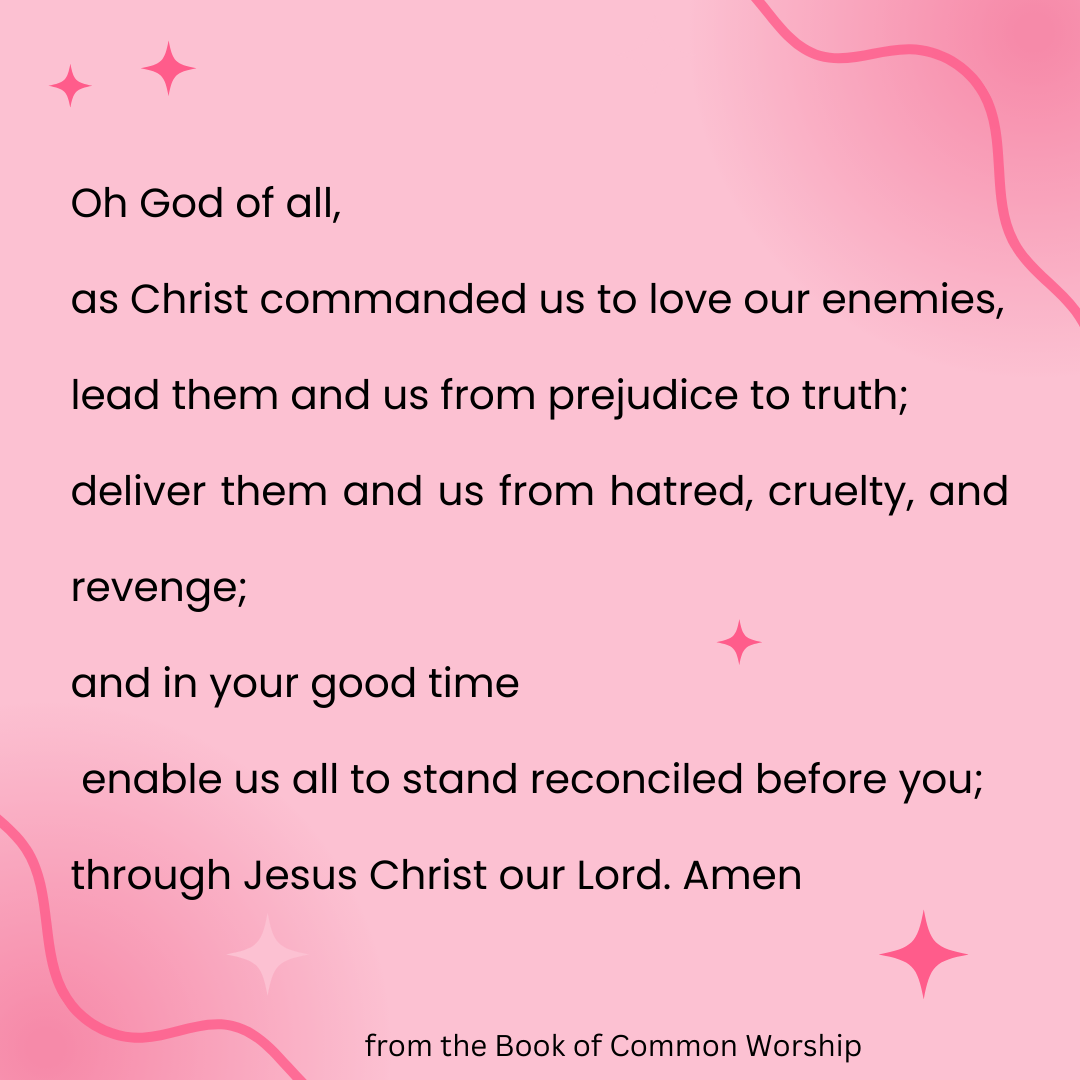
Living this way is not easy to do. Society encourages us to strike back. To take, by force if needed, what is ours. To retaliate. Following Jesus’ way of love, blessing and prayer means your enemies will think you are weak or afraid. And so will many of your friends. The temptation to curse, to mistreat ( because they started it), to strike back is strong. Which is why I pray this prayer morning and evening.
- Luke 10:25-37 The person knows they are to love their neighbor, but asks Jesus, “who is my neighbor” in an attempt to vindicate their actions (or lack of actions?) ↩︎
- See, R. Alan Culpepper, “The Gospel of Luke” in The New Interpreter’s Bible, Vol IX, Leander E. Keck, Gen. Ed. (Abingdon Press, 1995) page 146-149 and Joel B. Green, The Gospel of Luke, (Wm. B. Eerdmans Publishing Co. 1997) pages 269-275. ↩︎
- https://thenonprofittimes.com/npt_articles/3-5-of-the-population-agreeing-is-a-movement/ ↩︎
- https://www.bbc.com/future/article/20190513-it-only-takes-35-of-people-to-change-the-world ↩︎
 Conversation in Faith
Leave a comment