Have you ever had the experience of looking at something and having your experience of it shift? You looked up at a regular sunset and had an intense experience of it? A greater sense of revealed beauty and oneness with all that is?
Have you ever looked at someone and felt something shift? You experienced their humanity more fully, more deeply? They became somehow, more real. More precious.
Have you ever been with a group of people and felt a deeper connection, a more full sense of meaning? A greater sense of community?
If you have had experiences like these, did they last? Or were they fleeting glimpses that suggest something “more” exists?
Reflecting on experiences like these may help us enter into the story of the Transfiguration of Jesus.
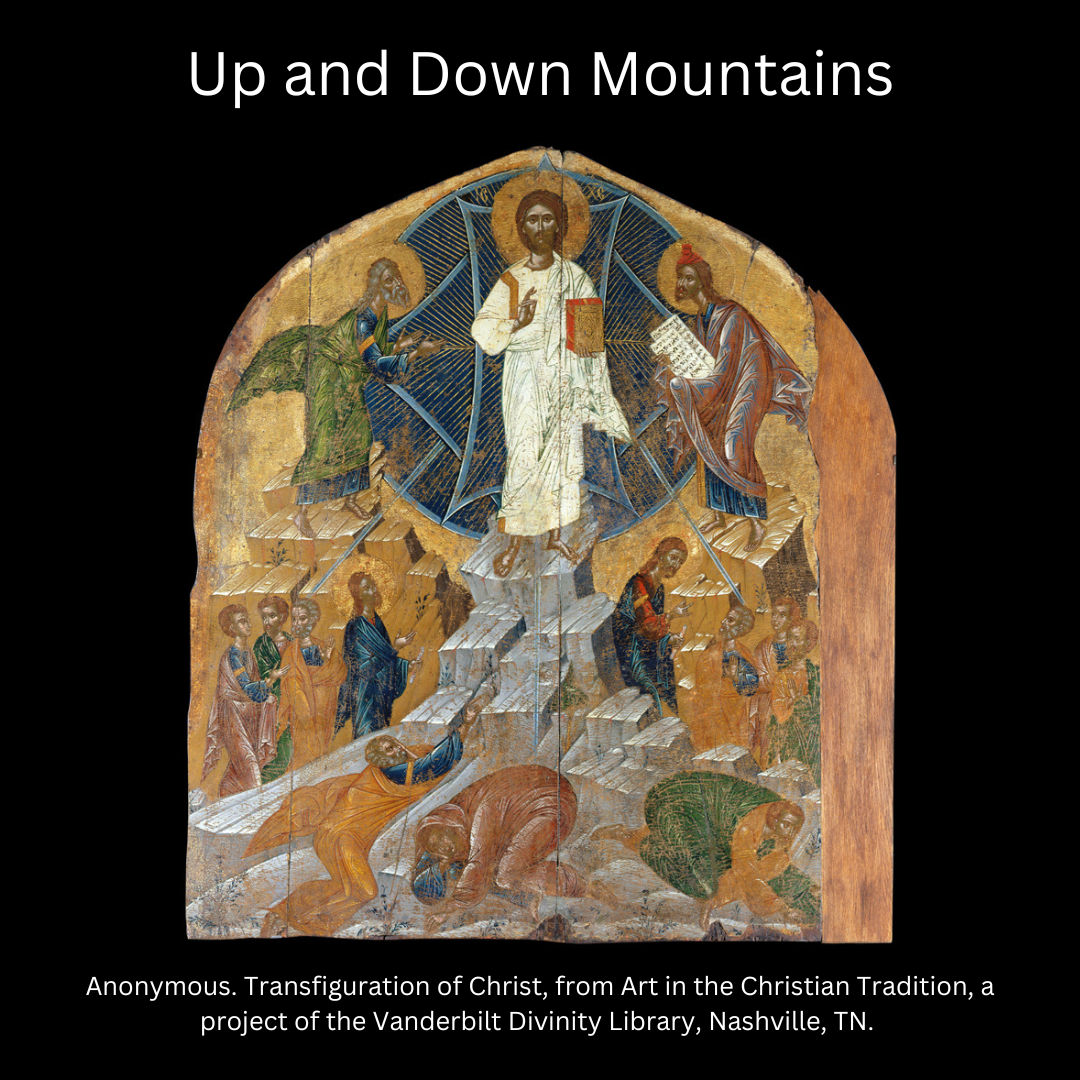
Now about eight days after these sayings1 Jesus took with him Peter and John and James and went up on the mountain to pray. And while he was praying, the appearance of his face changed, and his clothes became as bright as a flash of lightning. Suddenly they saw two men, Moses and Elijah, talking to him. They appeared in glory and were speaking about his exodus, which he was about to fulfill in Jerusalem. Now Peter and his companions were weighed down with sleep, but as they awoke they saw his glory and the two men who stood with him. Just as they were leaving him, Peter said to Jesus, “Master, it is good for us to be here; let us set up three tents, one for you, one for Moses, and one for Elijah,” not realizing what he was saying. While he was saying this, a cloud came and overshadowed them, and they were terrified as they entered the cloud. Then from the cloud came a voice that said, “This is my Son, my Chosen2; listen to him!” When the voice had spoken, Jesus was found alone. And they kept silent and in those days told no one any of the things they had seen. Luke 9:28-36 NRSVUE
The Bible nerd in me can’t help but point out some things to notice about the story of the transfiguration. I will always find it amusing that in the middle of this mystic experience, Peter starts talking “not realizing what he was saying” and God covers him in a cloud to help him be quiet. You may have noticed the word “exodus” in the text. The NRSV and NIV use the word “departure”. “Exodus” retains the use of the Greek word, which means “departure” or “way out”. It makes sense to use “exodus” rather than “journey” because the story of the transfiguration is filled with references and echoes of the story of Moses and the Exodus. During the Exodus, Moses ascends a mountain and encounters God. Moses is transfigured3. God speaks out of a cloud to Moses. And Moses leads the people on their journey, their exodus to deliverance and freedom. Luke is not claiming that Jesus is Moses. But the allusions to Moses help ground the story of Jesus solidly within the tradition. There are also echoes of Jesus’ baptism where God calls Jesus his Son, the beloved/chosen. There are echoes of the disciples falling asleep in the garden as Jesus prayed just before his arrest. And there are echoes of the resurrection scene with two men in “dazzling clothes”. The story of the Transfiguration brings all these echoes and images together to help us understand who Jesus is.
Every time we re read a Biblical text, we have the opportunity to notice something new to us. What strikes me this time is that Peter, John, and James were “weighted down with sleep, but as they awoke…” The NIV translates this ” Peter and his companions were very sleepy, but when they became fully awake…”. The NRSV translates this ” Now Peter and his companions were weighed down with sleep; but since they stayed awake…”
All this suggests that the disciples were drowsy, sleepy people who then roused themselves to see the transfigured Jesus talking with Moses and Elijah. But I also wonder if there isn’t a metaphor here also. How often do I sleepwalk through my days, expecting the ordinary and finding it? Do I miss the divine because I am not looking? Do I see the same things in the same way because I expect to see the same things in the same way?
However, what the disciples experience isn’t just the result of their being intentionally aware. Moments of transfiguration are gifts from the Holy Spirit. I suspect moments of transfiguration are even more intense, more spectacular than my experiences of the increased beauty of a sunset or a deep experience of oneness in a relationship. If you have ever read about the visions of mystics, they appear to have had experiences similar to the transfiguration. Their experience of the glory of God may be similar to what the disciples experienced. Those experiences are, perhaps, hints of what is to come, hints of life in the kindom of God. The Transfiguration suggests there is much more to the world than we can imagine.
But like the mystics and like Peter, John, and James, no one stays in the transfigured world. At least not yet. Mystics spend most of their lives in the world as it is. The three disciples come down the mountain with Jesus and they immediately encounter a child possessed by a demon.
On the next day, when they had come down from the mountain, a great crowd met him. Just then a man from the crowd shouted, “Teacher, I beg you to look at my son; he is only a child. Suddenly a spirit seizes him, and all at once he shrieks. It convulses him until he foams at the mouth; it mauls him and will scarcely leave him. I begged your disciples to cast it out, but they could not.” Jesus answered, “You faithless and perverse generation, how much longer must I be with you and put up with you? Bring your son here.” While he was being brought forward, the demon dashed him to the ground in convulsions. But Jesus rebuked the unclean spirit, healed the boy and gave him back to his father. And all were astounded at the greatness of God. Luke 9:37-43 NRSVUE
Jesus has some harsh words for the disciples, “You faithless and perverse generation…” This language echoes what Moses had to say in Deuteronomy 32:4-5. Again here are parallels between Jesus and Moses, and between the disciples and the people who will become Israel. In the wilderness, the people become impatient. They have trouble understanding what God is asking of them. When we read Luke, we find the disciples over and over again misunderstand Jesus and his mission. The disciples have trouble understanding what Jesus is asking of them. They fall back into the familiar patterns and practices of their culture, despite Jesus’ best efforts. Earlier, Jesus had given the disciples power over demons and the ability to cure diseases4. But somehow, whatever Jesus taught them or empowered them to do, they could not sustain. They cannot cast out this demon.
After the experience of the transfiguration, Jesus and Peter, John, and James cannot stay on the mountain. The experience of transfiguration does not persist. It is a glimpse, an encounter of the kingdom of heaven. It is an experience of what is in heaven and will be on earth- someday. But not that day. Jesus and the three disciples come down the mountain, into a crowd and run straight into a demon. Whatever we might think about demons, in the gospels they are entities that cause distress and injury. They cause people to be ostracized from family and community They cause fear and sorrow. They work against the wellbeing of God’s beloved people.
That’s how things work, isn’t it? We have a wonderful experience and then we’re back down into the crowd and faced with troubles- the demons that won’t leave.
I wonder, when Jesus and the three disciples started back down the mountain, what was it like to leave that space of holy encounter and return to the crowded world where demons persist? How soon did they see and hear the crowd? Were the disciples tempted to stop partway down the mountain? To be close but not too close. Not quite ready to leave that sacred space. Not quite ready to enter into the needs of the real people. Did they stop at the edge of the crowd? Or did they walk with Jesus into the midst of it surrounded by people who needed them?
Jesus came down the mountain. And his imperfect disciples followed. Luke tells us he “set his face to go to Jerusalem”5. And his imperfect disciples followed. Jesus came down the mountain and went about his work, healing, teaching, feeding. His work of reconciliation. His example of life in the kindom of God. His imperfect disciples did their best to learn from Jesus.
I suspect, just like Peter, most of us would prefer to pitch our tents and stay on the mountain. Will we, Jesus imperfect disciples, follow Jesus down the mountain and into the great crowd that longs for deliverance, reconciliation, and salvation?
 Conversation in Faith
Leave a comment