Advent is the four weeks of the church year just before Christmas. The word Advent means “coming” or “arrival”. Advent is a time when we look back in time to celebrate Jesus birth and we look forward to his future return. Advent helps us think about how we are to live in this time in between . “In Advent we expectantly wait for the One who has already come.”1 The Advent lectionary Old Testament and Gospel texts hold before us the hope and image of the Kingdom of God along with the words of Jesus and John the Baptist on preparation and repentance. This Advent let us live in this space where past, present, and future meet.
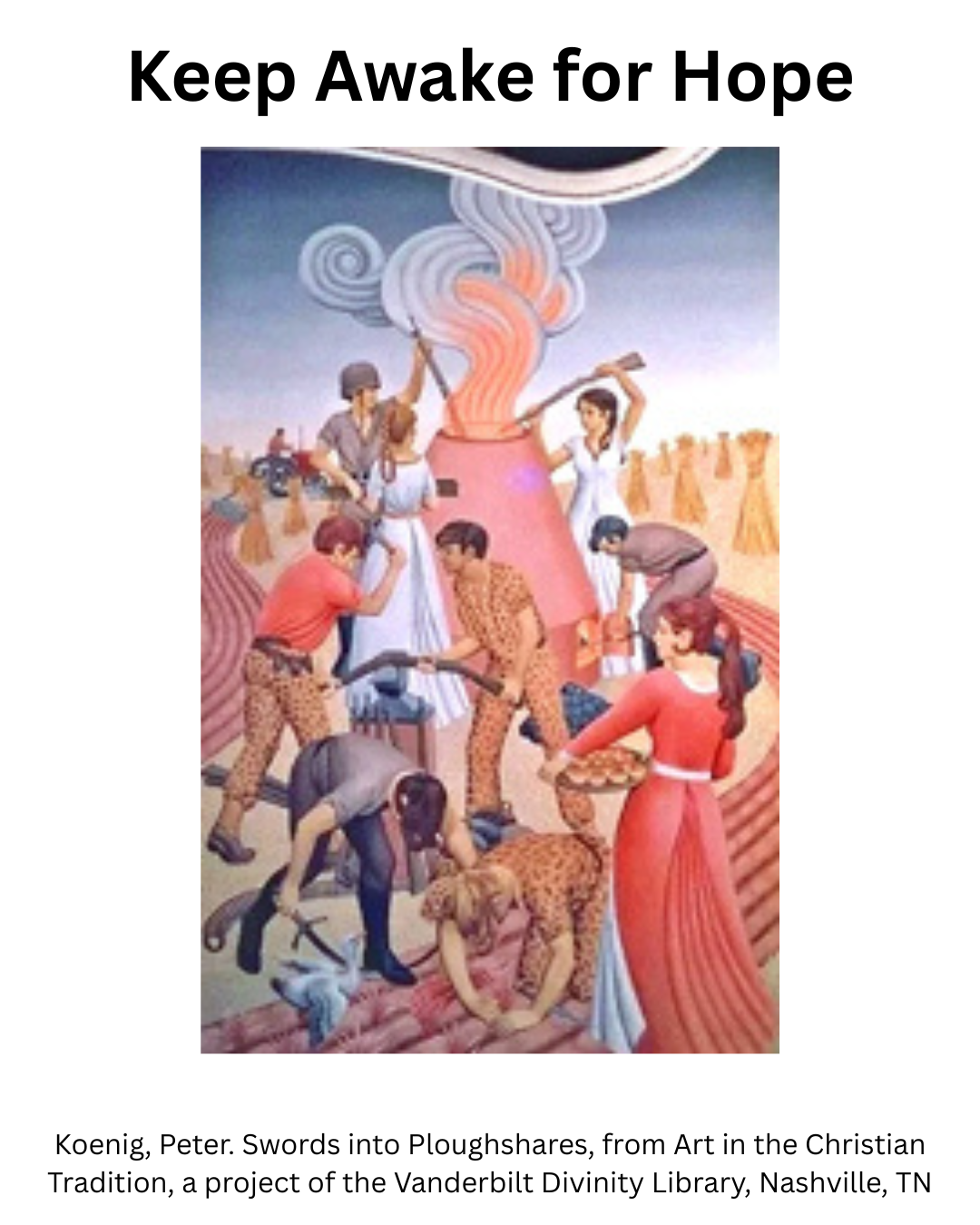
This week’s Old Testament reading comes from the book of Isaiah. It is a big, complicated book that comes to us as the result of three to four centuries of writing, collecting, and revisions. It contains some of the most familiar and beloved verses in all of scripture. The first part of Isaiah, (chapters 1-39) were written around the time of the Assyrian conquest of Israel 2. Isaiah contains words of critique and desolation as well as words of consolation and hope.
The word that Isaiah son of Amoz saw concerning Judah and Jerusalem.
In the days to come the mountain of the Lord’s house shall be established as the highest of the mountains and shall be raised above the hills; all the nations shall stream to it. Many peoples shall come and say, “Come, let us go up to the mountain of the Lord, to the house of the God of Jacob, that he may teach us his ways and that we may walk in his paths.” For out of Zion shall go forth instruction and the word of the Lord from Jerusalem. He shall judge between the nations and shall arbitrate for many peoples; they shall beat their swords into plowshares and their spears into pruning hooks; nations shall not lift up sword against nation; neither shall they learn war any more. O house of Jacob, come, let us walk in the light of the Lord! Isaiah 2:1-5 NRSVue
We might ask, along with Isaiah’s original audience, “When will this happen?” Jesus’ disciples believed that Jesus was the one ushering in this age of divine justice and peace. Jesus had a lot to say about the coming reign of God, and what he had to say was complicated and not necessarily crystal clear.
From the Gospel of Matthew, Jesus was speaking to his disciples in the Temple during Holy Week.
“But about that day and hour no one knows, neither the angels of heaven, nor the Son, but only the Father. For as the days of Noah were, so will be the coming of the Son of Man. For as in the days before the flood they were eating and drinking, marrying and giving in marriage, until the day Noah entered the ark, and they know nothing until the flood came and swept them all away, so, too, will be the coming of the Son of Man. Then two will be in the field; one will be taken, and one will be left. Two women will be grinding meal together; one will be taken, and one will be left. Keep awake, therefore, for yo do not know on what day your Lord is coming. But understand this: if the owner of the house had known in what part of the night the thief was coming, he would have stayed awake and would not have let his house be broken into. Therefore you also must be ready, for the Son of Man is coming at an hour you do not expect. Matthew 24:36-44 NRSVue
These verses are part of a larger group of sayings by Jesus (Matthew chapters 23-25) that are sometimes called the “Farewell or Final Discourse”. In these chapters Jesus talked about the coming destruction of Jerusalem which would happen just a few decades later. He talked about what the disciples might face as a result of their discipleship. Jesus also talked about his return and the coming reign of God in the age to come. This text from Matthew might stir up memories and feelings and worries about being “left behind”. Sometimes this text has been used to try to frighten people into faith- believe or else. But this isn’t a text of fear as much as it is an instruction to be attentive and to live faithful lives.
To be awake means disciples are to be alert, watching, and faithful. We do not know when Christ will come again, and so we must continue to follow the way of Jesus and not be distracted by false messiahs, or disasters. Nor are we to become lulled into complacency by daily life.3 As disciples we are to keep awake and to continue to follow the way of Jesus, the way of love and justice. Our persistence is needed because the “owner of the house” – the empires of the world- will do all they can to protect their power. If they could know when the kingdom of God will come, the powers and principalities4, would fight back even more fiercely than they do now.
The passage from Isaiah reminds us of why we are awake, what we are watching and hoping for. We are not called to grim endurance. We are called to hope, joy, faith, and love. Hope, in the Bible, is not a wish. Rather hope is a confident expectation. “Hope is the expectation of a favorable future under God’s direction.”5 We are awake when we anticipate with hope, the reign of God where there is no more war. We hope for a world where God, not a king nor an emperor, judges and arbitrates between and for humanity. Notice the image the prophet Isaiah presents. The nations, the people of the world come to the Lord’s house. The Hebrew word translated as “stream” can also be translated as “look with joy”.6 The people come, voluntarily, not by force or coercion or compelled by legislation.7
Advent is a time to remind ourselves to keep awake. To remain faithful. To live in hope. To keep working for peace and justice. We keep awake in hope for the world the prophets and Jesus tell us is coming. Where no one shall learn war any more. Come let us walk in the light of the Lord.
- Between Memory and Hope: from the Companion to the Book of Common Worship (Geneva Press, 2003, p. 96) accessed at PCUSA.org https://pcusa.org/theology-and-worship/advent ↩︎
- Assyria conquers Israel in 720 BCE. Isaiah was a prophet in Jerusalem from 740-700 BCE. Isaiah chapters 1-39 are about the life and prophecies of Isaiah. ↩︎
- Matthew 24:3-8, 11-12, 23-28 ↩︎
- “powers and principalities” is language from the King James Version of the Bible, Ephesians 6:12. “For we wrestle not against flesh and blood, but against principalities, against powers, against the rulers of the darkness of this world, against spiritual wickedness in high places.” The NRSVue says, “for our struggle is not against blood and flesh, but against the rulers, the authorities, against the cosmic powers of this present darkness, against the spiritual forces of evil in the heavenly places.” ↩︎
- “Hope” Karl Paul Donfried, in The HarperCollins Bible Dictionary, Gen Ed Mark Allan Powell,(HarperOne: 2011) pages 388-389 Kindle Edition. ↩︎
- Isaiah 2:2 footnote, page 936 in The Westminster Study Bible, New Revised Standard Version Updated Edition, General Editors, Emerson B. Powdery, Stacy Davis, Mary F. Foskett, Brent A. Strawn (Westminster John Knox Press, 2024) ↩︎
- Notice that this image of the world coming to faith and obedience to God is not coercive. It is an image of peace and joy. It is in direct contrast to the vision, aims and goals of Christian nationalism. ↩︎
 Conversation in Faith
Leave a comment