Sometimes we forget that there are two nativity stories, one in Luke’s gospel and one in Matthew’s. In popular telling, they are often conflated into one story- shepherds and magi, heavenly host and a star. However each gospel writer had reasons for telling the nativity story the way that they did1.
Luke’s nativity story has several angelic appearances- in the Temple to Zechariah, to Mary, and to the shepherds. Multiple people praised God with songs. What happened was very public, lots of people knew what was going on2.
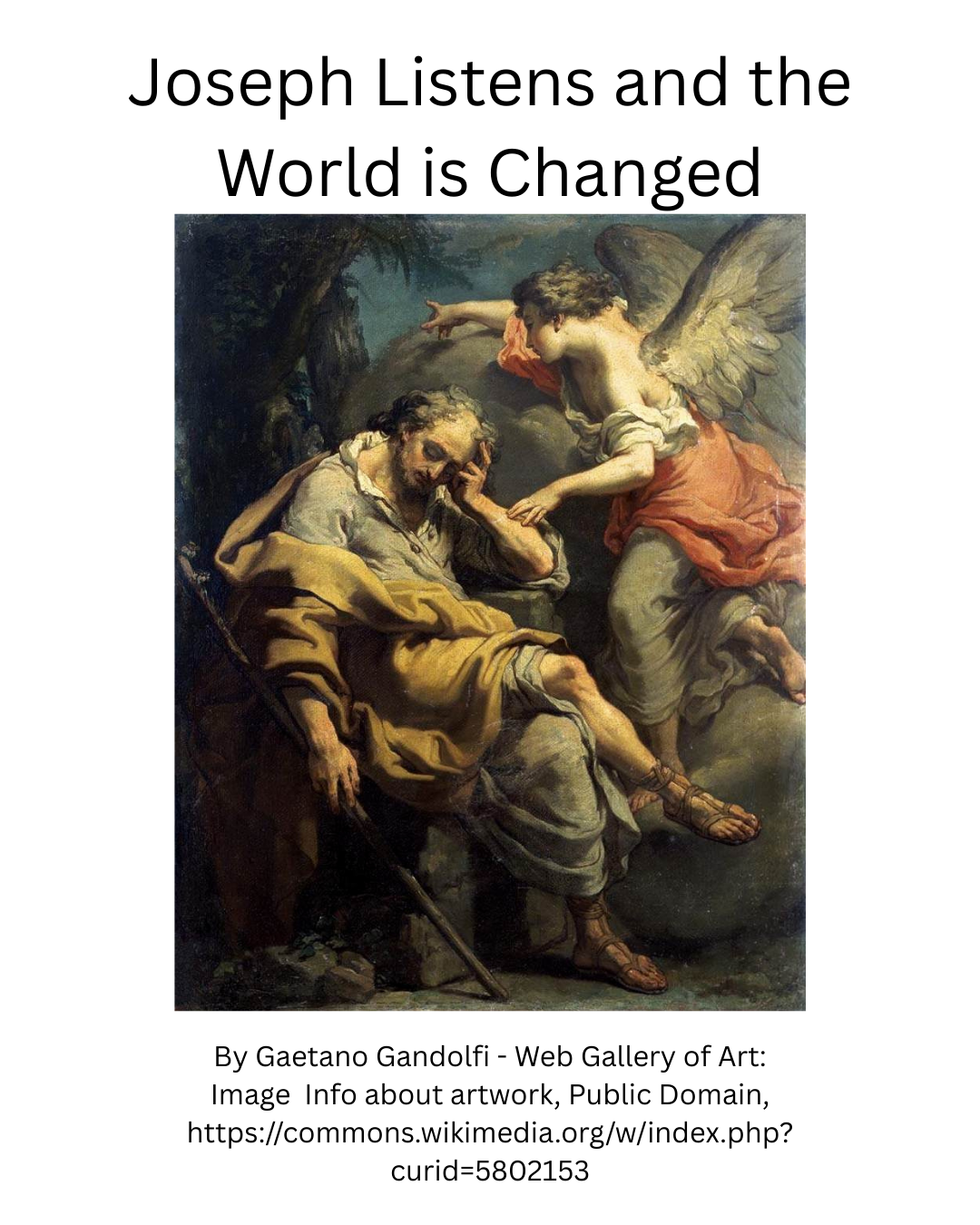
Matthew’s gospel begins with a genealogy of Jesus, that emphasizes King David and Jesus the Messiah.3 The genealogy ends with these words, “So all the generations from Abraham to David are fourteen generations; and from David to the deportation to Babylon, fourteen generations; and from the deportation to Babylon to the Messiah, fourteen generations.”4
Matthew’s birth story starts with the next verse, “Now the birth of Jesus the Messiah took place in this way.”
Matthew uses the genealogy to do several things, but one of them is to prepare us for the story of a royal birth. The genealogy doesn’t let us forget that the Messiah is the son of David and that Jesus is the Messiah. We are all set for the culmination of the story that began with Abraham, continues with King David, and now culminates Jesus, the long awaited Son of David. We are ready for the story of an important royal birth. We are ready for the story where one era ends and the new one begins.
Then Matthew writes, “When his mother Mary had been engaged to Joseph, but before they lived together, she was found to be pregnant from the Holy Spirit.”5 In one sentence we have gone from a grand royal history to the troubles of two definitely not royal people living in small town Bethlehem. The story of the Messiah is off to a small, uneasy start.
Now the birth of Jesus the Messiah took place in this way. When his mother Mary had been engaged to Joseph, but before they lived together, she was found to be pregnant from the Holy Spirit. Her husband Joseph, being a righteous man and unwilling to expose her to public disgrace, planned to divorce her quietly. But just when he had resolved to do this, an angel of the Lord appeared to him in a dream and said, “Joseph, son of David, do not be afraid to take Mary as your wife, for the child conceived in her is from the Holy Spirit. She will bear a son, and you are to name him Jesus, for he will save his people from their sins.”All this took place to fulfill what had been spoken by the Lord through the prophet:
“Look, the virgin shall become pregnant and give birth to a son, and they shall name him Emmanuel,” which means, “God is with us.”
When Joseph awoke from sleep, he did as the angel of the Lord commanded him; he took her as his wife,but had no marital relations with her until she had borne a son; and he named him Jesus. Matthew 1:18-25 NRSVue
Notice that Joseph doesn’t say a thing. In fact in the two chapters that are Matthew’s infancy narrative, neither Joseph nor Mary speak. The angel speaks. The Magi speak. Herod speaks. The chief priests and scribes speak.
Joseph received disturbing news. He was in a situation where all of his choices are troubling. His fiancee was pregnant. Bethlehem was a small place. While this pregnancy would be more problematic for Mary than Joseph, it still was a problem for Joseph. At the same time marrying her, knowing what they both knew- Joseph was not the father- was also a concern. He knew what Torah and custom prescribed as the solution to his dilemma. He considered his options and made what was a righteous decision.
And then the dream happened. The unexpected request from God, Joseph’s way forward in this disturbing situation comes from an angel in a dream.
Joseph didn’t speak. What Joseph did, was listen. He listened to the angel. Because he listened, the world was changed.
It’s common for thoughtful people to wonder if God is still speaking, either to us personally or to our world. There are always plenty of people eager to claim that God is speaking to them and that they have a message to deliver. Often these messages are focused on who is intimate with who. They would have had a field day with the situation Joseph and Mary found themselves in.
In these days of increasing Christian Nationalism, people make bold claims about God’s will for society and our nation. Yet these messages have essentially nothing to do with the teaching and life of Jesus.
Sometimes we seek direction and guidance and think we have found it; only to discover that we were probably mistaken about that.
How do we know God’s will for us and for the world? There is no simple answer. Not everyone in the Bible, and not all of us, have angels coming to us in our dreams. Theologians tell us that God comes to us in ways that we can understand. God accommodates themselves to our abilities and capacities. God is amazingly creative in how they communicate with us.
But, to hear what God has to say, we have to be listening.
These days I find myself thinking about what it means to listen to God. How do we enter the space where God can speak and we are listening? What happens, to us and through us the world, if we stay in that space of listening? What happens to us and through us the world when we act on what we hear?
Joseph listens. And Joseph takes what he hears seriously and acts. Are we?
 Conversation in Faith
Leave a comment