The nativity stories are a particular way of telling about Jesus. They function as a kind of overture for the rest of the gospel. Overtures, are the “opening part (French ouverture) of a work that serves as summary, synthesis, metaphor, symbol of the whole.”1 This is not to say the nativity stories are ahistorical, but they are more than history. They are primarily theology told by way of history.
Matthew’s nativity story may be surprising to you. All the things we love about the nativity story are missing. No singing angels. No cozy stable filled with happy animals. No awestruck shepherds. The birth of Jesus is told as part of one verse. And Jesus’ birth isn’t the main focus of that verse.2 Matthew spends more time telling the story of the Magi and its aftermath. Christmas carols notwithstanding, the Magi’s visit has tragic consequences.
The Lectionary changes the order of Matthew’s nativity, switching the story of the Magi with the story of its aftermath.To refresh our memories, here’s a quick summary of what happened before today’s reading. We’ll return to this story next week. The Magi are “from the east” and they go to King Herod and ask where to find the new king, his replacement. Herod asks the Magi to let him know when they find the child so that he, too, can “pay him homage.” The Magi find the child Jesus and are warned in a dream to not return to Herod, but to go home. And so they avoid Herod and go home.
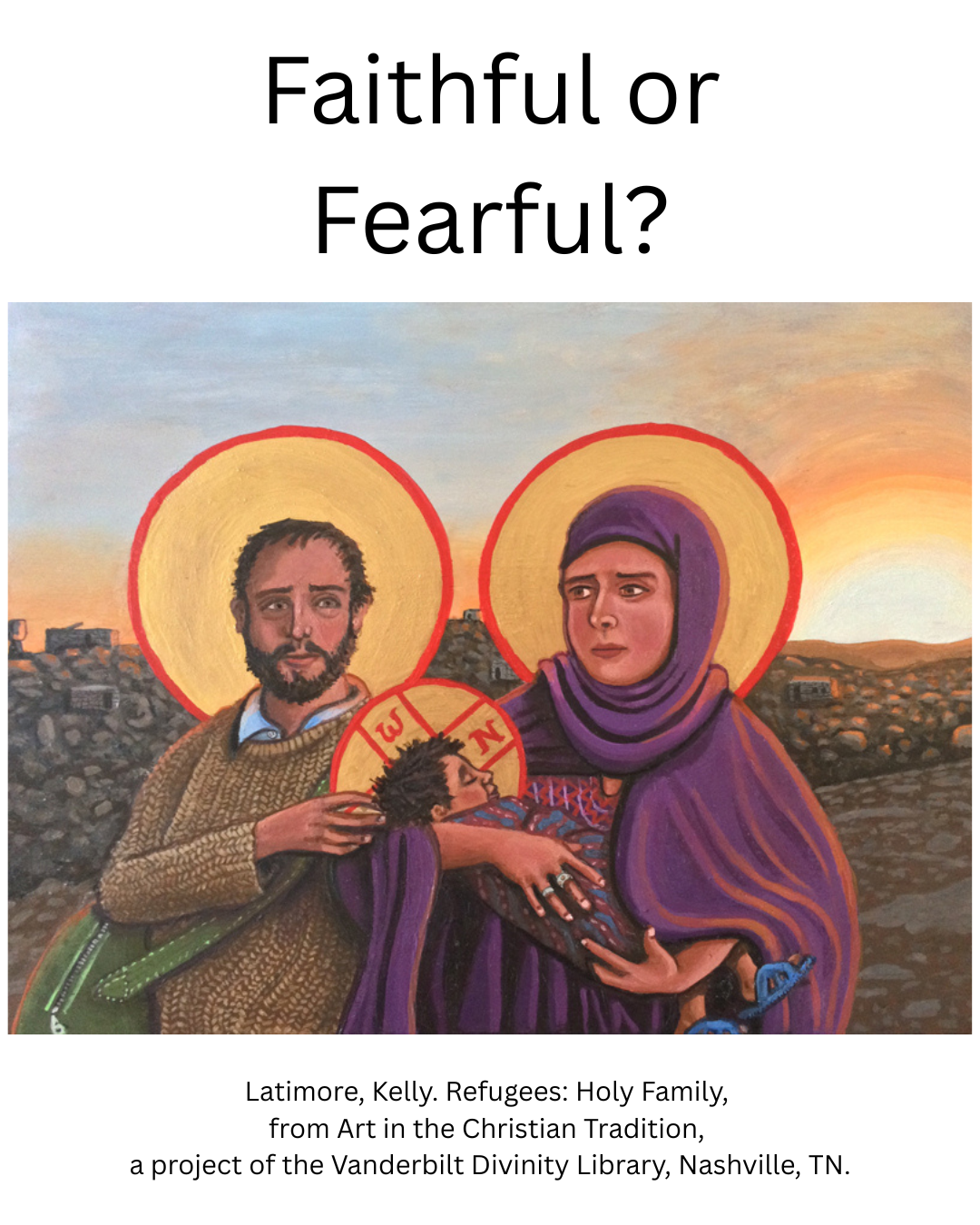
Now after they [the Magi] had left, an angel of the Lord appeared to Joseph in a dream and said, “Get up, take the child and his mother, and flee to Egypt, and remain there until I tell you, for Herod is about to search for the child, to destroy him.” Then Joseph got up, took the child and his mother by night, and went to Egypt and remained there until the death of Herod. This was to fulfill what had been spoken by the Lord through the prophet, “Out of Egypt I have called my son.”
When Herod saw that he had been tricked by the magi, he was infuriated, and he sent and killed all the children in and around Bethlehem who were two years old or under, according to the time that he had learned from the magi.Then what had been spoken through the prophet Jeremiah was fulfilled:
“A voice was heard in Ramah, wailing and loud lamentation, Rachel weeping for her children; she refused to be consoled, because they are no more.”
When Herod died, an angel of the Lord suddenly appeared in a dream to Joseph in Egypt and said, “Get up, take the child and his mother, and go to the land of Israel, for those who were seeking the child’s life are dead.” Then Joseph got up, took the child and his mother, and went to the land of Israel.
But when he heard that Archelaus was ruling Judea in place of his father Herod, he was afraid to go there. And after being warned in a dream, he went away to the district of Galilee. There he made his home in a town called Nazareth, so that what had been spoken through the prophets might be fulfilled, “He will be called a Nazarene.” Matthew 2:13-23 NRSVue
The world, then and now, is a dangerous place. Being the newborn Messiah was no guarantee of a trouble free childhood. In fact it seemed to be just the opposite. Being suspected of posing a future challenge to the Empire was sure to get a toddler into serious trouble. As one of my seminary professors was fond of saying, “The Empire always strikes back.”
Herod was frightened and infuriated, by the non compliance of the Magi and the potential threat of another king. Out of fear and anger, he struck back and he lashed out. Innocent people; innocent children and their families suffered. It was not fair and it was not right. But that is the way the world was and still is. Over and over again, children suffer because of what people in power do. Even today. Children in Gaza. Children separated from their families by ICE. Children in Africa denied food and medical care because USAID is abruptly ended.
The Bible doesn’t sugar coat or wish away the evils of the world. Simply because an event is in the Bible doesn’t mean God approves or that God willed it to happen. God doesn’t force people to act in certain ways. God doesn’t micromanage (or macro manage) events. People have agency and the capacity to make choices. What Herod did, killing “all the children in and around Bethlehem, who were two years old or under”3 was Herod’s decision, not God’s.
Matthew’s story of the nativity tells us that Joseph listened carefully to God. He paid attention. Joseph discerned God speaking to him in his dreams. And then he acted even though it wasn’t easy. Scandal or no, he changed his plans and married Mary. He got up after his dream and in the middle of the night left for Egypt. Think about that for a moment. They got up and left their home, their families, their community and went to a foreign land. They walked or rode several hundred miles to Egypt with a very young child with only what they could carry. Joseph must have wondered how they were going to survive once they got to Egypt. Consider how much people, then and now, depend on networks of support. Imagine going to a foreign country without that. Then, after another dream, they went home. But not exactly home. Warned again in a dream they went to Nazareth. Another new town and another new start.
The tragedy of the murder of children in and around Bethlehem happens because Herod acts, or rather reacts, out of fear and anger. His concern is to preserve his power and status. He is not listening to God. He is listening to and acting out of the political realities of his time.
I wonder what would have happened if Herod had stopped and tried to discern what God wanted him to do. What if he recognized his anger and fear and then realized those were not his only choices?
It was a difficult and dangerous task being the parent of the Messiah. It required careful listening and discernment by Joseph. Joseph then needed to be willing to act.
In different ways, both Herod and Joseph find themselves in situations where the future is endangered. Herod acts out of fear. Joseph acts out of faithfulness. Herod acts out of anger. Joseph acts out of love.
They each had choices to make. They each had the opportunity to listen for the guidance of the Holy Spirit. They each made their choice.
You and I may not have such high stakes choices to make. But we will have to make decisions about how we will act in the face of personal struggles and challenges. We will have to make decisions about how we will act when important Constitutional, legal, and ethical guardrails are broken. We will have to make decisions about how we will act when religious leaders deny the values of compassion and justice for the poor? How will we react? Will we act in accordance with social norms? Or will we seek the Spirit’s guidance? And will we be willing to act faithfully?
Matthew’s nativity story is a tale of discernment and courage in the face of visceral fear and anger. It is a story of listening carefully for the guidance of the Holy Spirit, rather than reacting according to conventional wisdom.
I suspect, although Matthew doesn’t tell us, that Joseph was able to listen to the Spirit because he had the established practice of listening for the Spirit. We can learn to hear what the Spirit has to tell us. Hearing what the Spirit has to tell us involves giving some time and space to careful listening. Listening to the Spirit also involves the support and insight of a community. It takes some practice because we are so adept at mistaking our ideas for God’s. Nevertheless we can learn to listen, even if imperfectly. It’s never too late to start. In fact, this may be a very good time to begin the practice of careful listening to the Spirit.
- The First Christmas: What the Gospels Really Teach About Jesus’s Birth, Marcus J. Borg and John Dominic Crossan, HarperOne:2007, page 39. ↩︎
- When Joseph awoke from sleep, he did as the angel of the Lord commanded him; he took her as his wife but had no marital relations with her until she had given birth to a son, and he named him Jesus. Matt 1:24-25 NRSVue ↩︎
- Matthew 2:16 NRSVue ↩︎
 Conversation in Faith
Leave a comment