“Baptism means everything which water means”1. We sometimes think, most of us being linear thinkers, that baptism does primarily one thing. Baptism = x. We think in the same way about the Lord’s Supper, that it means only one thing. But since Christians have at least three different names for the sacrament of the Lord’s Supper, how can we assume one meaning?
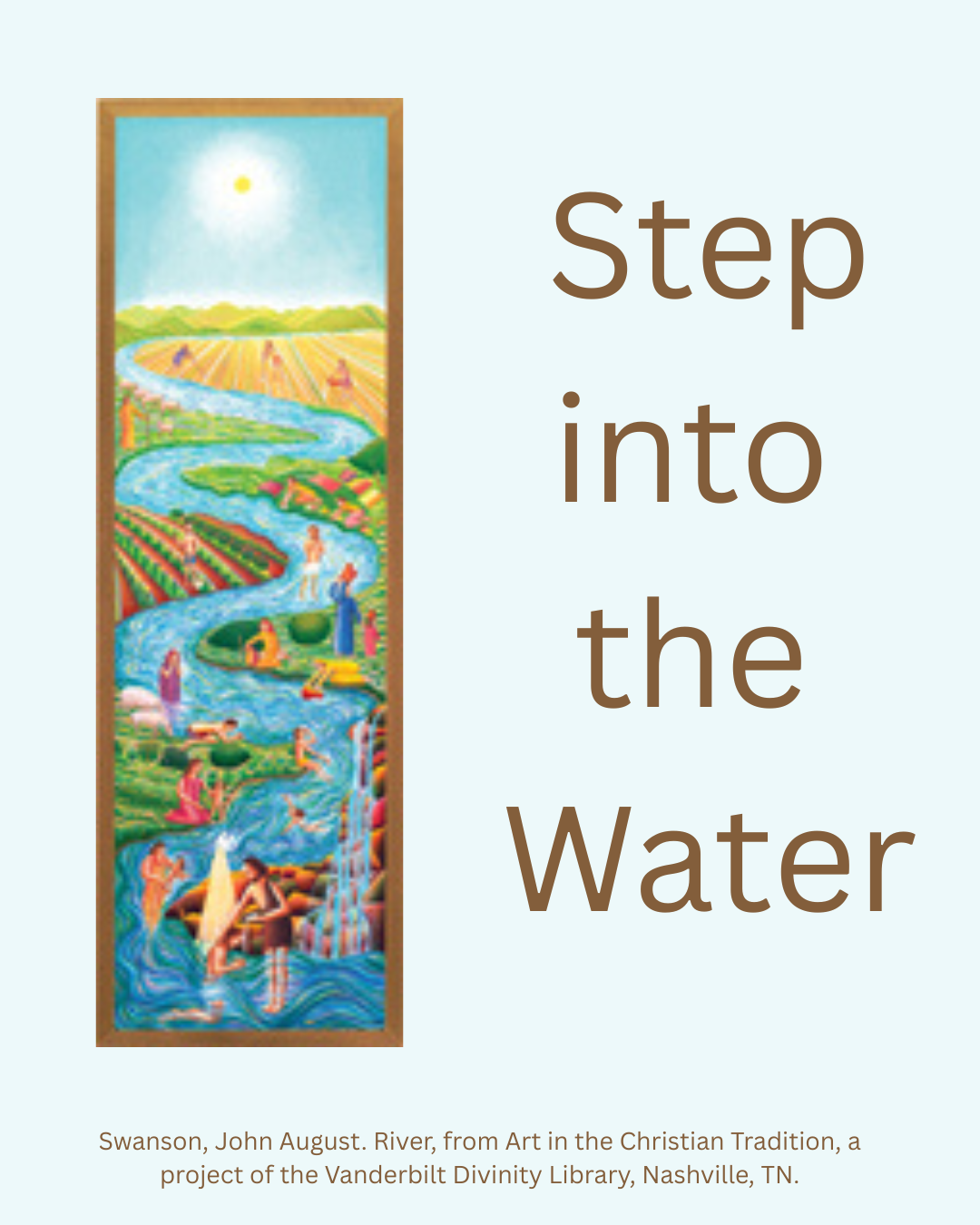
Occasionally there is a sentence which helps clarify a practice while retaining its complexity. “Baptism means everything which water means” is one of those very helpful phrases. Water cleanses, washes, and refreshes. Water is life giving and life saving. It can be still or moving. It can be shallow or deep. It can be fresh or salty or brackish. Over time water erodes rocks and creates the Grand Canyon. Water is also dangerous. It floods. It washes things away. It drowns. If we read about the baptism of Jesus with limited ideas about baptism, it’s a confusing story. If we read the story holding a multitude of ideas about baptism, what might we discover?
Then Jesus came from Galilee to John at the Jordan, to be baptized by him. John would have prevented him, saying, “I need to be baptized by you, and do you come to me?” But Jesus answered him, “Let it be so now, for it is proper for us in this way to fulfill all righteousness.” Then he consented. And when Jesus had been baptized, just as he came up from the water, suddenly the heavens were opened to him and he saw God’s Spirit descending like a dove and alighting on him. And a voice from the heavens said, “This is my Son, the Beloved, with whom I am well pleased.” Matthew 3:13-17 NRSVue
John the Baptist practiced a baptism of repentance. People came, confessed their sins, and were baptized.2 John’s baptism was not Christian baptism. And so not surprisingly John the Baptist is confused when Jesus comes to be baptized.3 He is reluctant to baptize Jesus, that act doesn’t make sense according to his understanding of baptism. Jesus expands baptism beyond repentance. He doesn’t replace that understanding, but he expands baptism. Jesus’ baptism shifts the act of baptism from a human initiated act of repentance to a God initiated act of acceptance. The emphasis shifts from humans doing something to humans receiving what the Spirit gives.
Jesus responded to John the Baptist’s reluctance to baptize him by saying this difficult sentence, “Let it be so now, for it is proper for us in this way to fulfill all righteousness.” What does he mean? Righteousness is a word with a complex and rich meaning. It carries the idea of justice. Some theologians tell us that when we read the word righteousness, we should include the idea of justice. They are two sides of the same coin. Righteousness includes God’s covenantal faithfulness, God’s saving actions, and God’s deliverance. Righteousness is a gift from God. And at the same time, human response and action are part of righteousness. Jesus is the “Righteous One”.4 At Jesus’ baptism, this expansive sense of righteousness is fulfilled. Fulfill, here, is more than doing God’s will, although it is that. Fulfill also carries the meaning of enacting or embodying or fully revealing. God’s righteousness/justice is made fully known, it is fully revealed in Jesus.
Jesus baptism is the beginning of Jesus’ ministry. It is the start of what Jesus does during his life on earth. Our baptism also, is not a finite event. It is our beginning. Methodist theologian William Willimon writes, “It [baptism] is the beginning of a lifelong pilgrimage with God, a lifelong discourse with our Creator… It is a lifelong process of conversion and nurture which begins at the font and does not end until death, until we are at last tucked safely into the everlasting arms of God who first reached for us in baptism.”5
“Baptism means everything which water means”. When we learn about the water cycle we learn that all water is connected6. Solid, liquid, vapor. Pond, estuary, river, ocean. Water is present and vital in a variety of ways. Pollution of some water, ultimately affects all water. Likewise the cleansing of some water ultimately affects all water. When Jesus steps into the water of the Jordan River, he is connected to us, as water is connected to water. Jesus truly and fully God, and truly and fully human. At his baptism he is, in a particular way, the visible connection that links all of us across time and place and the visible connection that links humans and God.
People say that we never step into the same river twice. A river is familiar water and yet also new water. All water is created to be holy water. All people are created to be holy people. Remember your baptism. Remember the water. Remember God’s love for you. Familiar and also ever new.
- Willimon, William Remember Who You Are: Baptism, A Model for Christian Life; Upper Room Books,1980, page 94 ↩︎
- Matthew 3:1,6,11 ↩︎
- You can find some of my thoughts on Matthew’s stories about John the Baptist, here and here. ↩︎
- “Righteousness” John H/P. Reumann, Park Allan Powell, in HarperCollins Bible Dictionary, Mark Allan Powell Gen. Ed. p882-883, Kindle Edition. The Society of Biblical Literature: 2011 ↩︎
- Willimon, 78-79 ↩︎
- https://en.wikipedia.org/wiki/Water_cycle ↩︎
 Conversation in Faith
Leave a comment