Occasionally in the Bible, people say odd things. I don’t necessarily mean theologically challenging things, although there’s plenty of that. I mean things that don’t make sense. For example, this passage in the Gospel of John. When we come across something odd in scripture, it’s an invitation to stay with it for a bit.
The next day he [John the Baptist] saw Jesus coming toward him and declared, “Here is the Lamb of God who takes away the sin of the world!
This is he of whom I said, ‘After me comes a man who ranks ahead of me because he was before me.’ I myself did not know him, but I came baptizing with water for this reason, that he might be revealed to Israel.” And John testified, “I saw the Spirit descending from heaven like a dove, and it remained on him. I myself did not know him, but the one who sent me to baptize with water said to me, ‘He on whom you see the Spirit descend and remain is the one who baptizes with the Holy Spirit.’ And I myself have seen and have testified that this is the Chosen One.”
The next day John again was standing with two of his disciples, and as he watched Jesus walk by he exclaimed, “Look, here is the Lamb of God!” The two disciples heard him say this, and they followed Jesus. When Jesus turned and saw them following, he said to them, “What are you looking for?” They said to him, “Rabbi” (which translated means Teacher), “where are you staying?” He said to them, “Come and see.” They came and saw where he was staying, and they remained with him that day. It was about four o’clock in the afternoon. One of the two who heard John speak and followed him was Andrew, Simon Peter’s brother. He first found his brother Simon and said to him, “We have found the Messiah” (which is translated Anointed).He brought Simon to Jesus, who looked at him and said, “You are Simon son of John. You are to be called Cephas” (which is translated Peter). John 1:29-42 NRSVue
It will help us as we think about this passage, to remember that the author of John’s gospel uses words that can have multiple meanings. Sometimes the context helps make the meaning clear, but sometimes the word remains ambiguous. As readers we have to decide if a word is to be understood literally or metaphorically. John’s gospel has several stories where ambiguous words cause people to misunderstand each other.1 Translators, necessarily, have to make decisions about the words they use. Because we are reading a translation, sometimes we miss what might be intended ambiguity.
When reading this passage in John, and the odd conversation between Jesus and the two disciples, we might wonder if something is lost in translation. The conversation between Jesus and the disciples seems to be taking place on two levels at the same time.
The disciples, after hearing John the Baptist talk about Jesus, decided to follow him. The word “follow” (akoloutheo) can mean to physically go, or to come after, and also it can be a metaphor for discipleship. The two people physically walked along with Jesus and by doing so, they became disciples.
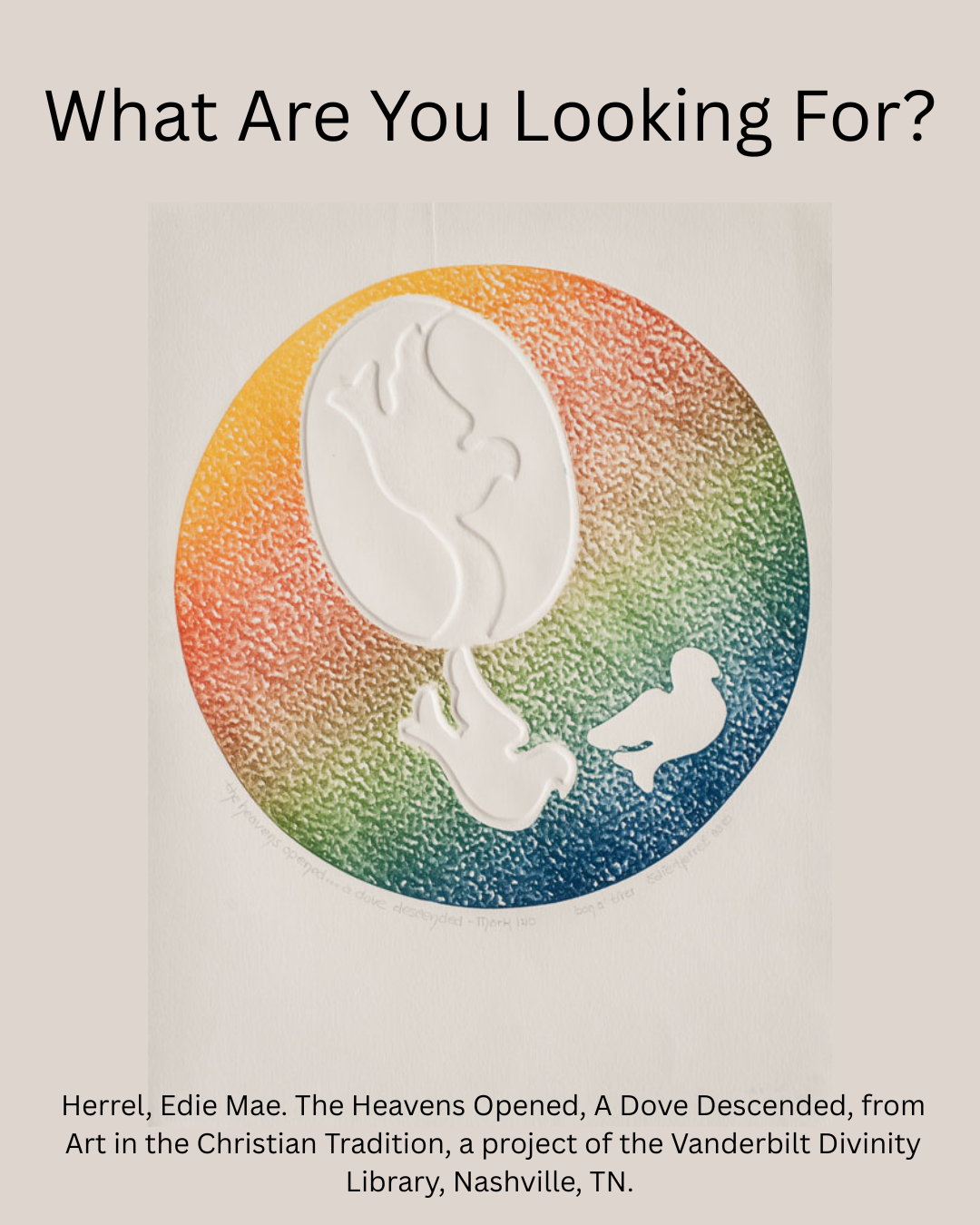
Jesus, saw these two guys walking behind him, turned and asked, “What do you want?” or “What are you looking for?” 2 These are the first words of Jesus in John’s gospel. It’s a question for the two disciples, and it is a question for those of us reading John’s gospel. If we are following Jesus, what are we looking for? What do we want?
We might expect these two new disciples to reply, “We’re looking for the Messiah.” or “John the Baptist says you are the lamb of God and we’re curious about that. Who are you? What does that mean?” Instead they reply, ” Rabbi, where are you staying?” Which logically doesn’t follow as a response to Jesus’ question. It seems as if a sentence is missing. When asked, “What are you looking for?” we might expect them to reply, “We need a place to stay.” And then, “Where are you staying?” Followed by “Can we stay there too?”
“What are you looking for?” “Rabbi, where are you staying?”
Their reply does make sense when we realize that the word “stay” (meno) may refer to a physical location. But in John’s gospel it can also mean abide or dwell and is used to describe “the relationship between God, Jesus, and the Spirit with one another and with believers.”3 In verses 32 and 33 John told these disciples that he saw the Spirit remain or abide on Jesus.
This conversation isn’t simply about where they’re going to spend the night. It becomes a theological conversation. The disciples wonder about Jesus’ relationship to God and the Spirit. Is what John told them true? Jesus invites them to “Come and see”. The two disciples stay, remain, abide with Jesus.
We know from the rest of the gospel that these disciples continue to stay with Jesus, in multiple senses of the word. They remain with Jesus, but they don’t stay in the same place. They are itinerant and travel with him. And they certainly do not remain the same people. The two disciples who trail along after Jesus, are profoundly changed because they did stay with Jesus. We can wonder, did they have any idea what the decision to follow after Jesus that day would mean?
The same holds true for us when we embark on a life of discipleship. What is it that we want? What are we looking for? What will it mean for us to stay with Jesus?
Christianity has often been reduced to being concerned about what happens to me, both now and after I die. Those are legitimate questions. But they are not the only concern. Like the first disciples, staying with Jesus will take us to unexpected places and change us in unanticipated ways. Following Jesus invites us to expand our concerns. As our relationship with Jesus deepens, our focus shifts from being mostly about ourselves to being more and more about God, and more and more about others.
What were you looking for when you first began to follow after Jesus? What are you looking for now? What have you found?
- For example, the story of Jesus and Nicodemus, John 3:1-10. There is confusion around a word that means both being born again and being born from above. ↩︎
- The NRSVue has “What are you looking for?” and the NIV had “What do you want?” A literal translation would be “Seek” ↩︎
- O’Day, Gail R. “The Gospel of John” in The New Interpreter’s Bible Volume IX, Leander E. Keck Abingdon Press: 1995, page 531. This post is influenced by O’Day’s commentary on this passage, pages 530-534. See John 1:32, 33; 8:31,35; 14:10, 17; 15 ↩︎
 Conversation in Faith
Leave a comment