Matthew’s story of Jesus calling the first disciples to follow him is often portrayed as a particular kind of miracle. The portrayal goes something like this: Jesus walks up as an unknown person to some random commercial fishers, and says “Follow me”. The fishers don’t ask questions, they just leave everything behind in response to Jesus. The miracle is their complete, unquestioning obedience to Jesus’ powerful word. Often, then, it’s implied that we are somehow less faithful than these disciples if we don’t immediately sacrifice everything to enter the mission field.
I’m inviting us to rethink that interpretation…
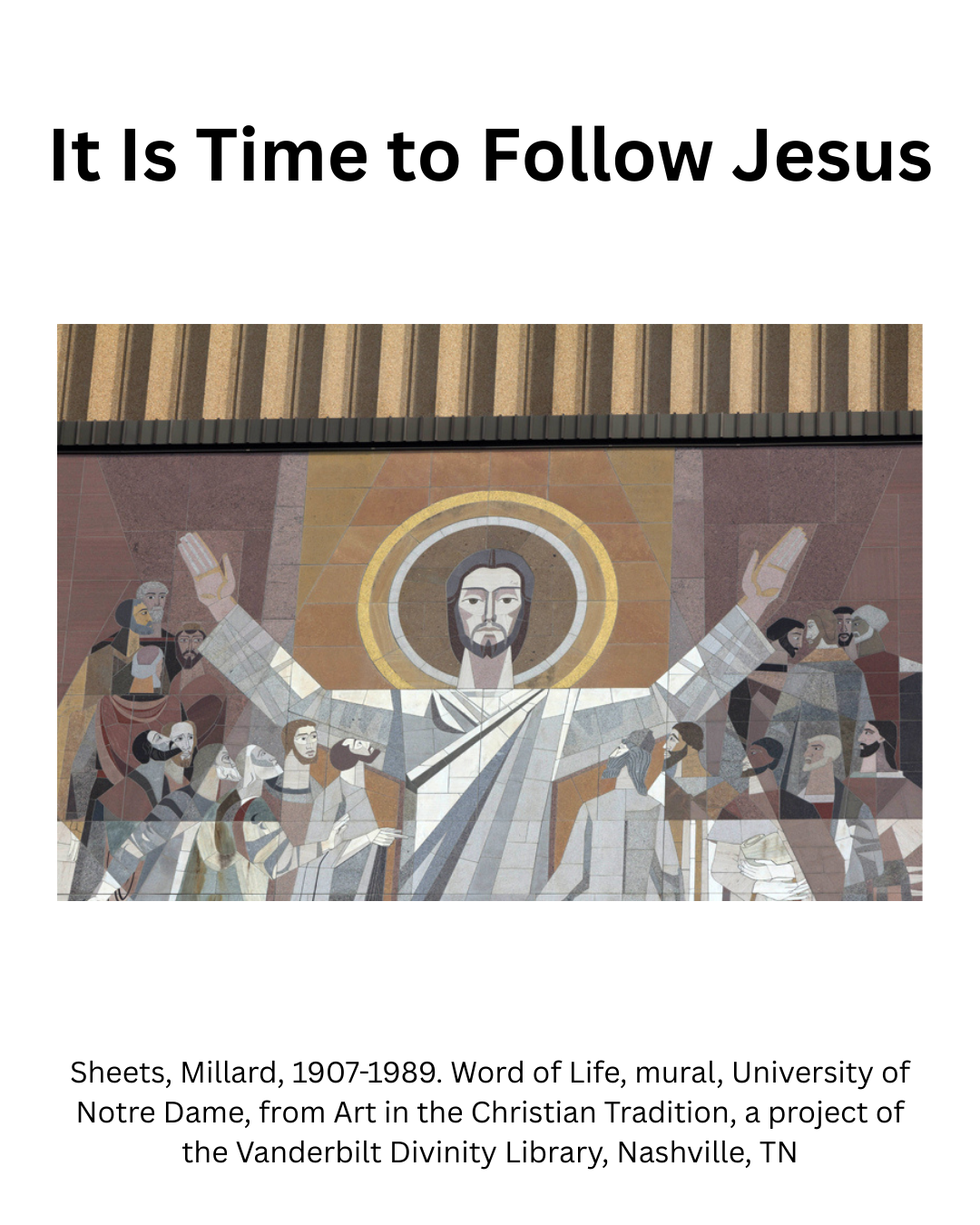
Now when Jesus heard that John had been arrested, he withdrew to Galilee. He left Nazareth and made his home in Capernaum by the sea, in the territory of Zebulun and Naphtali, so that what had been spoken through the prophet Isaiah might be fulfilled:
“Land of Zebulun, land of Naphtali, on the road by the sea, across the Jordan, Galilee of the gentiles–the people who sat in darkness have seen a great light, and for those who sat in the region and shadow of death light has dawned.”
From that time Jesus began to proclaim, “Repent, for the kingdom of heaven has come near.”
As he walked by the Sea of Galilee, he saw two brothers, Simon, who is called Peter, and Andrew his brother, casting a net into the sea for they were fishers. And he said to them, “Follow me, and I will make you fisher of people.” Immediately they left their nets and followed him. As he went from there, he saw two other brothers, James son of Zebedee and his brother John, in the boat with their father Zebedee, mending their nets, and he called them. Immediately they left the boat and their father and followed him.
Jesus went throughout all Galilee, teaching in their synagogues and proclaiming the good news of the kingdom and curing every disease and every sickness among the people. Matthew 4:12-23 NRSVue
Capernaum, in Jesus’ time, was a small place of about a thousand people. Jesus made his home in Capernaum and we have several stories in the Gospels of things Jesus did in Capernaum. In fact this text tells us that Jesus proclaimed “Repent, for the kingdom of heaven has come near.” after he moved there. We know Jesus taught in synagogues and in other places. It seems reasonable to assume that Jesus preached this message more than once. In a town of a thousand people, when someone moves in and starts preaching, I would expect that everyone knew who Jesus was and what he was teaching. It seems reasonable to me that Simon, Andrew, James, and John knew who Jesus was.
What was the message Jesus proclaimed? A call to repent is a call to change direction, to change behavior, to change actions. Modern Western people may think Jesus only or mostly means, repent of your personal sins and so you can expect to go to heaven when you die. Repentance for Jesus and his first disciples meant more than that. They anticipated and they expected God’s kingdom to be truly present on earth. For people living under the rule of the kingdom (empire) of Rome, the kingdom of heaven was not a future place where they expected to dwell after death. The kingdom of heaven was God’s kingdom coming to replace Roman Imperial rule. People in the first century expected the Messiah to deliver them from Roman rule and establish the kingdom of God. Exactly how the Messiah would do that was a topic of debate, but that the Messiah would somehow free them was not.
What did it mean to be a fisher in the Roman Empire? The fishing industry was highly regulated and controlled by the empire. The empire claimed the sea and the fish. They regulated the boats that caught the fish and controlled the bridges and roads that were used to transport the fish to markets. There were tolls and taxes to pay.1
“Fishing was a fundamental part of the embedded agrarian economy of first-century Galilee. This region was ruled by Herod Antipas; a client king of the Romans. An “embedded” economy was one in which questions of production, processing, trade, and their regulation could not be separated from politics, religion, and family or village life. There was no free market that functioned independently from other dimensions of society, and little if any upward mobility. Most peasant fishing families were poor and lived at subsistence level, while a small minority of elites held the bulk of wealth and power.”
When I think about this text, I think about a small town, where people know each other. I think about a place where someone proclaiming “Repent for the kingdom of heaven has come near.” would be a topic of community conversation. I think about a place people struggled to survive because of the systems and structures of the occupying Roman Empire. I wonder if these first disciples had been talking about Jesus and his message. I wonder if they have been talking to Jesus about his message. I wonder, as a result of hearing Jesus’ proclamation, if they were ready to change the world, to help bring the kingdom of heaven to their homeland. If they were ready to deliberately and knowingly make the sacrifices necessary to follow Jesus. Then one day, it’s time. It’s time to begin. It’s time to go. “Follow me, and I will make you fisher of people.” And so they follow.
They follow, they join Jesus, not naively. They followed having listened, and discussed, and assessed the cost to their families and themselves. And they decided Jesus and his message was worth the cost, worth the risk. This is the miracle. Not that they naively follow, unaware of the potential cost. This miracle is that they knew the potential cost and went anyway. At this point it’s five of them, heading out to proclaim, to advocate for a different way of living. Five of them inviting others into life in the kingdom of God and not the omnipresent regime of Rome. So off they go. teaching and proclaiming and healing and feeding. The miracle is they believed Jesus’ words and vision. The miracle is they knew the risks. The miracle is they went anyway.
If you are a Christian, you and I have spent time hearing about Jesus and hearing his message. You and I have talked about it. You and I have studied it. You and I have prayed about it. And you and I have looked around us at the state of the world. You and I see in our nation, in our towns, and in our neighborhoods the fear, and suffering, and injustices of our current time.
Beloved, is Jesus walking up to you and inviting you to “Follow me and I will make you fishers of people.”? Is Jesus inviting you to help him change the world? How will you and I respond?
What can you do? Look around in your town. Churches and faith based organizations all across the nation are developing coalitions of support and non violent resistance.2 They are caring for families and people who are afraid by organizing food drop offs, accompanying students to school and people to work and more. Not all of us can or should be arrested for acts of civil disobedience. Not all of us should go out watching for ICE. But we can all do something. What is Jesus calling you and I to do?
- https://sojo.net/interactive/fishing-against-empire and https://dianabutlerbass.substack.com/p/sunday-musings-f5c
and https://www.bibleodyssey.org/articles/fishing-economy-in-the-sea-of-galilee/
and Carter, Warren, Matthew and the Margins, Orbis Books:2001, page121 ↩︎ - These examples are in Minnesota because that’s the area of national attention. https://religionnews.com/2026/01/11/in-minneapolis-george-floyd-era-faith-networks-reignite-after-renee-goods-killing-by-ice/ and https://www.mprnews.org/episode/2026/01/15/minneapolis-church-has-delivered-more-than-12000-boxes-of-groceries-to-families-in-hiding and https://sojo.net/articles/news/faith-groups-plan-major-ice-protests-minneapolis and https://religionnews.com/2025/11/25/how-one-conservative-christian-family-is-pushing-back-against-ice/ ↩︎
 Conversation in Faith
Leave a comment