The Beatitudes contain some of Jesus’ best known teaching. And they may also be some of the more confusing. How are the poor in spirit blessed? Or those who mourn? Or those who are persecuted? Matthew’s version of the beatitudes, compared to Luke’s, is sometimes presented as spiritualizing Luke’s more down to earth words1. People suggest for Matthew, it’s not about the actual poor, it’s about spiritual poverty. As if we could separate the physical from the spiritual. And as if we can be disciples by being “spiritual” and not acting in the real world.
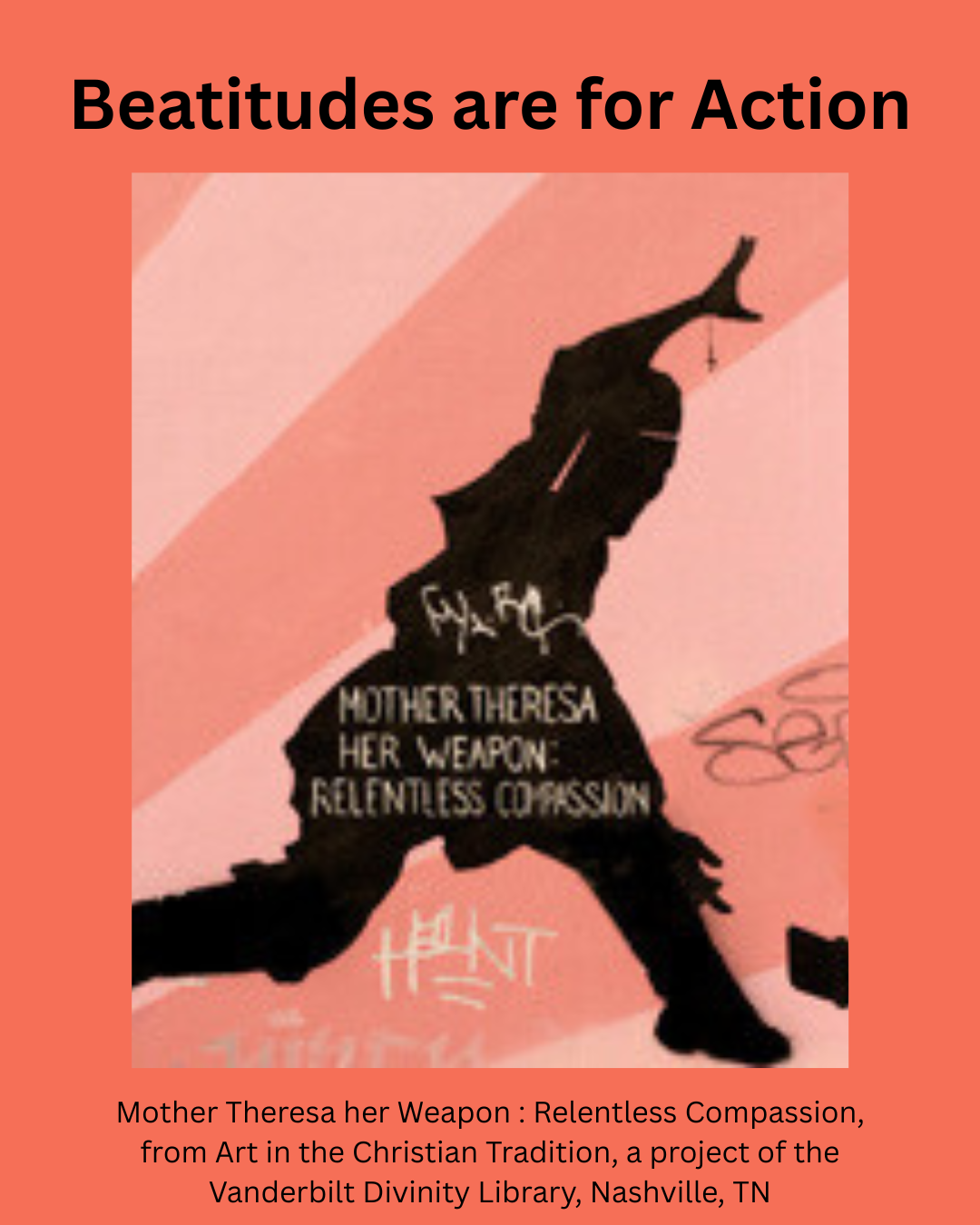
In the ancient world, blessings were often connected to their opposite- curses. While Jesus does not, here, pronounce anyone cursed, we could expect that his hearers made the connection. As we think about the blessed, give a thought to the opposite as well.
When Jesus saw the crowds, he went up the mountain, and after he sat down, his disciples came to him. And he began to speak and taught them, saying:
“Blessed are the poor in spirit, for theirs is the kingdom of heaven.
“Blessed are those who mourn, for they will be comforted.
“Blessed are the meek, for they will inherit the earth.
“Blessed are those who hunger and thirst for righteousness, for they will be filled.
“Blessed are the merciful, for they will receive mercy.
“Blessed are the pure in heart, for they will see God.
“Blessed are the peacemakers, for they will be called children of God.
“Blessed are those who are persecuted for the sake of righteousness, for theirs is the kingdom of heaven.
“Blessed are you when people revile you and persecute you and utter all kinds of evil against you falsely on my account.
Rejoice and be glad, for your reward is great in heaven, for in the same way they persecuted the prophets who were before you. Matthew 5:1-12 NRSVue
Blessed and blessing are words that contain a plurality of meaning. If we think to be blessed means only real time material goods, Jesus’ words don’t make much sense. What does mourning and meekness get us in this world? Blessing is more than the receiving of material goods and wealth.
When the Prophets say someone is blessed, they “declare the present/future blessedness of those who will be vindicated at the eschatological coming of God’s kingdom.”….”Matthew’s beatitudes are not practical advice for successful living but prophetic declarations made on the conviction of the coming-and-already-present kingdom of God.”2
Jesus, as the Messiah because he is speaking prophetically, creates this alternate reality. The people who hear Jesus proclaim “blessed are” know these claims, these declarations, create a new, alternative future and a new, alternative present. These words are encouragement for them, the disciples, to act. They now know who the blessed are and how they act. These are the signs and actions of life in the reign of God. The beatitudes are not simply a call to wait for God to “do something”. They are a call to action.
Who are these blessed people and what are they to be doing?
The “poor in spirit” are not the humble nor patient. This phrase is not a turn away from the actual poor. All of Scripture makes clear that the physically poor have a particular place in God’s heart. The poor in Spirit are those who are physically, emotionally, economically, and spiritually crushed and despised by the powers and people in charge. 3 Jesus begins by assuring all of us that those who are crushed and despised, no matter what the world says, matter greatly to God. The poor in spirit are part of the kingdom of God.
“Those who mourn” includes people who lament the unjust world they live in. People mourn and lament all death and injustice. They lament that God’s will is not done on earth.4 What is their comfort? That death and injustice do not have the last word
The meek are those who nonviolently await God’s vindication. They are not passive doormats. Rather the meek live non violent lives. Their work and action are non violent and non vindictive. They trust God and know God’s justice will ultimately change the earth.
To hunger and thirst for righteousness describes the intensity and the desire for righteousness. Righteousness is as essential for human life as food and water. The word for righteousness also always includes justice. These two concepts are inseparable in the ancient world. These “blessed” long for, hunger for, thirst for God’s justice to come into this world. The work for justice is as fundamentally necessary as working for food.
All these “blessed” are conditions and situations that God will change. We are told what the outcome will be. The next set of “blessed” are actions, the way of life we are to embody now.
Mercy. God’s reign is not one of retribution and punishment. Rather it is marked by surprising acts of mercy. Mercy involves care for the oppressed. Mercy is part of loving of our neighbor and our enemy.
A pure heart is not simply avoiding “impurity”. A pure heart is a heart, a person, who is devoted to God. Our actions reflect our values. Because we know God’s love and God’s intentions for the world, we do our best to be single minded- pure- in our actions. Devotion to God takes many forms, among them are prayer, contemplation and the various ways we work for justice. Jesus tells us that when we seek after God, we will find God.
Peacemaking is not passivity. Peacemakers actively work for peace. Peacemakers actively work for redemption and reconciliation. As children of God, peacemakers are about the work of their parent.
Did you think about who the opposite of the blessed are? Perhaps they are those who are in the economic, social, and spiritual majorities. Those who benefit from injustice. The vindictive and violent. Those who extract retribution on others. Those who benefit from injustice. Those whose hearts desire something or someone other than God. Those who benefit from war and violence. Those who persecute and obstruct the people who work against the status quo.
We should think about the blessed and the cursed not only as individuals but as systems and policies and structures that at best hinder and at worst actively oppose the reign of God. We are all, whether we like it or not, part of systems that harm and oppress. The taxes we pay. The laws we allow. The social niceties we affirm. Yet, rather than condemning us, Jesus invites us into a better way of living. Jesus reminds us that our personal struggles and trials and the struggles and trials of the world are not the final word. God has something better in store for all of us. And all of us are invited to participate.
Our calling as disciples is to move ourselves, as best as we can, into lives of greater blessing. Not a blessing only for ourselves, but like Abraham, blessed to be a blessing for others, indeed we are to be a blessing for the entire world. 5
As we move into the world of expanded blessings for all, we place ourselves at odds with those who profit from the current system. Scripture doesn’t gloss over the dangers of the new way of life. The empire always strikes back. And so this section of the Sermon on the Mount ends with persecution.
Remember righteousness also always means justice. Jesus is talking about people being persecuted because they work for justice. Jesus is talking about people who are reviled and persecuted because they are merciful, devoted to God, and working for reconciliation and redemption. These disciples rejoice, not because they are happy about persecutions. They rejoice in the sure and certain hope of God’s coming reign. They stand in a long line of people (like the prophets) who trust in God, who believe God will act and set the world right. They live as blessed witnesses to another way of life, another way of being.
The beatitudes are not, as sometimes presented, a call to passive waiting. They are a call to action and a promise “Blessed are… for they will…” They are a call to follow Jesus in solidarity with the poor in spirit, to lament the state of the world, to live with mercy not punishment, to work for justice, to be devoted to God, to actively work for peace. They are a call to believe that what Jesus declares in a future and present truth. May we believe.
- Luke 6:20-26 ↩︎
- Boring, M. Eugene, “The Gospel of Matthew:Introduction, Commentary, and Reflections” in The New Interpreter’s Bible, Volume VIII, Abingdon: 1994, Page 177. ↩︎
- Carter, Warren, Matthew and the Margins: A Sociopolitical and Religious Reading, Orbis Books:2001, page 131-132 ↩︎
- This and the rest of the “Blessed are…” influenced by Boring and Carter. ↩︎
- Genesis 12:1-3 ↩︎
 Conversation in Faith
Leave a comment