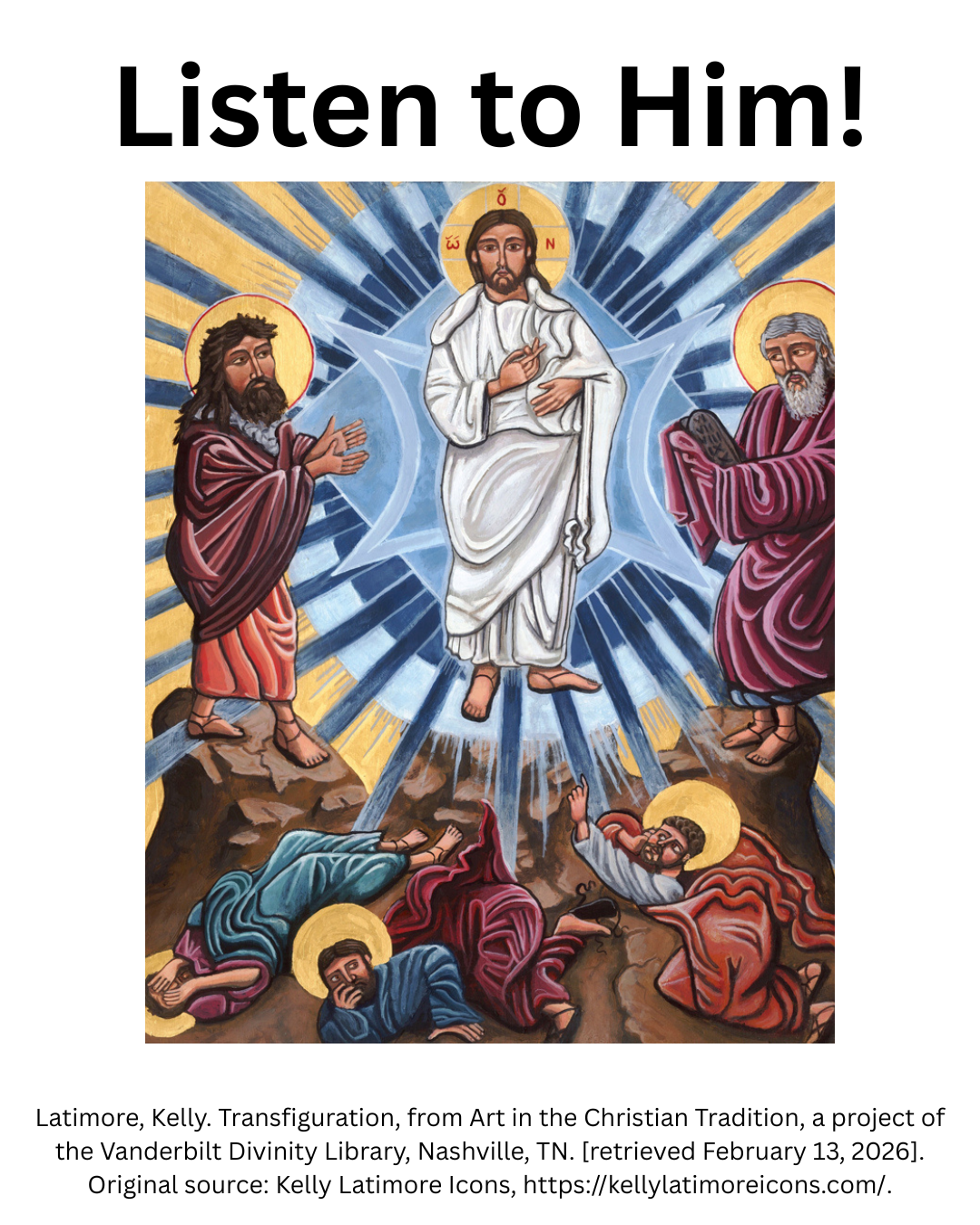
Sometimes stories in the Bible are hard to grasp. Perhaps the cultural context is so different we have trouble understanding it. Perhaps the text challenges some deeply held belief or a long held assumption. Sometimes the stories are just weird and perplexing. The Transfiguration story is a bit of all of these. What do we do with such a strange story? Why should it matter to us?
Six days later, Jesus took with him Peter and James and his brother John and led them up a high mountain, by themselves. And he was transfigured before them, and his face shone like the sun, and his clothes became bright as light. Suddenly there appeared to them Moses and Elijah, talking with him. Then Peter said to Jesus, “Lord, it is good for us to be here; if you wish, I will set up three tents here, one for you, one for Moses, and one for Elijah.” While he was still speaking, suddenly a bright cloud overshadowed them, and a voice from the cloud said, “This is my Son, the Beloved; with him I am well pleased; listen to him!” When the disciples heard this, they fell to the ground and were overcome by fear. But Jesus came and touched them, saying, “Get up and do not be afraid.” And when they raised their eyes, they saw no one except Jesus himself alone.
As they were coming down the mountain, Jesus ordered them, “Tell no one about the vision until after the Son of Man has been raised from the dead.” Matthew 17:1-9 NRSVue
Just before the Transfiguration, Jesus has asked the disciples, “Who do people say that the Son of Man is?” and “Who do you say that I am?” Peter responds, “You are the Messiah, the Son of the Living God.” Then Jesus tells them he must suffer, die, and be raised. And then he tells the disciples, “If any wish to come after me, let them deny themselves and take up their cross and follow me. For those who want to save their life will lose it, and those who lose their life for my sake will find it. For what will it profit them if they gain the whole world but forfeit their life? Or what will they give in return for their life?”1
This was the first time Jesus told the disciples that he will suffer, die, and be resurrected. This was not at all what they expected the Messiah to do. Six days later, Jesus takes Peter, James, and John up the mountain. I wonder what they talked about in those six days? Surely they had questions.
Jesus and three of the disciples go up a high mountain. In the Bible, mountains are places where important encounters with God occur. So we are forewarned that something significant is going to happen. On the mountain, Jesus is transfigured, or transformed or metamorphosed or changed2. Whatever we call it, Jesus is revealed in a new way to them. And if that wasn’t enough, Moses and Elijah show up and are talking with Jesus. I wonder what they were talking about? Perhaps they all commiserate about how difficult working with humans actually is. We don’t know.
How do you react when something amazing and totally unexpected happens? Some of us are silent, as James and John were. We are literally speechless. Others of us,like Peter, start talking.
It’s a very human impulse to want to mark the location to remember this extraordinary occasion. Peter proposes building tents. The word “tents” could also suggest building tabernacles, perhaps like the dwelling of God during the Exodus. Just as God appeared in a cloud in the tabernacle, God comes and is present in a cloud at the transfiguration.
And then,God interrupts Peter! Peter is talking, trying to make sense of what is happening, trying to properly honor the experience, and God cuts him off. I chuckle every time I read this. I wonder how often God hears our enthusiastic attempts to honor God and thinks that maybe we should be quiet and reflect more?
What God says is mostly exactly what God said at Jesus baptism. “This is my Son, the Beloved, with whom I am well pleased.”3 And then God says, “Listen to him!” The Bible rarely gives us clues about tone of voice. This year (2026) I imagine God is emphatic. Maybe God is just a bit frustrated. Perhaps even shouting. LISTEN TO HIM!
That seems to me to be a word for us today. Listen to him! Our inclination may be to memorialize. To build something. Create a painting, a song, a poem, a theological treatise, a social media post. We may be inclined to analyze and evaluate the experience. We may earnestly desire to stay in the presence of the Holy. None of those impulses are wrong. They can be useful. They have their place.
But God doesn’t say, “Great idea Peter!” God says “Listen to him!” Perhaps because God knows how hard it is for us to really listen and then follow Jesus. That question for Peter and the other disciples is a question for us as well.
What would we be doing today if we listened to Jesus? What if we read the gospel of Matthew (or any of the gospels for that matter) and pay attention to what Jesus said and did? How would our lives be different? Many of us would be making some changes in our lives and in our churches, and in our communities.
After they hear the voice of God, the disciples fell to the ground and “were overcome with fear”. Perhaps, likely even, because they were in the presence of God. But what if they were also overcome by the implications of listening to Jesus? What if they were overcome by what listening to Jesus, taking him seriously would mean?
No wonder they were afraid.
And then, the divine cloud is gone. Moses and Elijah are gone. Jesus is no longer transfigured. They see “Jesus himself alone”. They are will the Jesus they know and trust and love. And they get up and they go down the mountain with him.
We often treat what happens next as a separate incident. But maybe we shouldn’t. When the three disciples follow Jesus, after this holy encounter, there is no pause for reflection other than the time it takes to walk down the mountain. They walk down the mountain and end up in a crowd. A man comes and begs Jesus to heal his son.4 They have followed Jesus right back into the thick of things. Because listening to Jesus, means following Jesus. And when we follow Jesus we end up in the midst of the world as it actually is. Not the world of secluded mountain tops. We end up in and among real people with their real lives and concerns.
How would our lives and our world be changed if we listened to Jesus?
 Conversation in Faith
Leave a comment