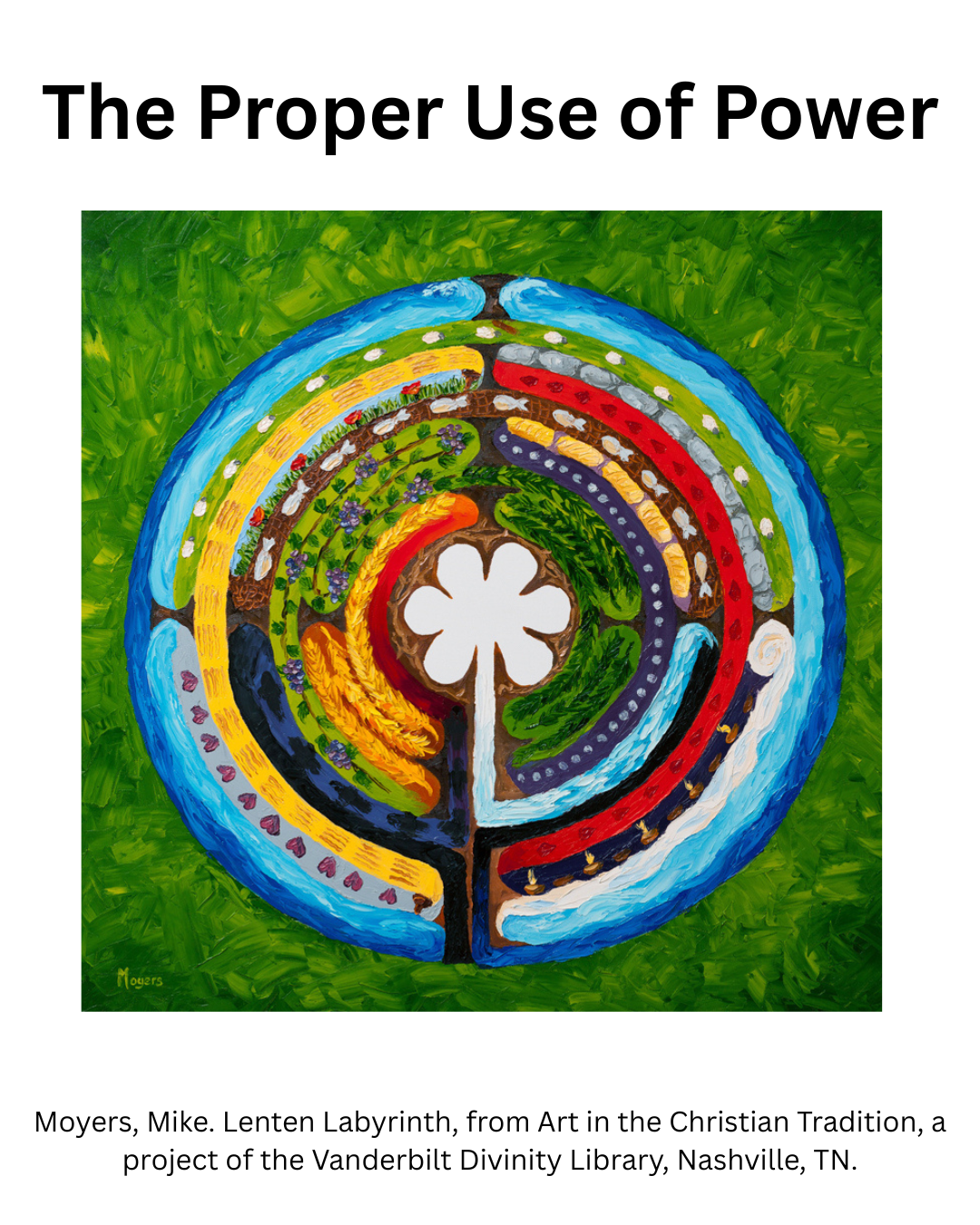
I’ve been spending a lot of time this past year thinking about power and how it is used and misused. Perhaps you have been too. The more I read and contemplate on the gospels, the more I realize how important it is to think seriously about how Jesus uses power and what he teaches about power.
Then Jesus was led up by the Spirit into the wilderness to be tested by the devil. He fasted forty days and forty nights, and afterward he was famished. The tempter came and said to him, “If you are the Son of God, command these stones to become loaves of bread.”But he answered,
“It is written, ‘One does not live by bread alone, but by every word that comes from the mouth of God.’”
Then the devil took him to the holy city and placed him on the pinnacle of the temple, saying to him, “If you are the Son of God, throw yourself down, for it is written,
‘He will command his angels concerning you,’ and ‘On their hands they will bear you up, so that you will not dash your foot against a stone.’”
Jesus said to him, “Again it is written, ‘Do not put the Lord your God to the test.’”
Again, the devil took him to a very high mountain and showed him all the kingdoms of the world and their glory, and he said to him, “All these I will give you, if you will fall down and worship me.”Then Jesus said to him, “Away with you, Satan! for it is written,
‘Worship the Lord your God, and serve only him.’”
Then the devil left him, and suddenly angels came and waited on him. Matthew 4:1-11 NRSVue
What I find interesting, this year1, about these temptations, is that they concern the proper use of power. Jesus isn’t without power and the ability to use that power. All we have to do is read the gospels to see that. The tempter asks Jesus, since he is the Son of God,2 to do things that he can already do. He does not tempt Jesus with new abilities or new powers. The temptation is to misuse the power he has.
Jesus, while not specifically turning stones into bread, does miraculously feed thousands of people. And of course, he himself is the bread of life. The issue in this request is how Jesus is to use his power?
Then at the pinnacle of the Temple, Jesus is challenged by the devil again and it’s a two part temptation. First, make God show that God will send angels to save you. At the end of this encounter with the devil, God does indeed send angels to care for Jesus. Angels are sometimes called the heavenly host, meaning the army of God. When Jesus was arrested, he reminds the disciples and those coming to arrest him that God would send angels to protect Jesus if Jesus asked.3 Will Jesus use his power to summon the army of God to save him?
Secondly, appearing on the pinnacle of the Temple and then leaping off to be saved by an army of angels would certainly be a dramatic and highly visible declaration of power. And Jesus never does that. His entire ministry is with the forgotten and marginalized. Even the resurrection is revealed only to a few at a time. The way of Jesus is not high visibility grandstanding. Will Jesus use his power to dramatize his status as Son of God?
Finally the devil claims he can deliver all the kingdoms of the world to Jesus in exchange for worship. Of course the irony is that all the kingdoms already belong to Jesus, as the Son of God. With whom will Jesus align himself? With the one who promises an apparently easy path of domination or will he use his power as the Son to follow the more difficult, non coercive way of God?
How does Jesus use his power? For his own respite, for his own care, for his own comfort, his own glory?
These temptations, and Jesus’ response to them, set the context for how Jesus lives and moves in the world. Jesus has power. He knows it. The devil knows it. The disciples know it. We know it. The point isn’t that he is powerless.
Jesus’ power isn’t simply raw, brute force power. Jesus’ power isn’t self aggrandizing. Jesus does not use his power for his own glorification. It’s not coercive or manipulative power over others. Jesus’ power both grows out of and is rooted in love. Love controls and guides and shapes Jesus’ power. Jesus uses his power out of love and to increase love in the world.
The gospel lesson for us is seeing how Jesus uses his power. And modeling the use of our power after his. We all have some measure of power. Some of us, obviously, have much more power than others of us. We have, at least, power over how we respond to God’s intention and hope for us. We have power over how we respond to other people. Do we respond out of love, or in anger or fear?
What would it mean for me to be aware of the power I have and then to intentionally use it as Jesus does, rooted, grounded, and growing in love?
- The story of the temptation of Jesus occurs every year in the lectionary. For some posts from previous years, see, here, and here, and here ↩︎
- Commentators tell us that the “if” in this text is not so much about proof- prove to me you’re the Son of God by doing this thing. This “if” is more in line with our word “since” – since you are the Son of God, do this. ↩︎
- Matthew 26:47-56 ↩︎
 Conversation in Faith
Leave a comment