If I had to choose one Bible verse that needs to be heard with fresh ears and seen with new eyes, it would be, “You must be born again.” This statement by Jesus is part of his conversation with Nicodemus. And as is often the case, when a verse is separated from the rest of the text, we would do well to put it back in context.
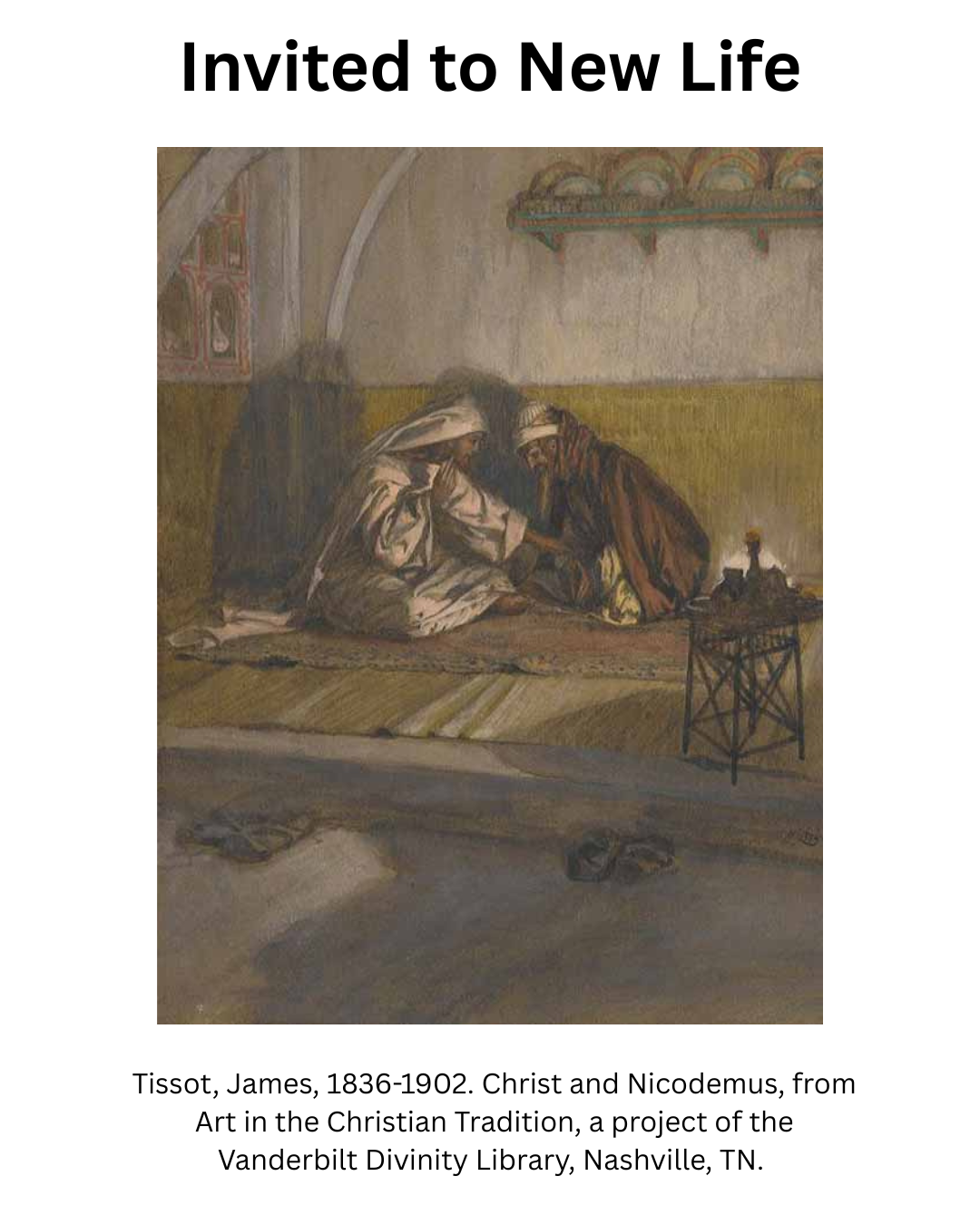
The author of John’s gospel likes word play. There are several stories where people misunderstand the meaning of a word Jesus uses. The story of Nicodemus has two words that have multiple related meanings. The word anothen can mean “from above” or “again”, or “anew”. Nicodemus takes the common, physical meaning when Jesus says, “Very truly, I tell you, no one can see the kingdom of God without being born anothen.” Honestly, why wouldn’t he?
The other word is pneuma, which can mean “wind” or “spirit” or “breath”.
This story about Nicodemus comes with some interpretive baggage. The first thing we are told about Nicodemus is that he is a Pharisee. Often Christians assume that Pharisees are hypocrites. Or that they are uniformly opposed to Jesus. Or they are not actually people of sincere faith, but rather controlling, legal nitpickers. As with any group of people, some are this way, and some are not. Pharisees are not presented in the gospels as uniformly bad or good. The HarperCollins Bible Dictionary says, that Pharisees were, “A group of particularly observant and influential Jews…” “..[I]t is clear from the NT stories that the Pharisees emphasized faithfulness to Torah, including the study of scripture and obedience to the law.” 1 Perhaps we ought not to assume the worst about Nicodemus.
How would our reading of this story change if we assumed Nicodemus had serious and sincere questions for Jesus? The story of Nicodemus comes right after the incident when Jesus entered the Temple and drove out the livestock and overturned the tables of the money changers. Perhaps Nicodemus has questions about who Jesus is and what he is up to. Maybe he doesn’t want to make assumptions about Jesus, so Nicodemus went to Jesus to talk directly to him.
Nicodemus comes to Jesus at night. Often commentators present this as a sign that Nicodemus is ashamed to visit Jesus or he is afraid, or generally up to no good. Which could be. John’s gospel often uses images of dark and light to make theological points. But what if we don’t automatically jump to that assumption? What if, nighttime is the only time Nicodemus and Jesus can have an uninterrupted and personal conversation? Maybe there is not time to talk until the day’s work is finished. What if these are two people simply talking in the quiet of the night. Some of the most meaningful conversations I have ever had, happened in the quiet of night. What if was not “teaching” but conversation? A conversation that was slow and thoughtful, with pauses and time for reflection? What if Nicodemus is sincerely trying to understand Jesus and his message?
Now there was a Pharisee named Nicodemus, a leader of the Jews. He came to Jesus by night and said to him, “Rabbi, we know that you are a teacher who has come from God; for no one can do these signs that you do unless God is with that person.” Jesus answered him, “Very truly, I tell you, no one can see the kingdom of God without being born from above.” Nicodemus said to him, “How can anyone be born after having grown old? Can one enter a second time into the mother’s womb and be born?” Jesus answered, “Very truly, I tell you, no one can enter the kingdom of God without being born of water and Spirit. What is born of the flesh is flesh, and what is born of the Spirit is spirit. Do not be astonished that I said to you, ‘You must be born from above.’ The wind blows where it chooses, and you hear the sound of it, but you do not know where it comes from or where it goes. So it is with everyone who is born of the Spirit.” Nicodemus said to him, “How can these things be?” Jesus answered him, “Are you the teacher of Israel, and yet you do not understand these things?
“Very truly, I tell you, we speak of what we know and testify to what we have seen, yet you do not receive our testimony. If I have told you about earthly things and you do not believe, how can you believe if I tell you about heavenly things? No one has ascended into heaven except the one who descended from heaven, the Son of Man. And just as Moses lifted up the serpent in the wilderness, so must the Son of Man be lifted up, that whoever believes in him may have eternal life.
“For God so loved the world that he gave his only Son, so that everyone who believes in him may not perish but may have eternal life.
“Indeed, God did not send the Son into the world to condemn the world but in order that the world might be saved through him. John 3:1-17 NRSVue
When I read this story assuming sincerity on Nicodemus’ part and kindness on Jesus’ part, I hear a story of invitation. Could Jesus be inviting Nicodemus to expand his faith? To expand his ideas about God and God’s hope for the world? 2 What if this is an invitation to a reborn faith? A faith that steps out of the safe shelter of the familiar and into the unpredictable wind? What if Nicodemus is being invited to let the Spirit wind blow him someplace new?
Often being born again is understood as a one time event that results in participation in a particular theology. But what if being born anew is a continual process? What if we are moved more and more by the Spirit wind into life in the kin dom of God? The Spirit wind blows. Sometimes it’s a gentle refreshing breeze that invites growth. Sometimes it’s a gale or a tornado that blows the familiar apart. Each time we let the Spirit wind blow around us, we have the opportunity to move more deeply into life in the coming age of God. 3
As this part of Nicodemus story ends, we do not know what he decided. Does Nicodemus believe? It is an open question whether he decides to follow Jesus or not. The author of John’s gospel does this, I suspect, on purpose. He leaves the question for us to answer for ourselves. If we had this conversation with Jesus, how would we respond? Would we, will we, step out of the safe shelter we know, to be blown about by the Spirit wind? Are we willing to be born anew, again and again? Will we step more and more fully into life in the kin dom of God?
- “Pharisees” Anthony J. Saldarini, Mark Allan Powell, pages 790-791 in HarperCollins Bible Dictionary, Mark Allan Powell, General Editor, 2011 ↩︎
- I want us to be careful here also. I’m not saying Jesus is inviting Nicodemus to stop being Jewish and become a Christian. Jesus remained a Jew his entire life. ↩︎
- The biblical phrase “eternal life” is not simply about life after death. It is a way of speaking about life in the coming age of God. ↩︎
 Conversation in Faith
Leave a comment