Through these weeks of Lent, we have been thinking about how Jesus, invites various people into a larger, deeper, richer faith. This week’s gospel reading has a multitude of invitations both from Jesus and to Jesus.
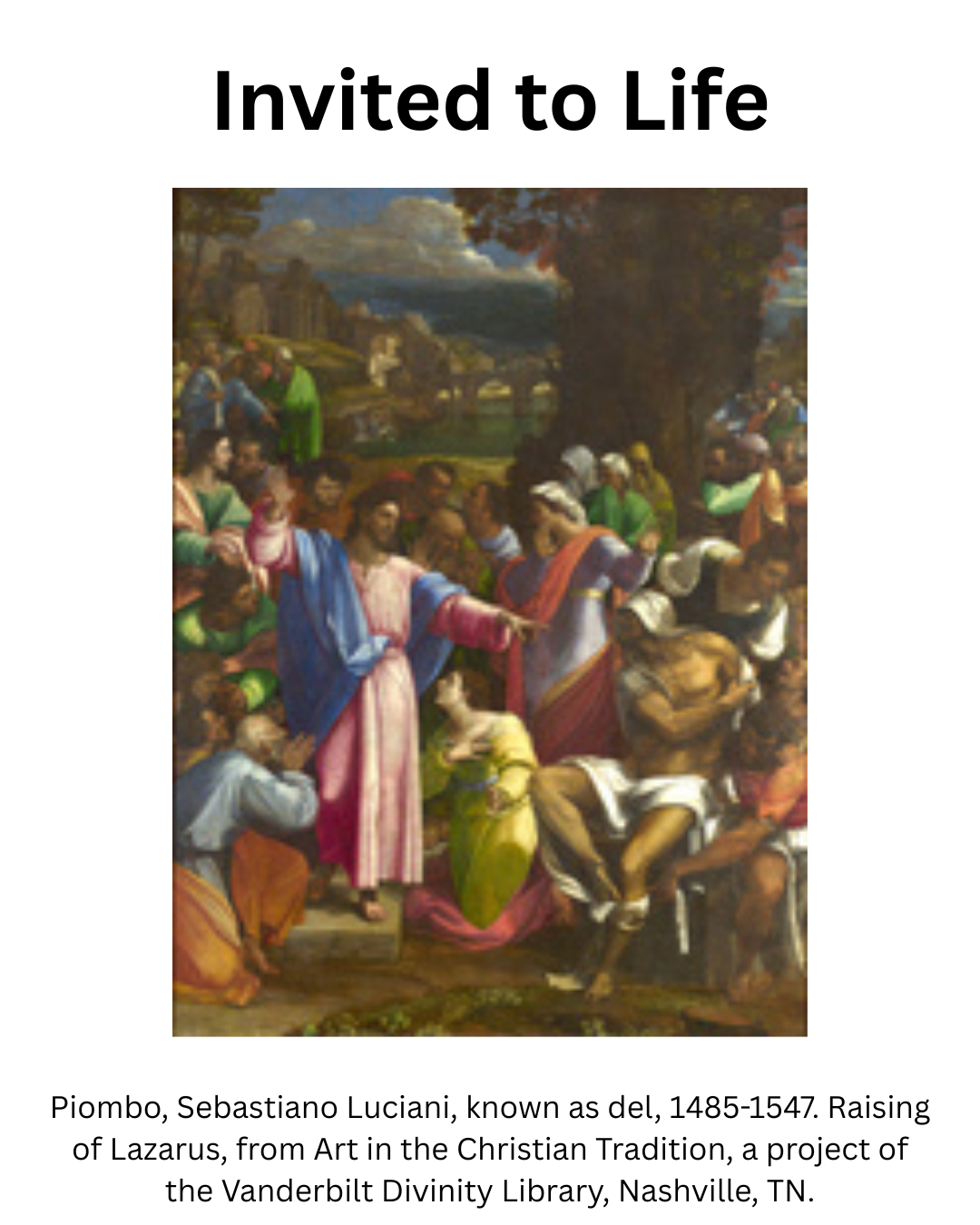
The story of the raising of Lazarus is a long story, for a gospel, 45 verses. Jesus and the disciples have just left Jerusalem because some people wanted to kill him for what he said there. And even though he left, many people found him and believed in him. There are multiple conversations and multiple characters in this story. Once again, we have wordplay and contrasts, light/dark, day/night, asleep/dead, wake/resurrection. There is a lot going on here.
Now a certain man was ill, Lazarus of Bethany, the village of Mary and her sister Martha. Mary was the one who anointed the Lord with perfume and wiped his feet with her hair; her brother Lazarus was ill. So the sisters sent a message to Jesus, “Lord, he whom you love is ill.” But when Jesus heard it, he said, “This illness does not lead to death; rather, it is for God’s glory, so that the Son of God may be glorified through it.” Accordingly, though Jesus loved Martha and her sister and Lazarus, after having heard that Lazarus was ill, he stayed two days longer in the place where he was.
Then after this he said to the disciples, “Let us go to Judea again.”The disciples said to him, “Rabbi, the Jews were just now trying to stone you, and are you going there again?” Jesus answered, “Are there not twelve hours of daylight? Those who walk during the day do not stumble because they see the light of this world. But those who walk at night stumble because the light is not in them.” After saying this, he told them, “Our friend Lazarus has fallen asleep, but I am going there to awaken him.” The disciples said to him, “Lord, if he has fallen asleep, he will be all right.” Jesus, however, had been speaking about his death, but they thought that he was referring merely to sleep. Then Jesus told them plainly, “Lazarus is dead. For your sake I am glad I was not there, so that you may believe. But let us go to him.” Thomas, who was called the Twin, said to his fellow disciples, “Let us also go, that we may die with him.”
When Jesus arrived, he found that Lazarus had already been in the tomb four days. Now Bethany was near Jerusalem, some two miles away, and many of the Jews had come to Martha and Mary to console them about their brother. When Martha heard that Jesus was coming, she went and met him, while Mary stayed at home. Martha said to Jesus, “Lord, if you had been here, my brother would not have died. But even now I know that God will give you whatever you ask of him.” Jesus said to her, “Your brother will rise again.” Martha said to him, “I know that he will rise again in the resurrection on the last day.” Jesus said to her, “I am the resurrection and the life. Those who believe in me, even though they die, will live, and everyone who lives and believes in me will never die. Do you believe this?” She said to him, “Yes, Lord, I believe that you are the Messiah, the Son of God, the one coming into the world.”
When she had said this, she went back and called her sister Mary and told her privately, “The Teacher is here and is calling for you.” And when she heard it, she got up quickly and went to him. Now Jesus had not yet come to the village but was still at the place where Martha had met him. The Jews who were with her in the house consoling her saw Mary get up quickly and go out. They followed her because they thought that she was going to the tomb to weep there. When Mary came where Jesus was and saw him, she knelt at his feet and said to him, “Lord, if you had been here, my brother would not have died.” When Jesus saw her weeping and the Jews who came with her also weeping, he was greatly disturbed in spirit and deeply moved. He said, “Where have you laid him?” They said to him, “Lord, come and see.” Jesus began to weep. So the Jews said, “See how he loved him!” But some of them said, “Could not he who opened the eyes of the blind man have kept this man from dying?”
Then Jesus, again greatly disturbed, came to the tomb. It was a cave, and a stone was lying against it. Jesus said, “Take away the stone.” Martha, the sister of the dead man, said to him, “Lord, already there is a stench because he has been dead four days.” Jesus said to her, “Did I not tell you that if you believed you would see the glory of God?” So they took away the stone. And Jesus looked upward and said, “Father, I thank you for having heard me. I knew that you always hear me, but I have said this for the sake of the crowd standing here, so that they may believe that you sent me.” When he had said this, he cried with a loud voice, “Lazarus, come out!” The dead man came out, his hands and feet bound with strips of cloth and his face wrapped in a cloth. Jesus said to them, “Unbind him, and let him go.”
Many of the Jews therefore, who had come with Mary and had seen what Jesus did believed in him. John 11:1-45 NRSVue
The first invitation in this story is from Mary and Martha. They invite Jesus to come, and as the story unfolds we realize the invitation is for Jesus to come and heal their brother. After a couple of days, Jesus accepts that invitation. Then Jesus invites the disciples to go with him to Judea. The disciples are not so sure about this. They remind Jesus of the danger involved. People, literally, had picked up stones to stone him. 1 Thomas, who the tradition commonly has called “doubting Thomas” doesn’t have any doubts here. He is willing to go with Jesus and die with Jesus. He invites the other disciples to go with Jesus. This is the last thing any of the Twelve say in this story. We don’t actually know if the disciples accepted the invitation of Jesus and Thomas and go to Bethany or not.
Martha and Mary separately meet with Jesus. They each say the same thing to Jesus. “Lord , if you had been here, my brother would not have died.” We don’t know the tone and intent of how they said this. Was it sorrow and regret. If only Jesus had come sooner, things would have been different. Or were they upset or angry? Why didn’t Jesus come in time to heal Lazarus? Martha, invites Jesus to do more even though Lazarus is dead. “But even now I know that God will give you whatever you ask of him.”
Martha met Jesus by herself. As with the Samaritan woman at the well, Jesus and Martha have a serious theological conversation. Jesus’ invitation into a larger faith is extended to these women, who accept his invitation. Jesus invites Martha into a larger faith with the words, “I am the resurrection and the life. Those who believe in me, even though they die, will live, and everyone who lives and believes in me will never die. Do you believe this?” Martha declares her belief in Jesus.
Martha leaves and tells Mary that Jesus wants to see her, another invitation. Mourners go with Mary, thinking she is going to Lazarus’ tomb to weep. They go with her to support her and mourn with her. Her statement to Jesus, “Lord, if you had been here, my brother would not have died.”, along with the presence of a group of mourners invites Jesus into their sorrow and pain. Jesus accepts this invitation, to be with them in their suffering and loss. Jesus is disturbed and moved and he weeps with them. He doesn’t dismiss their sorrow. He doesn’t tell them not to be sad because he is going to raise Lazarus. He acknowledges their sorrow. He enters into it with them.
The raising of Lazarus from the dead is the climactic invitation in this story. The stone blocking the tomb is removed and Jesus calls out, “Lazarus, come out!” And he does. A crowd is present to see this happen. We might call this a miracle, but John’s gospel calls it a sign. Signs in the gospel are more than just amazing acts. They are sign posts. They point to who Jesus is, they point to the connection between Jesus and God, and they point to God’s hope and intention for the world.2
Lazarus is invited to return to life. All who witness this sign are also invited to life- to a different kind of life. The life they are invited to is not life apart from the world. It was not life in some future kingdom of God. Lazarus and the witnesses are invited to life in the world as it was. And at the same time, they are also invited into a life that expands and enlarges what they have experienced. Lazarus, his sisters, and the witnesses live their lives in the world of the first century Roman empire. And they have experienced a sign that assures them that there is more than what they have experienced so far. The empire does not limit God’s future and it does not limit their present reality of life with God.
They live in the paradox and the truth of Jesus’ words. Words that invited them and invites us into life here in the actual world. While at the same time inviting us to believe and trust in a bigger, fuller life with Jesus. “I am the resurrection and the life. Those who believe in me, even though they die, will live, and everyone who lives and believes in me will never die.”
 Conversation in Faith
Leave a comment