Has someone told you they don’t want to hear politics preached in church? I suspect what people mean is that they don’t want preaching that takes sides in a partisan manor.
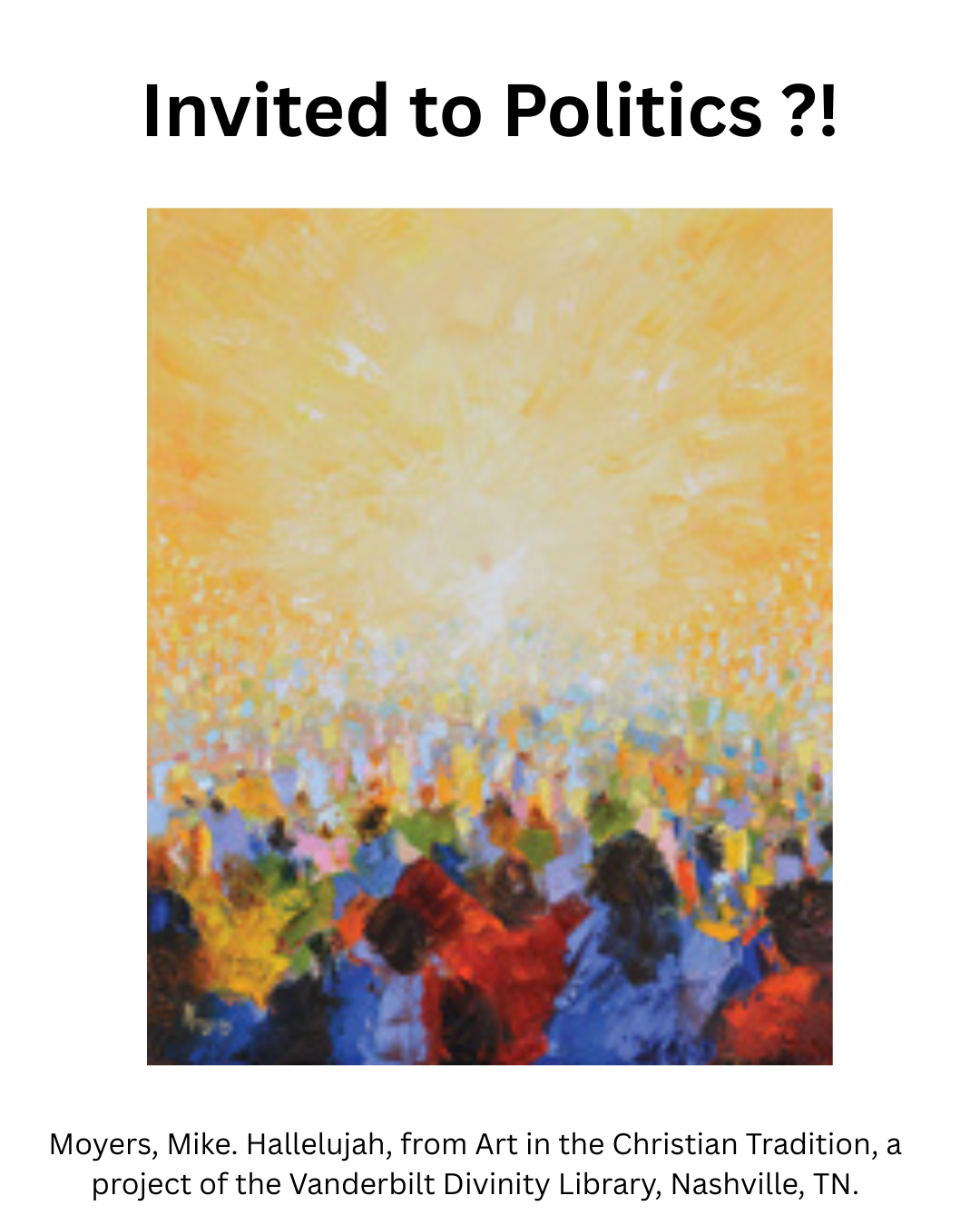
Words can and do have a variety of meanings. The word partisan means “a firm adherent to a party, faction, cause, or person especially: one exhibiting blind, prejudiced, and unreasoning allegiance.”1 While the term “politics” or “political” is often confused with “partisan”, politics simply has to do with how we organize ourselves and make decisions as a society.2 How will we distribute resources? How will we resolve differences? How will we care for each other? Or will we only care for ourselves?
Jesus has a lot to say about how we distribute resources, how we resolve differences, and how we care for each other. His teaching and example caused people to follow him. And his teaching and example caused the authorities to view him as a threat to society. Jesus isn’t partisan, but he is political. John’s gospel makes this particularly clear as it tells us about the days and weeks leading up to Holy Week.
We need to remind ourselves of a few things before we read John’s Gospel.
- The first century Roman Empire that Jesus and his followers lived in is quite different from the world we live in. Politics and religion were not clearly distinct entities in the ancient world. The Roman Empire was a political entity and it was a religious entity. People were expected to honor the Emperor with religious and civil ceremonies. Some Emperors were deified after death, some claimed divinity during their lifetime. 3 Our modern ideas about the separation of church and state were simply not present in the first century.
- The Roman Empire was not a democratic republic by the time of Jesus. 4 Empire wide elections didn’t happen. People could not vote. There was not an approved or protected way to criticize the empire or advocate for change. The Pax Romana was maintained by crushing dissent by military force. “Romans regarded peace not as an absence of war, but as a rare situation which existed when all opponents had been beaten down and lost the ability to resist.”5
- We also need to remember that the language and idea of “shepherd” was a religious and political concept. Commonly in the Old Testament, kings are referred to as shepherds- as either good or bad shepherds. Israel also understood God as the shepherd of Israel. 6 To call oneself a good shepherd, as Jesus did, implied political as well as religious leadership. It also implied that the Emperor was a bad shepherd. Similarly to call Jesus “Lord” was to imply that the Emperor was not “Lord”.
- “The head of the temple, the high priest, was de facto the head of government of Judea. He represented Judea in dealing with the ruling powers, collected taxes, and was responsible for the spiritual welfare of the people… After the rule of Herod the Great, the Roman prefects or procurators who rule in Judea (6041, 44-66 CE) appointed high priests, many of whom are said to have bought the office. Thus, wealthy priestly families created an oligarchy of power and prestige, and they were sometimes regarded by the Pharisees as Roman sympathizers.”7
- There were various expectations about what the Messiah would do when he came. Nearly everyone expected the Messiah to liberate them from Imperial rule and make Israel a free nation. How, exactly, the Messiah would do this was an open question. But that the Messiah would liberate Israel, politically and religiously, was expected. The Roman empire promptly and thoroughly and violently responded to any hint of a messianic movement.
With all this in mind, let’s look at what happens in the Gospel of John just before Holy Week.
In John 9, Jesus heals the man born blind8. In chapter 10 Jesus tells the Pharisees that he is the good shepherd and the true shepherd whose sheep will follow him. Others are thieves and bandits and strangers whom the sheep will not follow.9 Remember talking about a shepherd is not only religious but political.
Then Jesus is at the Festival of Dedication in Jerusalem and people ask him if he is the Messiah. Again Jesus talks about “my sheep”. He says that his actions show who he is. And Jesus says, “The Father and I are one.” and that he acts on God’s behalf. People attempt to stone him and Jesus leaves Jerusalem.10
Then Jesus raises Lazarus from the dead. People tell the Pharisees what Jesus had done11.
But some of them went to the Pharisees and told them what Jesus had done. So the chief priests and the Pharisees called a meeting of the council and said, “What are we to do? This man is performing many signs. If we let him go on like this, everyone will believe in him, and the Romans will come and destroy both our holy place and our nation.” But one of them, Caiaphas, who was high priest that year, said to them, “You know nothing at all! You do not understand that it is better for you to have one man die for the people than to have the whole nation destroyed.” He did not say this on his own, but being high priest that year he prophesied that Jesus was about to die for the nation, and not for the nation only, but to gather into one the dispersed children of God. So from that day on they planned to put him to death.
Jesus therefore no longer walked about openly among the Jews but went from there to a town called Ephraim in the region near the wilderness, and he remained there with the disciples.
Now the Passover of the Jews was near, and many went up from the country to Jerusalem before the Passover to purify themselves. They were looking for Jesus and were asking one another as they stood in the temple, “What do you think? Surely he will not come to the festival, will he?” Now the chief priests and the Pharisees had given orders that anyone who knew where Jesus was should let them know, so that they might arrest him. NRSVue John 11:46-57
The religious elite are worried that Jesus presents a threat to the Roman Empire and therefore he is a threat to the safety and existence of the entire nation. This is a legitimate worry. In 66 CE Rome does in fact destroy Jerusalem and the Temple.
What is Jesus saying and doing that is so dangerous? He is inviting people into a way of life that does not conform to Roman imperial values and culture. The Roman Empire was hierarchical with very few wealthy people at the top. Most people were poor. They were heavily taxed, not for public works or a public safety net but they were taxed to support the lifestyle of the rich. A large part of the food and goods they produced went to Rome. And there was nothing they could do about it. The Emperor installed King Herod. Any protests, agitation, or acts that could be interpreted as rebellious were violently ended.
Jesus did what the Emperor and the Empire would not or could not do. He fed hungry people. He healed the sick and injured. He upset and reset social norms of hierarchy and power. He was a religious and a political threat to the Empire. Not because he advocated violent revolution but because he empowered people to live in ways that subverted the imperial social order. The poor are blessed. The last are first. Love your enemy.
Six days before Passover, Jesus returns to the home of Lazarus, Mary and Martha. Mary anoints Jesus . Then Jesus goes to Jerusalem just before the Passover. The Passover is the celebration of liberation from Pharoah and unjust enslavement. God hears the cries of the people and intervenes to save them from bondage. It is a festival with both religious and political aspects.
My point in writing all this is not to deny the religious and spiritual significance of Jesus, he is the Messiah, the Savior of the world. But when we read the New Testament, Jesus is also very focused on the actual lives of people. He fed hungry people, he healed the sick and injured. He taught about economic justice. He cared about how people treated each other. This is all part of his proclamation of the kingdom of God, which is still to come and is now present.
Holy Week, Palm Sunday through Easter, draws all these spiritual and political themes together. If we pay attention to the gospels we cannot help but have our faith impact the ways we understand our lives together as humans in a particular time and place. We need to think and talk and pray about how we should live together at all levels of society. Yes, I mean politics.
To be clear, this is not an endorsement of Christian nationalism. In fact it is the opposite- as Jesus’ entry into Jerusalem makes clear. And that is the focus of the next post.
- https://www.merriam-webster.com/dictionary/partisan ↩︎
- The word “politic” comes from “Middle English politik, pollitique “of spiritual or secular governance, political, sagacious, prudent,” borrowed from Middle French & Latin; Middle French politique “of the state, political, of the regulation of social behavior,” borrowed from Latin polīticus “of civil government, political” (Medieval Latin, “judicious, prudent”), borrowed from Greek polītikós “of citizens, civic, made up of citizens, of a statesman, of a state, political, public,” from polī́tēs “citizen, freeman” + -ikos” , ēs “citizen, freeman” + -ikos, https://www.merriam-webster.com/dictionary/politic
see also, https://en.wikipedia.org/wiki/Politics ↩︎ - Jones, Donald. L. and Mark Allen Powell, “Emperor Cult”,in HarperCollins Bible Dictionary,Revised and Updated, 2011, Powell, Mark Allan, Ed. HarperOne, Kindle Edition,page 239-241. ↩︎
- https://education.nationalgeographic.org/resource/romes-transition-republic-empire/ ; https://www.pbs.org/empires/romans/empire/; https://en.wikipedia.org/wiki/Roman_Empire ↩︎
- https://en.wikipedia.org/wiki/Pax_Romana ↩︎
- Mattingly, Gerald L. “Shepherd” in HarperCollins Bible Dictionary,Revised and Updated, 2011, Powell, Mark Allan, Ed. HarperOne, Kindle Edition,page 950-951 ↩︎
- Schiffman, Lawrence H.”, priests”in HarperCollins Bible Dictionary,Revised and Updated, 2011, Powell, Mark Allan, Ed. HarperOne, Kindle Edition,pages 827-830. ↩︎
- https://conversationinfaith.com/2026/03/13/invited-to-see/ ↩︎
- John 10:1-21 ↩︎
- John 10:22-42 ↩︎
- https://conversationinfaith.com/2026/03/21/invited-to-life/ ↩︎
 Conversation in Faith
Leave a comment