Palm Sunday is the day Christians remember Jesus’ entry into Jerusalem. It is the start of Holy Week, which ends with the crucifixion of Jesus on Friday and his resurrection on Sunday.
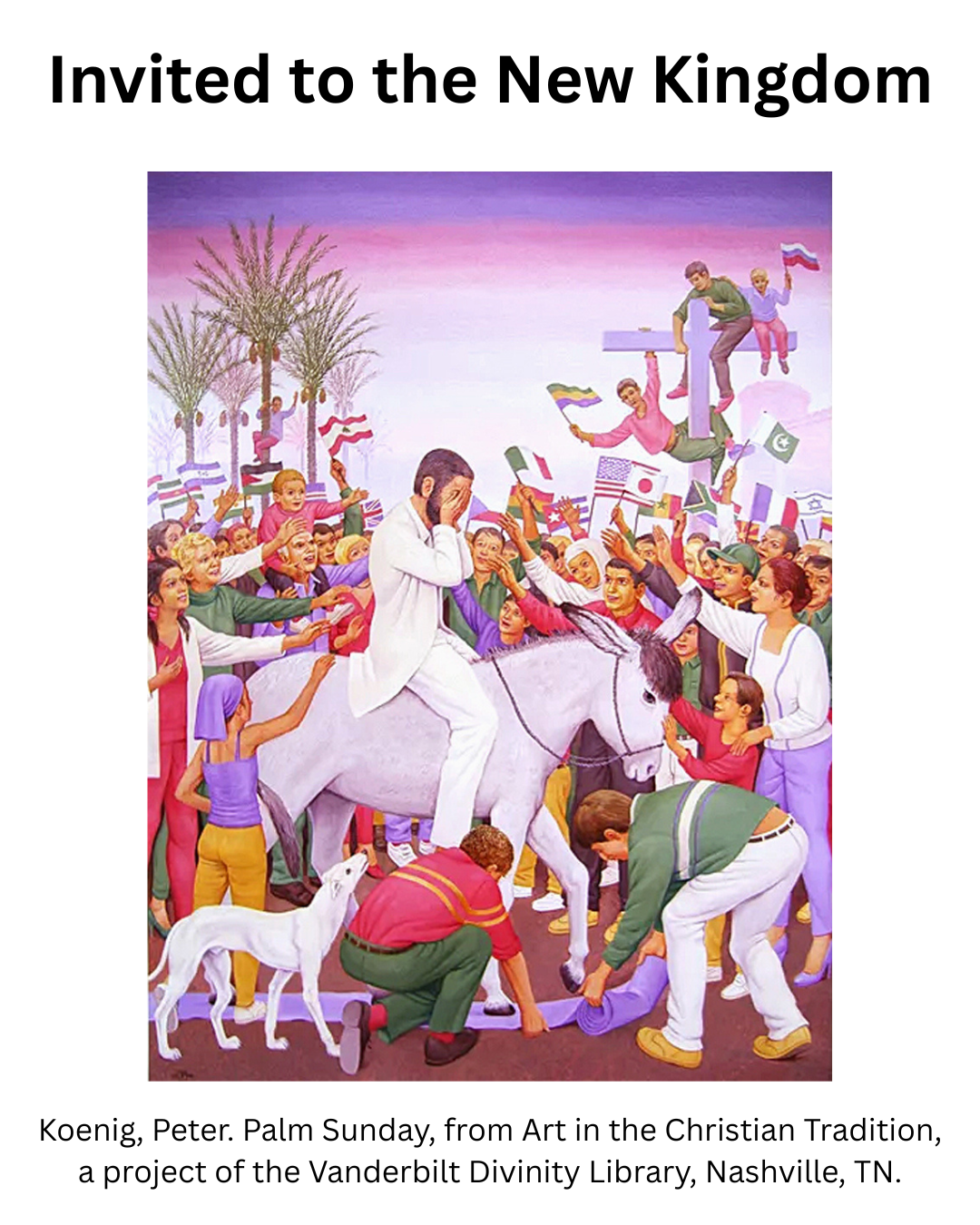
In the previous post,1 I wrote about how religion and politics were intermingled in the first century. The religious and political authorities wouldn’t have been concerned about Jesus if he was simply teaching about how to go to heaven after death. The problem was that Jesus was teaching about how to live in the world, right now, as if the kingdom of God was present. Jesus’ vision for life in the kingdom of God was in direct contradiction to the Roman Empire’s vision of life in the empire. Jesus’ entry into Jerusalem brings these conflicting visions into sharp focus.
Jesus enters Jerusalem just before the start of Passover. Passover is a religious festival that recalls and remembers God’s deliverance of the Jews from slavery in Egypt. It “became the festival of freedom and redemption par excellence. It served to give people hope in the face of physical and spiritual oppression, highlighting God’s acts of liberation and redemption.”2 Large numbers of people traveled to Jerusalem to celebrate the Passover, perhaps as many as one hundred thousand.3
It’s not surprising that the Roman authorities were concerned about such a large gathering of people in occupied land celebrating a festival of deliverance and freedom. It was common for Roman authorities to be in Jerusalem during various festivals. Roman military presence displayed its power and was there to quash any thoughts of liberation that might result in unrest. Some commentators suggest that while Jesus was entering Jerusalem from the Mount of Olives, Pilate was entering with his own royal procession in another part of town. Jesus entered proclaiming the kingdom of God. Pilate entered proclaiming the power of the Roman Empire.4
Processions of kings and conquering generals into cities were familiar spectacles and they had a recognizable structure. The king or general was escorted into the city by citizens and/or the person’s army. There were statements of acclamation. The procession was designed to proclaim the authority of the person. There were war horses, soldiers, and weapons. The entrance was followed up with an act that demonstrated their claim to the city, such as a sacrifice in a temple.5
Jesus and everyone else in Jerusalem knew what these processions looked like and what they meant. Notice how Jesus’ entry into Jerusalem proclaims another reality.
Here is the story of Jesus’ entry into Jerusalem from the Gospel of John. John’s telling us brief, but notice what he says.
The next day the great crowd that had come to the festival heard that Jesus was coming to Jerusalem. So they took branches of palm trees and went out to meet him, shouting, “Hosanna! Blessed is the one who comes in the name of the Lord- the King of Israel!”
Jesus found a young donkey and sat on it, as it is written: “Do not be afraid, daughter of Zion. Look your king is coming, sitting on a donkey’s colt.”
His disciples did not understand these things at first, but when Jesus was glorified, then they remembered that these things had been written of him and had been done to him. So the crowd that had been with him when he called Lazarus out of the tomb and raised him from the dead continued to testify. It was also because they heard that he had performed this sign that the crowd went to meet him. The Pharisees then said to one another, “You see, you can do nothing. Look , the world has gone after him!” John 12:12-19 NRSVue
Scholars tell us that, “Since the Maccabean period6, palm branches were symbols of national triumph and victory.”7 The word “Hosanna” means “Save us now”. Hosanna and “Blessed is the one who comes in the name of the Lord.” are from Septuagint version of Psalm 118. This is a Psalm of Thanksgiving for victory in battle. Verses 19-29 are the instructions for a processional ceremony.8 John tells us the crowd greets Jesus with the words, “the King of Israel”. There are also echos of the prophet Zechariah 9:9 “Rejoice greatly, O daughter of Zion! Shout aloud, O daughter Jerusalem! See, your king comes to you; triumphant is he, humble and riding on a donkey, on a colt, the goal of a donkey.”
All these signs combine to declare a particular message. The Pharisees don’t miss the political implications of this event. “You see, you can do nothing. Look , the world has gone after him!” Jesus is the true Lord and Caesar is not.
Often in our Palm Sunday worship children are given Palm branches and they may even enter worship together in imitation of the crowds that greeted Jesus. And that is not wrong. But Palm Sunday is more than a special Sunday service.
On Palm Sunday, we look back and we remember. We remember the kind of kingdom Jesus proclaimed. We remember the kind of king Jesus was, and as the risen Lord continued to be. We remind each other, through the waving of palms, that we are called to live into this Jesus kingdom way of life now.
To reduce Palm Sunday to merely a political act is to ignore its cosmic and eternal importance. Similarly, to restrict the importance of Palm Sunday to a future life after death is to ignore it’s mandate to work for justice and true peace in this world. We need to hold both together at the same time.
“Hosanna! Blessed is the one who comes in the name of the Lord- the King of Israel!”
- Unterman, Jeremiah and Mark Allan Powell, “Passover” in HarperCollins Bible Dictionary,Revised and Updated, 2011, Powell, Mark Allan, Ed. HarperOne, Kindle Edition,page 743-746. ↩︎
- Brown, Sherri, “The Gospel According to John” 1889, note on 2.13,The SBL Study Bible, NRSVue, Steven L. McKenzie, Kristin De Troyer, F. Scott Spencer, Gen Eds. HarperOne,2023 ↩︎
- The Final Week, Marcus Borg, John Dominic Crossan, (Harper Collins: 2009) Kindle Ed. location 115-149 ↩︎
- “The Gospel of Luke” R. Alan Culpepper, in The New Interpreter’s Bible, volume 9, Leander E. Keck, Ed. (1995: Abingdon Press) page 366-367 ↩︎
- see 2 Macc 10:7; 1 Macc 13:51. The Maccabean period was a time of Jewish self rule from 167 BCE to 63 CE. https://en.wikipedia.org/wiki/Maccabees ↩︎
- “The Gospel of John” Gail R. O’Day, in The New Interpreter’s Bible,Vol IX, Leander E. KEck, Ed. (1995:Abingdon Press) page707. ↩︎
- O’Day, 707 ↩︎
 Conversation in Faith
Leave a comment