Every time I read the resurrection story, no matter which gospel, I am struck by the absence of triumphalism, the absence of domination, the absence of abusive power in the stories. I shouldn’t be surprised. The resurrection is consistent with Jesus’ entry into Jerusalem and his response to the Devil’s temptations.1 If there was ever an occasion for Jesus to appear on the pinnacle of the Temple, or in the holy places of the Temple, the resurrection would be it. If there was an occasion to enter Jerusalem triumphantly, the resurrection was it. If there was ever an occasion to claim power and control over the world, this was it.
Instead we have stories of emptiness. There are no descriptions of the actual resurrection. No one actually sees Jesus’ triumph over death. What the disciples find is absence, an empty tomb. And they are perplexed.
As N. T. Wright explains, ” …[I]t is striking that the story bears no sign of anyone saying, ‘Ah yes, we should have expected this.’… the discovery of the empty tomb is not presented as the historicizing ‘explanation’ of a belief in Jesus’ resurrection, but as itself a puzzle in search of a solution. It is not that someone believes in Jesus’ resurrection and now finds an empty tomb to confirm that belief; it is, rather, that they have found and empty tomb and are offered the startling and totally unexpected explanation that Jesus has been raised. The resurrection interprets the tomb, not vice versa.”2
As John’s gospel tells the story, the disciples assume Jesus’ body has been stolen, or at least moved. They “did not understand the scripture, that he must rise from the dead.” (v8-9) So they all go home, which is such a human response. When you don’t know what to do, go home. Except Mary Magdalene. She had accompanied Jesus’ body to the tomb. She knew that’s where he had been laid. And she doesn’t leave.
Early on the first day of the week, while it was still dark, Mary Magdalene came to the tomb and saw that the stone had been removed from the tomb. So she ran and went to Simon Peter and the other disciple, the one whom Jesus loved, and said to them, “They have taken the Lord out of the tomb, and we do not know where they have laid him.” Then Peter and the other disciple set out and went toward the tomb. The two were running together, but the other disciple outran Peter and reached the tomb first. He bent down to look in and saw the linen wrappings lying there, but he did not go in. Then Simon Peter came, following him, and went into the tomb. He saw the linen wrappings lying there, and the cloth that had been on Jesus’s head, not lying with the linen wrappings but rolled up in a place by itself. Then the other disciple, who reached the tomb first, also went in, and he saw and believed, for as yet they did not understand the scripture, that he must rise from the dead. Then the disciples returned to their homes.
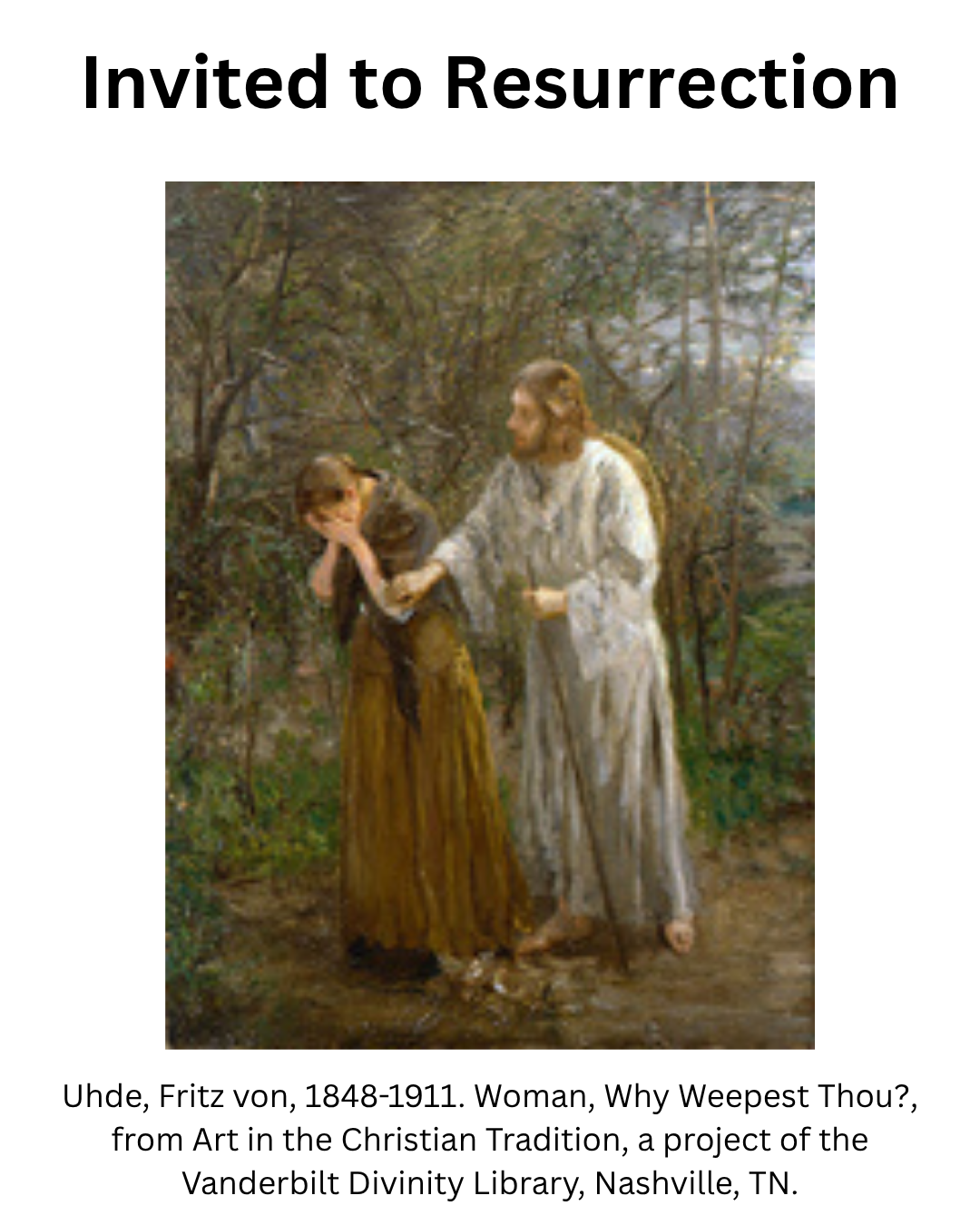
But Mary stood weeping outside the tomb. As she wept, she bent over to look into the tomb, and she saw two angels in white sitting where the body of Jesus had been lying, one at the head and the other at the feet. They said to her, “Woman, why are you weeping?” She said to them, “They have taken away my Lord, and I do not know where they have laid him.” When she had said this, she turned around and saw Jesus standing there, but she did not know that it was Jesus. Jesus said to her, “Woman, why are you weeping? Whom are you looking for?” Supposing him to be the gardener, she said to him, “Sir, if you have carried him away, tell me where you have laid him, and I will take him away.” Jesus said to her, “Mary!” She turned and said to him in Hebrew, “Rabbouni!” (which means Teacher). Jesus said to her, “Do not touch me, because I have not yet ascended to the Father. But go to my brothers and say to them, ‘I am ascending to my Father and your Father, to my God and your God.’” Mary Magdalene went and announced to the disciples, “I have seen the Lord,” and she told them that he had said these things to her. John 20:1-18 NRSVue
The life of the resurrected one is not a life of power over others or a life of glory. He doesn’t appear in the places of political or religious power. The resurrected Jesus takes the time to talk with Mary. He is patient with her. Jesus sends her to tell the other disciples about the resurrection.
The invitation to resurrection, while life changing, is not necessarily any more dramatic than hearing your name. And then knowing that Jesus is there with you, in your grief and in your joy. But that knowing, also, changes everything.
 Conversation in Faith
Leave a comment