Have you ever noticed how remarkably easy it is for us to assume that what Jesus said is what we want him to mean? As we read the gospels (and the rest of scripture, for that matter) we bring our assumptions and ideas about how the world should work to the text.
Having a set of expectations about how the world should be organized and structured, caused Jesus’ first audience to struggle with what he taught. The first century Roman Empire was patriarchal and hierarchical. Most governing systems in the world were kingdoms, tribes, or empires. It is hard to imagine a world other than the one you live in and know. But Jesus, consistently invited people, then and now, to imagine life in the kingdom of God, a kingdom unlike any other.
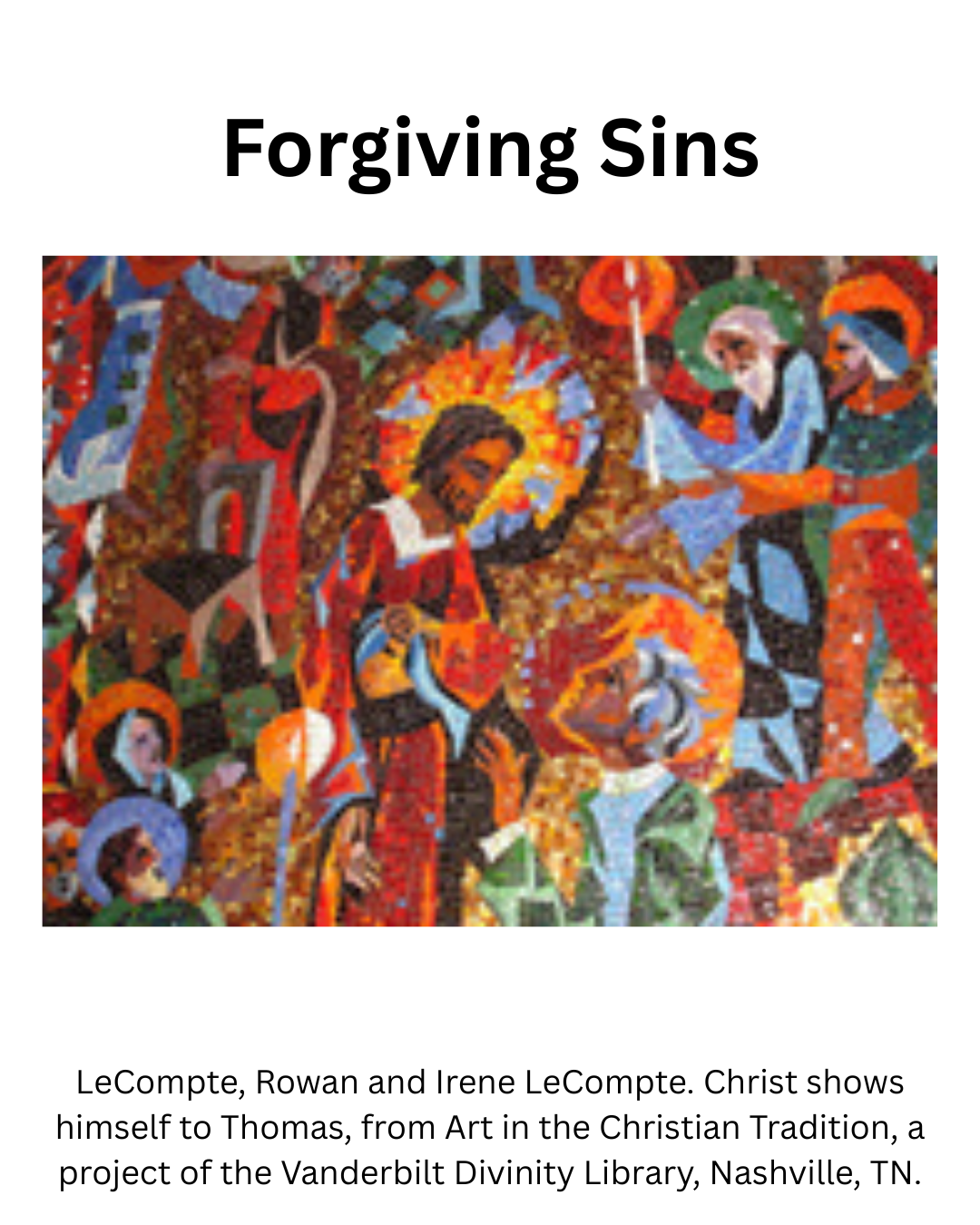
There are a few things we need to remind ourselves about before we read today’s story from the Gospel of John. First, is the phrase “the Jews”. John is not talking about all Jews. This is John’s shorthand way of talking about the religious authorities. Remember it is very likely everyone in the room with Jesus was a Jew. Speaking of everyone in the room, John’s phrase “the disciples” probably doesn’t mean only the 12, or now 11 male disciples. There may have been a larger number of people present and the group may include women.1 Also in John’s gospel, sin is not primarily about breaking rules or moral violations, sin is being alienated from God, not believing the good news that Jesus brings about God’s purposes for the world.2
The “evening on that day” was Sunday, the day Jesus appeared to Mary Magdalene and when she told the disciples that Jesus was risen.
When it was evening on that day, the first day of the week, and the doors were locked where the disciples were, for fear of the Jews, Jesus came and stood among them and said, “Peace be with you.” After he said this, he showed them his hands and his side. Then the disciples rejoiced when they saw the Lord. Jesus said to them again, “Peace be with you. As the Father has sent me, so I send you.” When he had said this, he breathed on them and said to them, “Receive the Holy Spirit. If you forgive the sins of any, they are forgiven them; if you retain the sins of any, they are retained.”
But Thomas (who was called the Twin), one of the twelve, was not with them when Jesus came. So the other disciples told him, “We have seen the Lord.” But he said to them, “Unless I see the mark of the nails in his hands and put my finger in the mark of the nails and my hand in his side, I will not believe.”
A week later his disciples were again in the house, and Thomas was with them. Although the doors were shut, Jesus came and stood among them and said, “Peace be with you.” Then he said to Thomas, “Put your finger here and see my hands. Reach out your hand and put it in my side. Do not doubt but believe.” Thomas answered him, “My Lord and my God!” Jesus said to him, “Have you believed because you have seen me? Blessed are those who have not seen and yet have come to believe.”
Now Jesus did many other signs in the presence of his disciples that are not written in this book. But these are written so that you may continue to believe that Jesus is the Messiah, the Son of God, and that through believing you may have life in his name. John 20:19-31 NRSVue
The disciples were afraid and the door was locked. Sometimes people are critical of this, accusing them of lacking faith. But I think it makes sense. There was no reason to assume that the authorities were not interested in arresting and executing Jesus’ followers. They could still have been perceived as a threat to the empire. In addition, Jesus’ body was gone and who was likely to be blamed and in trouble for that?
Jesus appeared to the disciples behind locked doors. As with Mary Magdalene in the garden, it took the disciples a moment to realize that it was Jesus. When they did recognize Jesus, he told them, “Peace be with you. As the Father has sent me, so I send you.” then he breathed on them and said, “Receive the Holy Spirit. If you forgive the sins of any, they are forgiven them; if you retain the sins of any, they are retrained.”
Some in the Christian tradition thought that Jesus was speaking to the 11 disciples and then assumed this meant that only they were charged with what we might call church discipline. It followed then, that subsequent leaders have the authority and responsibility to hold people accountable for sin or to absolve them of sin. These church leaders also had the authority to remove people from the fellowship of the church if they are insufficiently repentant, or have sinned too egregiously. 3 This reading comes out of an assumption about how the world works. It was assumed that a small group of male leaders would have control over everyone else. That was certainly how the world worked in the first century. This is certainly how certain churches and institutions work today. But that is not the only way to read this text.
If Jesus is speaking to the larger faith community of believers, this relocates the task of forgiveness from a few to the larger community. Jesus, persistently and consistently throughout all four gospels, teaches a non hierarchical way of life. Jesus taught the disciples not to exalt themselves. He taught them to serve others. 4 In John’s gospel Jesus washed the disciples feet. 5 In Jesus’ farewell meal in John’s gospel, Jesus repeatedly spoke about love. Twice he told the gathered community he was giving them a new commandment, “to love one another”.6 This love was to be the sign of the new community, “By this everyone will know that you are my disciples, if you have love for one another.”7 The disciples were no longer servants of Jesus, but now were friends, social distinctions based on status and hierarchy are done away with.8
Jesus regularly invited people into relationship, into friendship with him. He healed people whose conditions prevented them from fully participating in community. He ate with sinners. He invited people to change their ways and join in life in the kingdom of God. Jesus ate with and washed the feet of people who would desert and betray him. And here Jesus comes to frightened and hiding disciples bringing peace and the Holy Spirit.
I think Jesus, here, is telling the community, not to exclude, not to hold grudges, not to divide themselves. It would be easy, in those dangerous post crucifixion days to suspect each other, to doubt each other, to shame and shun. It would have been easy to quarrel over who fled and who remained faithful.
This is a call from Jesus to remain in community, even when people were not “worthy”. Even if they were fearful and frightened. Even if they were in danger. Pushing people out of community is not part of God’s desire for the world.
For the early church and for us, Jesus words about forgiving and retaining sins is not an excuse for us to create boundaries that enclose a pure and perfect community. It’s not permission to exclude people who think or act differently. That’s not to say anything goes. That’s not to say harmful behaviors or ideas should not be confronted and corrected. But still, we should be continually inviting each other to live more faithfully. We should be working towards the health, wholeness and healing of all people. Remembering that nothing separates us, any of us, from the love of God in Christ.
It is more difficult to include than it is to exclude. If I’m being honest, I would prefer to, at the very least, to ignore some folks I live next to or worship with or share a nation with. Staying in community, talking to each other, working out our differences is hard work.
And yet, this is the work Jesus calls us to. Jesus doesn’t give up on the disciples. They misunderstood. They got things wrong. They struggled to live faithfully. They abandoned Jesus. They denied knowing Jesus. They hid behind locked doors. They doubted.
Nevertheless, Jesus came to them. He came to them. He didn’t make them search for him. Jesus found them and brought God’s peace. He gave them the Holy Spirit. Then he sent them into the world to live and demonstrate the way of God’s love. They did not do this perfectly. They made mistakes. And the way of Jesus, which became the early church, grew because they lived the way of Jesus’ love. Forgiving. Reconciling. Caring for the poor, the sick, the hungry, those who society considered expendable.
People are to know that they and we are Jesus’ disciples by our love. What, in our time, does this love entail? The details may change but the charge remains. Love is the sign of the community of believers.
- “The Gospel of John” Gail R. O’Day, in The New Interpreter’s Bible, Vol IX, Leander E. Keck, Ed. (1995:Abingdon Press), 846, Carter, Warren, John: Storyteller, Interpreter, Evangelist, Hendrickson Publishers, 2006, 73-74.
Unlike the other gospels, the Gospel of John does not have a list of disciples. ↩︎ - Carter, 207-208; O’Day 663-665, 847. ↩︎
- O’Day 847, ↩︎
- Luke 22:24-27; Luke 14
:11; Matt 18:1-5, Matt 23:11-12, among many examples. ↩︎ - John 13:3-17 ↩︎
- John 13:34-35; 15:12. ↩︎
- John 13:35 ↩︎
- John 15:13 ↩︎
 Conversation in Faith
Leave a comment