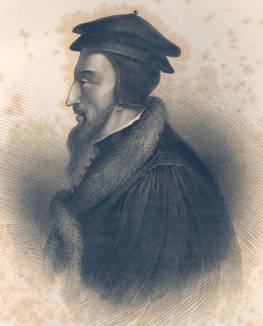
 No, its not a 70’s rock band. I mean the John Calvin (1509-1564).
The excerpt below is from Calvin’s Commentary on Genesis, (1554, Latin ed., 1578 English) ed.) This is what he has to say about Chapter 1, verse 16. of Genesis. Calvin, like others of his day, believed Moses wrote Genesis. They didn’t have any evidence to the contrary. As you read this, notice what Calvin has to say about astronomers and their discoveries and Scripture.
16. The greater lightI have said, that Moses does not here subtilely descant, as a philosopher, on the secrets of nature, as may be seen in these words. First, he assigns a place in the expanse of heaven to the planets and stars; but astronomers make a distinction of spheres, and, at the same time, teach that the fixed stars have their proper place in the firmament. Moses makes two great luminaries; but astronomers prove, by conclusive reasons that the star of Saturn, which on account of its great distance, appears the least of all, is greater than the moon. Here lies the difference; Moses wrote in a popular style things which without instruction, all ordinary persons, endued with common sense, are able to understand; but astronomers investigate with great labor whatever the sagacity of the human mind can comprehend. Nevertheless, this study is not to be reprobated, nor this science to be condemned, because some frantic persons are wont boldly to reject whatever is unknown to them. For astronomy is not only pleasant, but also very useful to be known: it cannot be denied that this art unfolds the admirable wisdom of God. Wherefore, as ingenious men are to be honored who have expended useful labor on this subject, so they who have leisure and capacity ought not to neglect this kind of exercise. Nor did Moses truly wish to withdraw us from this pursuit in omitting such things as are peculiar to the art; but because he was ordained a teacher as well of the unlearned and rude as of the learned, he could not otherwise fulfill his office than by descending to this grosser method of instruction. Had he spoken of things generally unknown, the uneducated might have pleaded in excuse that such subjects were beyond their capacity. Lastly since the Spirit of God here opens a common school for all, it is not surprising that he should chiefly choose those subjects which would be intelligible to all. If the astronomer inquires respecting the actual dimensions of the stars, he will find the moon to be less than Saturn; but this is something abstruse, for to the sight it appears differently. Moses, therefore, rather adapts his discourse to common usage. For since the Lord stretches forth, as it were, his hand to us in causing us to enjoy the brightness of the sun and moon, how great would be our ingratitude were we to close our eyes against our own experience? There is therefore no reason why janglers should deride the unskilfulness of Moses in making the moon the second luminary; for he does not call us up into heaven, he only proposes things which lie open before our eyes. Let the astronomers possess their more exalted knowledge; but, in the meantime, they who perceive by the moon the splendor of night, are convicted by its use of perverse ingratitude unless they acknowledge the beneficence of God.

Calvin was living on the cusp of the Copernican Revolution. By around 1512, Copernicus is circulating a manuscript, Commentariolus which advances the theory that the earth moves around the sun. Copernicus published De revolutionibus orbium coelestium in 1543 where he proposed what becomes known as the Copernican Theory. Galileo and his “problems” occur after this time. And Darwin is of course, much later.
Calvin really isn’t worried about what astronomers might discover. My hunch is that Calvin couldn’t imagine that science could discover anything that God wasn’t already, in some way, aware of. And, as Calvin writes elsewhere, God comes to us in ways that we can understand.
It seems to me, Calvin has a good approach to the science and religion debate. I’d like to know, what do you think?


 Conversation in Faith
Leave a reply to Orion Telescopes Cancel reply