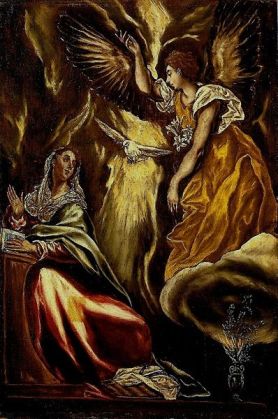
 One of the claims Christians make about Jesus is that he, as the Apostle’s Creed says, “was born of the Virgin Mary”. Both Nativity stories, Matthew and Luke, make this claim. People who want to defend the faith and debunk the faith write about this topic. Unfortunately people on all sides of the issue are prone to wonder off into unhelpful discussions. The church has historically mixed the virginal conception of Jesus with it’s thinking about sin and sex. People wishing to prove and disprove Christianity have attempted to “scientifically” discuss the “facts”. People point to other traditions and their miraculous conception stories as proof – either of some universal truth or of the gospel author’s complete lack of imagination.
Miracle? Fairy tale? Essential to the faith? Historical fact? Myth? Attempt to explain an inconveniently timed pregnancy? What to do with this odd story?
Here is what I suggest. First lets ask why the author of Luke tells us this. Why does this matter? He tells us three times in the space of 8 verses that the mother of Jesus is a virgin. “If it’s repeated, it must be important”.* We also need to consider how the author tells us. This means we should think about the literary structure of this carefully and skillfully told story.
There are alot of things we could discuss about the structure of the story, but today notice this. Luke starts with the story of John the Baptizer’s conception and birth. Elizabeth is barren. Zechariah and Elizabeth have been praying for a child and now God has answered their prayers. Why do we need to know this? Why is John’s conception important? The story of Elizabeth, Zechariah and John remind us of the other Biblical stories of special births and long awaited children. We remember the stories of Sarah, Rachel,and Hannah. We remember the lives of Isaac, Jacob, and Samuel. We have been given a way to think about who John was and what he was about.
Then Luke tells us about Jesus. What does he tell us? It is as if Luke says,”Remember all those special births? This isn’t one of those. This is not the latest in a line of special births.” Jesus is different, right from the start. For ancient biographers, nativity stories are more than a recitation of facts. The events that surrounded a great leader’s birth were important clues about who this person was and why they were great. The contrast between John and Jesus help us understand who Jesus is.
Luke is writing his gospel after the fact. This isn’t the 5 pm eyewitness news. Luke is writing to a small group of Christians with the aim of helping them make sense of who Jesus is. ” so that you may know the truth concerning the things about which you have been instructed” (Luke 1:4).
Part of what Luke wants us to understand is that Jesus did not become the Messiah, the Christ after the resurrection, 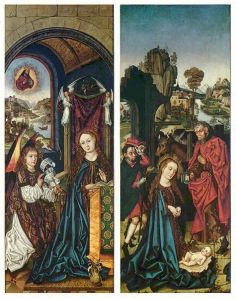 or at some point in his life. Jesus is the Messiah. There is no “becoming”, he is not made into the Messiah. he is not declared or appointed Messiah. Jesus doesn’t start as human and change into someone divine. Jesus is who he is right from the start. Jesus “is” the Messiah. He is unlike anyone else.
Luke, I think, also wants to be clear that even though other religions have stories of gods and humans mating; this is not what happened with Jesus. No matter what our religious belief, Jew or pagan, Luke wants us to understand, Jesus is unlike anyone else.
The virginal conception is not what causes Jesus to be the Messiah. The virginal conception is an expression of Jesus particular relationship with God. It is a way of saying the son of Mary is also the son of God. He is the Messiah, there is no one else like him.
When we debate the virgin birth and demand an anwer- possible or impossible – fact or fiction- we compress and reduce the activity of God to our simple ways of thinking.
We tend to forget that all of our language about God is inadequate. Whatever we say about God is less than the reality of God. I think that is our problem with the language of virgin birth. Our words are simply inadequate.
The author of Luke has an impossible job. He has to explain the unexplainable. How do you explain the incarnation? We don’t have language for that. We don’t have words to describe it. We can barely imagine it.
If you were Luke, what language would you use?
The Gospel According to Luke chapter 1,2
*Thanks to my Greek and New Testament professor, Warren Carter for repeating this several times in various classes.


 Conversation in Faith
Leave a reply to T Crosthwaite Cancel reply