The Parable of the Wise and Foolish Bridesmaids is familiar to many Christians. What were you told it means? What do you think it means?
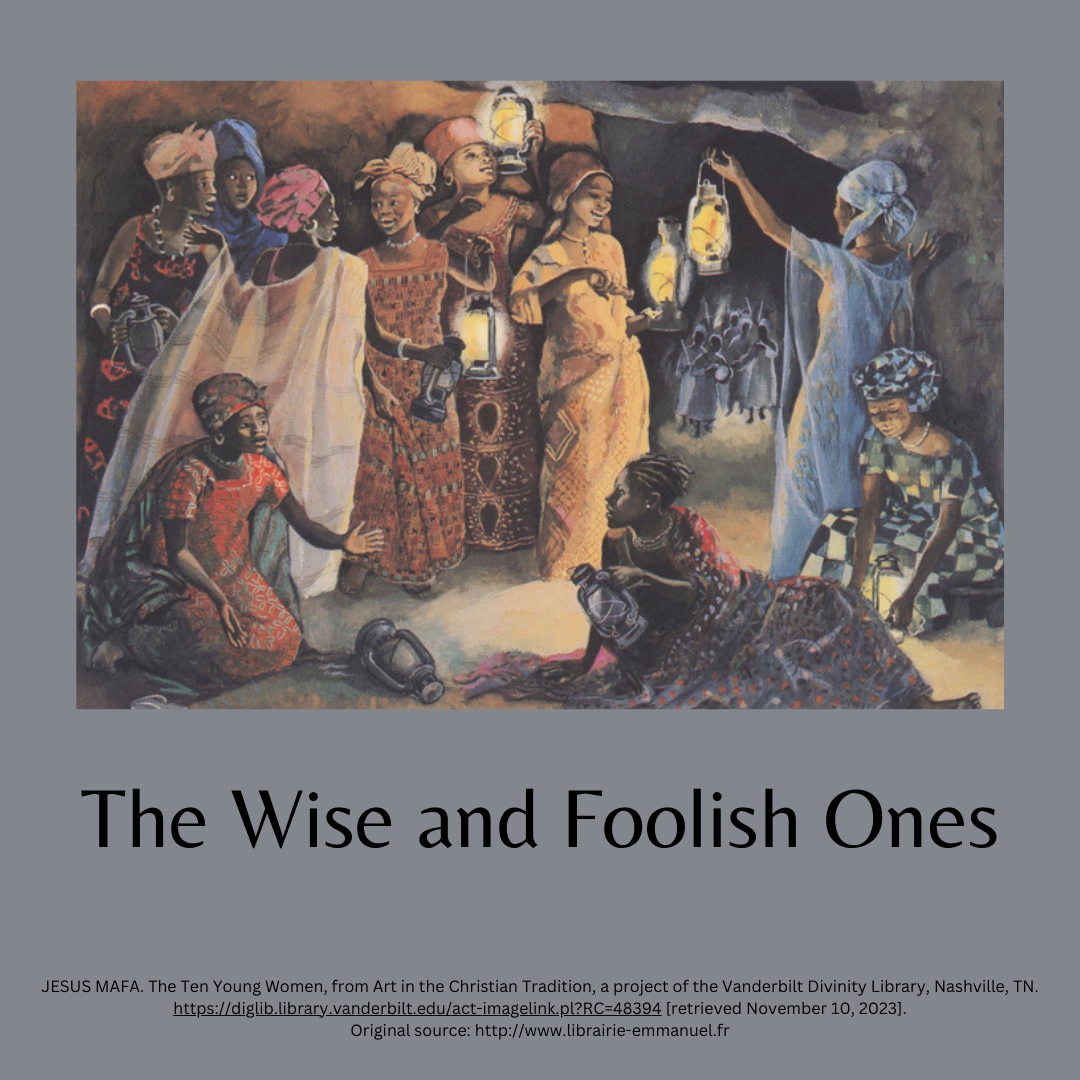
As always, we are going to begin by looking at where this text is placed in the gospel. It’s location and the text before and after it can help us understand it.
Jesus tells this parable during the week between his entry into Jerusalem and his crucifixion. It is part of what Bible scholars call Jesus’ fifth discourse1 found in Matthew’s gospel. The fifth discourse (Matthew chapters 23:1-25:46)2 is a series of parables, warnings, and teachings for Jesus’ followers that have to do with the time between Jesus’ resurrection and his return. Matthew’s gospel was probably written in the decade of 80 CE3. The stories, parables and warnings in the fifth discourse look to the recent past, to the gospel audience’s current situation, and to the future. Because the various parables and teachings are not clearly identified as to which time period they refer to we need to read them thoughtfully. The text, through Jesus’ words, wants to make clear that Rome, or any other empire, does not have the final word. The world belongs to God and God’s kingdom will come. Disciples need to be prepared, and ready for the coming kingdom of God, even though they cannot know the time of its arrival.
Jesus tells these stories to “insiders”, his disciples. Not the Jerusalem elites and not the crowds. That is a clue for us to guide our interpretation. These stories are not calling non believers to repent or to believe. These stories are for those who already believe.
When we look at the story itself, there are a few things to note.The categorizing of people as either “wise” or “foolish” is a standard Biblical way to talk about people who follow God’s will or who don’t. As readers, right from the start, we are pointed toward a particular interpretation.
Imagery about a bridegroom and bride is also commonly used in the Bible. In the Old Testament the bridegroom is God and the bride is Israel. In the early church the bridegroom is Jesus and the bride is the church.The traditional pairing is altered here. This story has a bridegroom. But there is no bride! Instead there are bridesmaids.
There are a couple of other odd things about this story. Having the bridegroom (only, again no bride) delayed and arriving at the wedding banquet at midnight is unusual. Another odd thing is that the wise bridesmaids don’t share their oil with the foolish ones. You might expect, if the wise bridesmaids are doing God’s will that they would share what they have. Sending the foolish bridesmaids off to buy oil is also interesting. Who in the first century CE went to the shops at midnight?
As readers we need to decide if these deviations from what we might expect are significant or not. Do they signal something important that we should pay attention to, or are they altered to narrow the focus of the story to its main point?
Most bible scholars think that Jesus’ early followers expected him to return fairly quickly. But in these chapters of Matthew’s gospel, Jesus is telling his followers there will be a delay. Remember, Matthew’s gospel is written somewhere around 80-100 CE, fifty plus years since Jesus’ death and resurrection. In chapter 24 Jesus has, more than once, told the disciples that no one knows when the Messiah will return. The parable right before this one (Matthew 24:45-51), praises the slave in charge of the household for faithfully taking care of their responsibilities and condemns the slave who behaves badly.
The parable of the wise and foolish bridesmaids offers a similar but slightly different perspective. All the bridesmaids are ready for the bridegroom – as long as they don’t have to wait too long. Everyone has some oil. What is the “oil” in this story4? Perhaps the oil stands in for what we might call “good works” or faithful living. The oil may signify active working to bring about God’s will. Faithful living is not a physical item, like food, or shelter, that we can pass on to another. The ones with enough oil remained focused and prepared until God’s kingdom finally came.
Why bridesmaids and no bride? Perhaps this is just to remind us that we are disciples with others? Working for God’s kingdom is done with others.
All the bridesmaids fall asleep and that isn’t criticized. In other stories, falling asleep is a problem. Is sleeping in this parable a way to talk about duration? Do bridesmaids need to pace themselves so they can keep doing the work of God?
When the bridegroom finally comes, some, the foolish, are in a panic because they aren’t adequately prepared. The wise are not panicked, because they are ready. Those who have steadily been doing God’s will, those who have persistently worked to bring about the kingdom of God, can rest when appropriate. And they don’t need to be anxious or panic when the bridegroom comes no matter how unexpected. They are prepared.
Perhaps this is a parable reminding the disciples to be ready for the “long haul” To borrow a phrase, to be ready for a marathon, not a sprint.
The kingdom of God is often referred to as a wedding banquet so it’s not a surprise that the wise bridesmaids go into the banquet. But what about the foolish? When they returned from trying to buy oil, the banquet doors were shut. When they asked to be let in, they were told, ” ‘Truly I tell you, I do not know you.’ Keep awake therefore, for you know neither the day nor the hour.” These verses echo back to Matthew 7:21-23,5 and seem to warn us about false discipleship. We are reminded that discipleship, faithful living requires some effort, some attention and that while we can rest, we also need to continue to actively follow Jesus.
Parables are meant to provoke thought and discussion. This one, it seems to me, is advising us to remain focused, diligent, and persistent in our life as disciples. What thoughts does this parable prompt for you?
- Matthew has his gospel organized into a narrative story containing five distinct sections of Jesus’ teaching. ↩︎
- The weekly lectionary has skipped over some text between last week’s text (Matthew 23:1-12) and this week’s (Matthew 25:1-12) ↩︎
- It is difficult to precisely date Biblical texts. Many would date the Gospel of Matthew anywhere from 70 CE to 100 CE, with a time in the 80s a frequent choice. ↩︎
- Thanks to Warren Carter for reframing “oil” from a material object to a way of living. Matthew in the Margins: A Sociopolitical and Religious Reading Warren Carter, Orbis Books,p 486 ↩︎
- ‘Not everyone who says to me, “Lord, Lord”, will enter the kingdom of heaven, but only one who does the will of my Father in heaven. On that day many will say to me, “Lord, Lord, did we not prophesy in your name, and cast out demons in your name, and do many deeds of power in your name?” Then I will declare to them, “I never knew you; go away from me, you evildoers.” Matt 7:21-23 ↩︎

 Conversation in Faith
Leave a reply to Linda Male Cancel reply