Do you know? How long is the story of Jesus’ birth in Matthew?1 Its eight verses. The genealogy was 17 verses and it sets us up for the birth of a king. But the birth story simply starts talking about Mary and Joseph, with no indication of who they might be or where they live. Mary is unexpectedly pregnant. Joseph had planned to quietly end their engagement, but he listens to an angel who appears in a dream. The only being who speaks in this account is the angel. Joseph’s actions are described but he doesn’t speak.
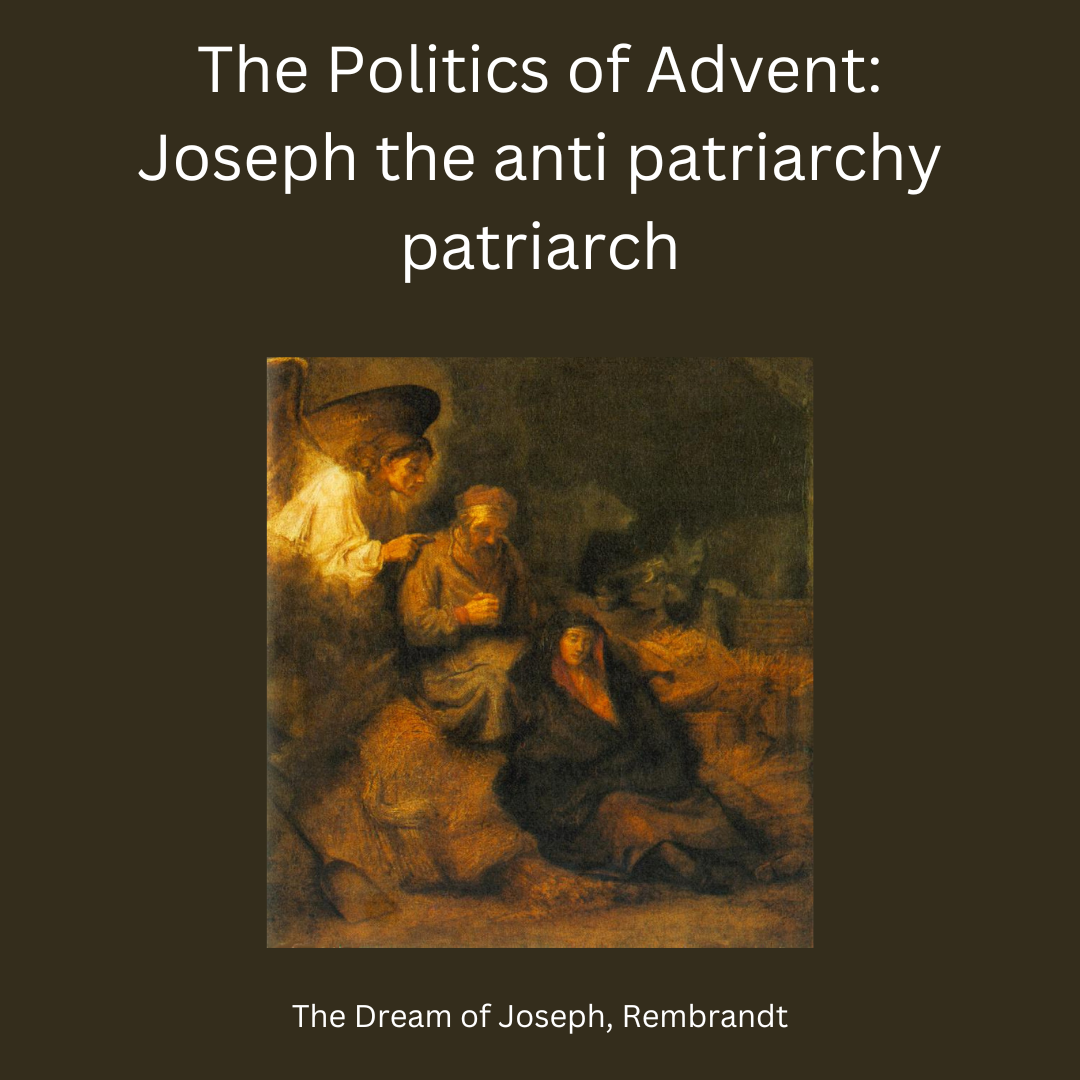
Joseph is described as righteous, which also carries overtones of justice. Notice that righteous Joseph does not follow cultural and religious norms. Being righteous means Joseph considers Mary’s situation and tries to do what will be best for both of them.
In the genealogy, Joseph is named as the son of Jacob, which- probably- is to remind us of the Joseph of the Old Testament/Hebrew Bible. That Joseph had dreams from God and obeyed them. That Joseph is called a son of David. By accepting and naming the child, this Joseph of Matthew’s gospel adopts Jesus into David’s line.
The author of Matthew intentionally connects the story of Jesus to the history of Israel. The genealogy is one way the connection is made. Another way is by using citations of Hebrew Bible texts. There are 10 of these citations in Matthew’s gospel, five of which are in the birth narrative. Matthew really wants us to understand how the story of Jesus continues and connects to the story of Israel. We need to recognize that people in the ancient world used different criteria to select a citation than we might. The reference in Matthew 1:22-23,
“All this took place to fulfil what had been spoken by the Lord through the prophet:
‘Look, the virgin shall conceive and bear a son,
and they shall name him Emmanuel’,
which means, ‘God is with us.’ “
refers to Isaiah 7:142. To modern readers, it can be difficult to see the connection. We have to accept that ancient people worked with their texts differently than we might. The Isaiah text is a text of assurance that God will deliver God’s people through the birth of a child and that serves Matthew’s purposes.
The virgin birth is a traditional Christian belief3. For some Christians, the virgin birth is a fundamental and crucial belief. Others have difficulties with it. Thinking about why Jesus’ birth is presented this way can help us move past the “did it happen” question. Ancient people knew where babies came from. And also in the ancient world there were well known stories about other supernatural, “irregular” births. That the birth of an important person, such as the messiah, was described as atypical would not have surprised ancient people.
As Christians we believe that Jesus holds a unique place in the world, fully human and fully divine. So the Christian tradition has not wanted to say that Jesus is nothing more than another human born of human parents and we also don’t want to say that Jesus is God pretending to be human. How do we speak of both these things? Using the language of virgin birth is one way. We don’t have a term for someone like Jesus. He is unique and we need some creative language to talk about his uniqueness.
The focus as Matthew tells the birth story is on divine action, a virgin birth, and angelic visit and at the same time the full cooperation and participation of human people who need to make decisions about how they will act and react to unusual and challenging circumstances.
Joseph deserves some acknowledgment for his actions that resist cultural norms. He is presented in this chapter and the next as a faithful person. Joseph, just as the earlier Old Testament patriarchs, is obedient to God’s guidance. Abraham, Jacob, Moses and others follow God’s surprising and often unsettling instruction. Joseph stands in the long tradition of faithful patriarch of the faith.
At the same time, he doesn’t follow the cultural expectations (religious and societal) of his time. He had a pregnant fiancee, in a society where women are to obey fathers and husbands, and where honor and shame are guiding social structures. Joseph ignores all this to follow God’s lead. Joseph stands up for Mary and the baby of questionable parentage.
We would do well to consider how church and society treat people who don’t follow cultural and religious expectations. And we would do well to consider the courage and strength of character this took.
- https://bible.oremus.org/?ql=569317950 ↩︎
- https://bible.oremus.org/?ql=569392148 ↩︎
- To read about the translation in Isaiah 7 of “virgin” or “young woman” see New Interpreter’s Bible Commentary Vol VIII, Abingdon Press page 135 and Matthew and the Margins: A Sociopolitical and Religious Reading by Warren Carter, Orbis Books page 71 ↩︎


Leave a comment