The Bible urges us to be intentional and thoughtful about what we do and how we do it.1 Paradoxically for some of us, being thoughtful and intentional- can result in inaction. We can get caught in an endless loop of questioning and reflection that never results in a decision to act. There is always new information or a new insight to process. And we wonder, do we know enough to act wisely?
This happens to us as individuals and as communities, groups, and congregations. My particular group of Christians ( Presbyterian Church USA) can ask questions and study issues in great depth and with great care, but we can get trapped in indecisiveness and then struggle to make a decision and act. In addition much of Christianity, as practiced in the US, emphasizes a personal, individual response to the gospel. This is not wrong but it is insufficient. All this helps us avoid taking action, both as individuals and as a society. Because, honestly, it’s easier to do nothing.
But the Bible and the Holy Spirit are determined not to let us get away with dithering or excuses or half measures or inaction. This week’s lectionary2 texts are a case in point. They are an example of how God’s call for justice is found throughout the Bible. Read the texts using the links in the footnotes: Proverbs 22: 1-2,8-9, 22-233, Psalm 1254, James 2:1-175, Mark 7:24-376. I hope you see a theme.
The Letter of James, in particular is quite directive about faith and action. We might try to wiggle out of our responsibilities, but the author of the letter of James is not going to give us a pass. We might try to individualize what James writes, but doing so creates an artificial distinction between individual and community actions. Communities are made up of individuals. When enough of us act as individuals, ultimately the entire community has acted. The author of James is addressing a community and not just an individual.7
Sometimes we like to point out that James is a letter to and for a Christian community. We might treat this like a loophole which relieves us of responsibility for people outside our community. But we’re not off the hook. Yes, James is correct, we should not make distinctions within the church based on wealth (2:2-4). We should be sure our siblings in faith have food, shelter, and clothing. And we need to become aware of the ways, both subtle and obvious, where we privilege wealthy members over poor members- because we do.
The church is where we learn to do better. It’s our opportunity to practice and grow. Once we see how the wealthy are privileged and the poor dishonored in one place, we can more easily see when it happens in other places.
A careful reading of the Letter of James tells us we must expand our care outside the church and the faith. The author reminds us what Torah and Jesus taught, “You shall love your neighbor as yourself.” We read that and we remember what Jesus taught in the parable of the good Samaritan8. Our neighbors are not only members of our own faith. Our neighbor is the one we do not know. Our neighbor is the one we thought was our enemy. There are no limits, and no borders in this neighborhood.
James, in this passage goes on to say, “What good is it, my brothers and sisters, if you say you have faith but do not have works? Can Faith save you? If a brothers or sister is naked and lacks daily food, and one of you says to them, “Go in peace; keep warm and eat your fill,” and yet you do not supply their bodily needs, what is the good of that? So faith by itself, if it has no works, is dead. (James 2:14-17 NRSV)
So what does this mean for us, in the United States9 in 2024? As Biblical texts often do, it carries many meanings. It means individual acts of care and compassion. And it means congregational works of care and compassion. It also has national implications. Remembering who our neighbors are will also impact how we think about caring for the poor and hungry and unhoused as a nation. Yes, I’m talking about politics. Because politics is how we organize and care for each other at a larger level10. I am making a distinction between “politics” as the way we organize our society and “partisanship” which promotes one party over another. Now it may happen that your understanding of politics- how we organize and care for each other may currently align more with one party over another, but those alignments change over time. Ultimately the ethics that guide personal actions also inform what sort of citizens we are.
We are just 8 weeks away from election day. We will be voting to fill positions at all levels of government. President, US House and Senate, State Houses and Senates, Mayors, City Councils, School boards, County Commissions, Judgeships, and more.
Many of us are frustrated by “politics”. There’s too much silliness and too much meanness and too much focus on the trivial. The issues are complex and there aren’t simple answers. There are no ideal candidates. They all have flaws. They will all make mistakes. But they are who we have, and they are the ones who will be making the decisions that shape our future.
I recently read that voting is like getting on the bus. You know where you want to go. The bus probably won’t get you exactly where you want to go, but it will get you close. And it will get you closer than if you didn’t get on the bus at all or got on a different bus altogether. Each of us has an idea about the kind of country we want to live in. Which bus will get us closer to our destination? We’re talking about movement towards a goal, not perfection.
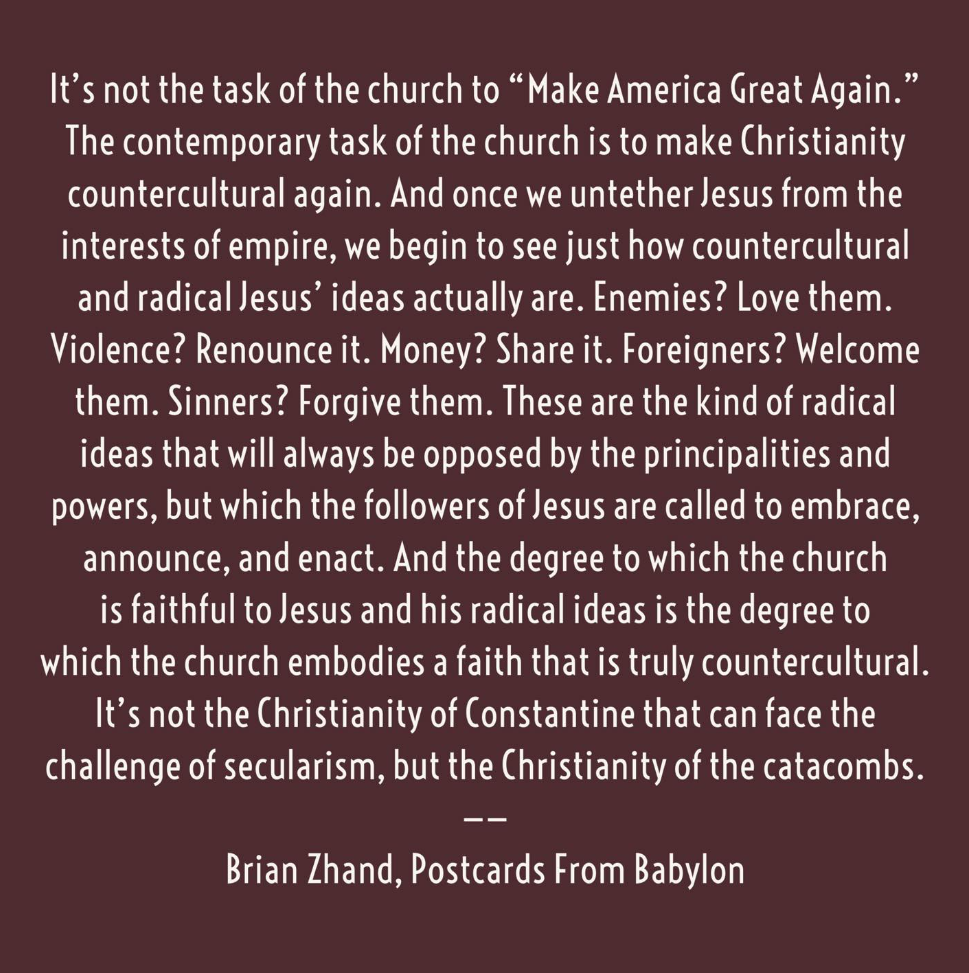
How do we approach voting as people of faith? Personally, I don’t think Christians should necessarily vote in our self interest. I don’t think we are called to defend Christianity. I do think we should try to hold a vision of what Jesus taught and talked about. It seems to me that as Christians, our responsibility as voters is to cast our vote for what benefits the poor, and the stranger, the hungry, the unhoused, those in need of access to medical care, and education. Our charge is not to impose a Christian way of life- whatever that is… Our charge is to love our neighbors by working to create a society where all are respected and cared for.
The kind of faith informed action that Jesus calls us to is not a top down imposition of rules. Jesus never tells his followers that they are to rule in this world. That’s what the disciples and others expected the Messiah to do and Jesus repeatedly tells them they’re wrong. Jesus talks about sacrifice and service, not power and control.11
Jesus doesn’t teach that everyone has to do exactly what he says. He does his best to persuade people. And yet, he lets people walk away, he doesn’t force behaviors or compliance. Jesus’ way is to heal, and feed, and to restore community, working from within not from outside or above.
It is said that “fear not” is one of the most common phrases in the Bible. These days there are certainly appeals to fear in our national and local discussions. Candidates and pundits paint scenarios steeped in fear. Fear of the loss of power. Fear of the “other”. “They are coming…”. “They are going to take….” But should our votes be cast from a place of fear of the other? That’s not what Jesus teaches. Jesus calls us away from fear and from power. Jesus calls us to solidarity with the poor and the “other” in our midst.
As you consider your vote, consider which candidates will move us closer to the sort of community Jesus envisions. Cast your vote out of love and for love.
- See last week’s post as an example. ↩︎
- One of the reasons to follow the lectionary is that it causes us to read passages we might otherwise skip over. ↩︎
- https://bible.oremus.org/?ql=592389521 ↩︎
- https://bible.oremus.org/?ql=592389580 ↩︎
- https://bible.oremus.org/?ql=592389678 ↩︎
- https://bible.oremus.org/?ql=592389678 ↩︎
- In this passage, for example, all the “you”s are plural. ↩︎
- Luke 10:25-37 ↩︎
- If you are reading this and you are not in the US, I’m not going to presume to tell you what to do in your context. ↩︎
- (see US history for multiple examples.) ↩︎
- see for example Matthew 20:25-28, Mark 9:33-37 among many examples ↩︎


Leave a Reply