When we read Biblical texts (any texts for that matter) we want to pay attention to what is said, and to what is not said. We need to consider what is expected and what is unexpected. With familiar texts and stories we all tend to read with our assumptions and previous learning in place. This week most churches will mark the day of Pentecost and most will read from Acts 2:1-21. It’s a familiar text for many of us. Let’s try to set aside what we “know” and focus on what is said and unsaid.
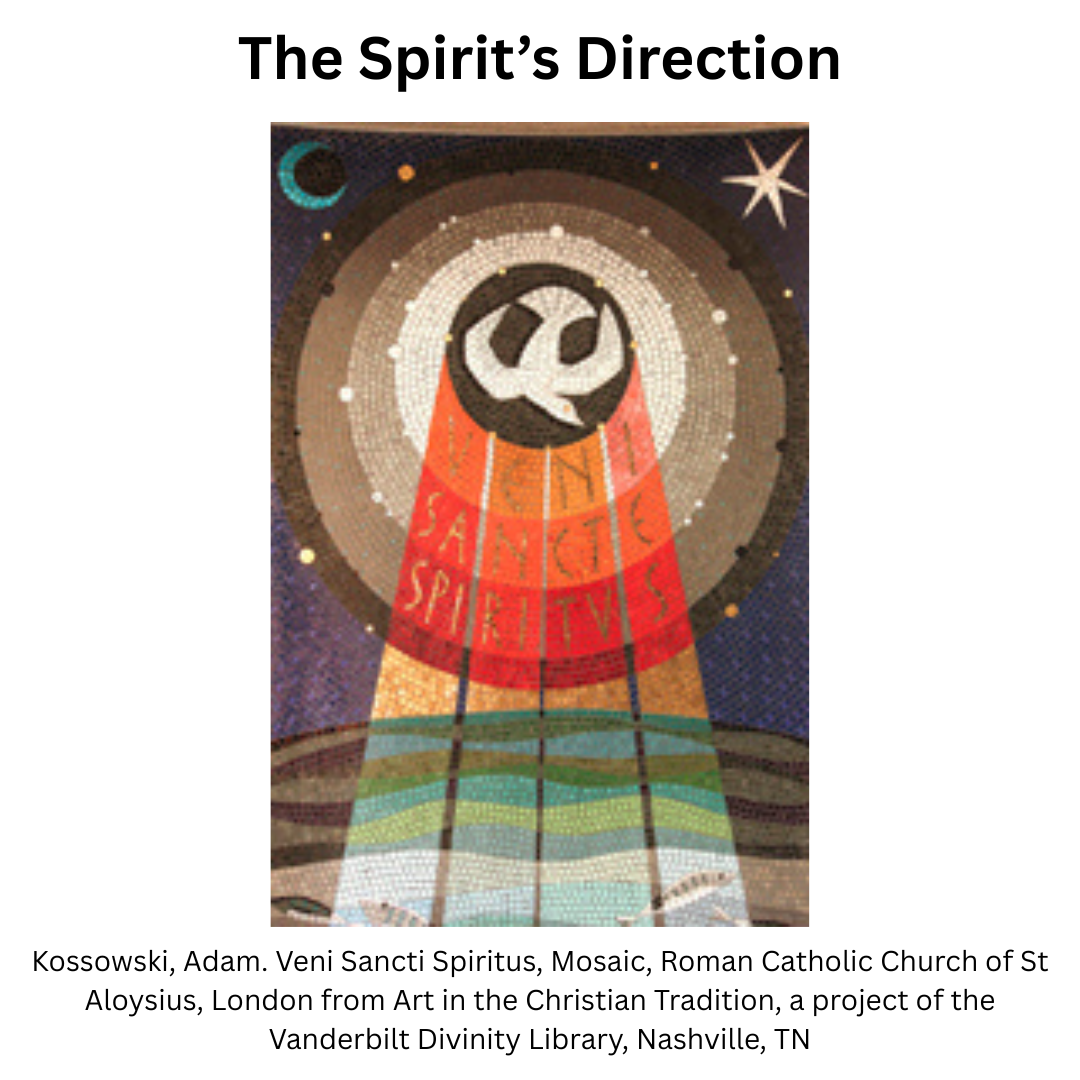
When the day of Pentecost had come, they were all together in one place. And suddenly from heaven there came a sound like the rush of a violent wind, and it filled the entire house where they were sitting. Divided tongues, as of fire, appeared among them, and a tongue rested on each of them. All of them were filled with the Holy Spirit and began to speak in other languages, as the Spirit gave them ability.
Now there were devout Jews from every people under heaven living in Jerusalem. And at this sound the crowd gathered and was bewildered, because each one heard them speaking in the native language of each. Amazed and astonished, they asked, “Are not all these who are speaking Galileans? And how is it that we hear, each of us, in our own native language? Parthians, Medes, Elamites, and residents of Mesopotamia, Judea and Cappadocia, Pontus and Asia, Phrygia and Pamphylia, Egypt and the parts of Libya belonging to Cyrene, and visitors from Rome, both Jews and proselytes, Cretans and Arabs- in our own languages we hear them speaking about God’s deeds of power.” All were amazed and perplexed, saying to one another, “What does this mean?” But others sneered and said, “They are filled with new wine.”
But Peter, standing with the eleven, raised his voice and addressed them, “Fellow Jews and all who live in Jerusalem, let this be known to you, and listen to what I say. Indeed, these are not drunk, as you suppose, for it is only nine o’clock in the morning. No, this is what was spoken through the prophet Joel:
‘In the last days it will be, God declares, that I will pour out my Spirit, and they shall prophesy. And I will show portents in the heaven above and signs on the earth below, blood, and fire, and smoky mist. The sun shall be turned to darkness and the moon to blood, before the coming of the Lord’s great and glorious day. Then everyone who calls on the name of the Lord shall be saved.’ (Acts 2:1-21 NRSVUE)
As we think about what happens at Pentecost, we should also remember Jesus’ ascension. Here is part of the conversation between Jesus and the disciples just before the ascension.
“So when they had come together, they asked him, “Lord, is this the time when you will restore the kingdom to Israel?” He replied, “It is not for you to know the times or periods that the Father has set by his own authority. But you will receive power when the Holy Spirit has come upon you, and you will be my witnesses in Jerusalem, in all Judea and Samaria, and to the ends of the earth.” ( Acts 1:6-8 NRSVUE)
The expectation for a Messiah was that they would, somehow or another, restore the kingdom of Israel. Somehow or another Israel would be freed from Roman occupation. And so, the disciples ask an obvious question, “When? When will you Make Israel Great Again?1” Jesus reply is essentially, “Don’t worry about that. Your task is to be my witnesses. Your task is to spread my teaching and message.” Jesus refocuses the disciples. He orients them away from nation building and away from nation controlling. Jesus focuses them on living and proclaiming the way of Jesus, the way of love and reconciliation, regardless of nationality, regardless of social, political, or economic status.
Then the day of Pentecost came. Pentecost (The Jewish festival is actually, Shavout) was a festival that occurred 7 weeks after the second day of Passover2. It was a festival, like Passover and Sukkot, where Jews traveled to Jerusalem to celebrate. For the disciples, the large crowds gathered in Jerusalem presented an opportunity, this was a time to talk about the way of Jesus.
If the mission was the restoration of the nation of Israel, we might have expected the reverse of what happened. Instead of people hearing the disciples speak in their own native language, wouldn’t they all hear and understand one language, Hebrew or Aramaic? Wouldn’t a unified nation have a unified language? Wouldn’t we expect the movement to be away from diverse languages in a variety of countries to the language and nation of Israel? We might expect the Spirit to bring people into conformity, “unity” rather than the Spirit adapting and adjusting to diversity. But that’s not what happened. Instead of bringing people into conformity, the gospel message goes out in a variety of languages, respecting the diversity that existed.
The list of nations listed is interesting, not least because it includes some nations that did not exist when Acts was written (e.g. Parthians, Elamites). Some of the “nations” listed were not nations but more like groups (e.g. Cretans and Arabians).3 This is a theological statement about the Christian mission. The mission is not making all the nations or any one nation Christian. The mission is spreading the message of Jesus throughout the world. The mission is not confined to time and place, or existing nations and groups. The way of Jesus is bigger than we can imagine.
Peter’s speech in response to the Spirit’s actions and peoples’ amazement and confusion is to begin by quoting the prophet Joel.4 Peter makes an interesting adjustment to the verses he quotes. This is the text as it appears in Joel.
“I will show portents in the heavens and on the earth, blood and fire and columns of smoke. The sun shall be turned to darkness and the moon to blood, before the great and terrible day of the Lord comes. Then everyone who calls on the name of the Lord shall be saved , for in Mount Zion and in Jerusalem there shall be those who escape, as the Lord has said, and among the survivors shall be those whom the Lord calls”.
Peter changes the day of the Lord’s coming from “the great and terrible day” to “the great and glorious day”. He ends his quote cutting off the end of the original text, “for in Mount Zion and in Jerusalem there shall be those who escape, as the Lord has said, and among the survivors shall be those whom the Lord calls”. Peter makes changes that opens up who is saved more broadly than the original text. He has reinterpreted Joel’s statement about the day of the Lord from judgement and salvation for a few to inclusion and happy anticipation.
Don’t be alarmed by this. Judaism has a long tradition of reinterpreting their texts. And for that matter so do Christians, starting with Jesus who reinterprets Torah in terms of himself and who extends Torah’s commandments. For example, “You have heard it said… but I say to you”5 Jesus, himself, calls us to move expansively forward in our understanding of what it means to follow God’s commands. Paul, also, spends a lot of time reinterpreting the received understandings about the Messiah so that they “fit” better with Jesus.6
What does all this mean for us, in our times?
The direction of the gospel is outward and expansive. It is liberative not oppressive. It invites people to a way of life rather than legislating actions.
There is much that can be (and will be) said about the heresy of Christian Nationalism7. But let’s start with this. Jesus and the apostles were not interested in nation building. They were not about Making Israel Great Again. Or making Israel a Christian nation. Or about making any nation a Christian nation. And that includes the United States.
On Pentecost the Spirit showed up and made herself known to people in their own language. Jesus sends the disciples out to make disciples, not to overthrow the government, not to take over towns and villages, not to force people to believe. Yes they told people about Jesus. They wanted people to believe and they wanted people to live faithful lives. They understood that God’s love is for all people and is not coercive. God doesn’t force people to believe and behave. God doesn’t expect us to force people to believe and behave.
Pentecost has many important things to teach us. Not least about the nature of the kingdom of God. As Jesus said, his kingdom “does not belong to this world…my kingdom is not from here.”8 This doesn’t mean that following Jesus doesn’t impact and shape how we live in the world. We are not called to disengage from the world. We are called to Jesus’ non coercive way of love. A way that embraces the variety and diversity of the world.
- Just so we’re all clear, my use of “Make Israel Great Again” is not to be interpreted as a comment (positive or negative) about the modern state of Israel. It is a comment on the slogan “Make America Great Again”. ↩︎
- The Jewish festival is Shavuot ↩︎
- “The Acts of the Apostles” Robert W. Wall, page 56, in The New Interpreter’s Bible, Volume X, Abingdon Press,2002 ↩︎
- The book of Joel is difficult to date. There are not clues in the text itself. Most scholars think it dates sometime after the Exile when Israel was under Persian rule. In extremely general terms, the prophet talks about a devastating locust plague, God’s restoration from the plague and also salvation from outside invaders and enemies. ↩︎
- Jesus talks about himself as the culmination, the fulfillment of Torah see Matthew 5: 17-48 ↩︎
- There are too many examples to cite here. In Romans, for example, Paul spends a lot of time reinterpreting how to think about Abraham and circumcision, and the Law. Or 1 Cor 8 where Paul reinterprets food. ↩︎
- Christian Nationalism is a diverse movement but some unifying characteristics can be identified. Christian Nationalists agree that US laws should be based on Christian values, being Christian is an important part of being truly American, The US government should declare America a Christian nation, If the US moves away from our Christian foundations,we will not have a country anymore, and God has called Christians to exercise dominion over all areas of American society. See the PRRI survey on Christian Nationalism. ↩︎
- John 18:36 ↩︎


Leave a comment