I usually post on Fridays, as you probably know. I’m a few days late because of “things in life1” but the text is important and, as always, I have some thoughts.
This story in Luke starts in an odd way. Jesus has been talking about the cost of discipleship to thousands of people (Luke 12:1- 13). He tells them even if (or perhaps when) they are brought before the authorities, disciples are not to be afraid. They are of more value than many sparrows and the Holy Spirit will guide them. And then a guy says, “Teacher, tell my brother to divide the family inheritance with me.” Where does that come from?
Someone in the crowd said to him, “Teacher, tell my brother to divide the family inheritance with me.” But he said to him, “Friend, who set me to be a judge or arbitrator over you?” And he said to them, “Take care! Be on your guard against all kinds of greed, for one’s life does not consist in the abundance of possessions.” Then he told them a parable: “The land of a rich man produced abundantly. And he thought to himself, ‘What should I do, for I have no place to store my crops? Then he said, ‘I will do this: I will pull down my barns and build larger ones, and there I will store all my grain and my goods. And I will say to my soul, Soul, you have ample goods laid up for many years; relax, eat, drink, be merry’ But God said to him, ‘You fool! This very night your life is being demanded of you. And the things you have prepared, whose will they be?’ So it is with those who store up treasures for themselves but are not rich toward God.” Luke 12:13-21 NRSVue
Often this parable is discussed in terms of personal greed. The rich man’s problem is not that he is wealthy but that he doesn’t help others out of his abundance. In a word, he’s selfish. As far as he is concerned, as long as he is personally okay, everything is fine. His responsibility is to himself and perhaps to his family (although a family is not mentioned.)
We often think about Jesus’ parables and teaching in terms of individual actions and behaviors. That’s not wrong, but it is also incomplete. Often Jesus’ parables and teaching use stories about individuals to illustrate and critique societal problems.
Luke has already told us that thousands of people are present. This would not be a crowd of wealthy people, it’s not even a crowd of middle class folks. There was literally a wealthy 5-10 % and then everyone else2. The crowd knew this parable was not about them. They did not have anything to hoard. Before you can tear down barns and build bigger ones, you need to have some sort of barn, and something to put in it.
What about the guy who asked Jesus to arbitrate his family inheritance dispute? We might be tempted to say he was motivated by greed. Or perhaps he was simply asking for justice as society defined it. I wonder, if under everything else he was afraid. Afraid that he wouldn’t get what was his. Afraid that there wouldn’t be enough. Afraid that if he didn’t have something of his own, he would be vulnerable, and at risk.
The guy asks and Jesus’ response is that he didn’t come to make the status quo more fair. He didn’t come to improve the current system. He didn’t come to enforce the rules.
Jesus is here to start something entirely different. His parable is about society, and it is about society’s rules and norms and expectations. Throughout the gospels, Jesus has hard words for the rich and the well off. There is not a prosperity gospel theology in the actual gospels.
A rich man, a rich nation has plenty and wants to figure out the best way to keep what they have. “The land of the rich man produced abundantly…”. What an interesting phrase. Not that the man worked hard, or was prudent or anything else. The land produces and the rich man assumes all the produce is his. He decides to keep what is believes is his and build bigger barns to store it all- his grain and his goods. He doesn’t sell it. Is he waiting for supplies to dwindle so he can get a better price? We don’t know. He doesn’t give any of it away. He keeps it all. And now he has enough for many years. He can relax.
Plenty of us can relate to this way of thinking. If you are near retirement age do you have enough saved to retire? If you are just starting out will you be able to pay off student loans or be able to afford a place to live? If you become sick, will medical bills bankrupt you? In a world with increasingly fewer and thinner safety nets, it can feel like the rich man was also a wise man. The question of the man, asking Jesus to help him get his part of the family inheritance, can feel reasonable. These may seem like reasonable questions. And they are prudent questions, given the systems we live in.
The Gospel tells us this fear based greed, the fear that I have to be sure that I have enough, and some extra- just in case- is not the kingdom of God. But it is scary to try to step out of this way of living, especially when everything in society tells us that this is just how things are. If you don’t provide for yourself and your family, who will? Who will help you when hard times come? The answers are increasingly frightening and push us to a fear and greed based way of living. And yet, Jesus calls us toward something completely different.
The kingdom of God calls for an entirely different way of reckoning. As Jesus says before and after this parable, life in the Kingdom of God means that everyone has enough.
If we think of the rich man as a society or a nation, what does this parable say? It’s both straight forward and challenging. The way of life of rich nations that ignore the economics of God will come to an end. One may be part of the rich elite. One may live in a rich country. But if there is not food, and security, and rest, and enjoyment for all, it will not last- because this is not the will of God for humanity.
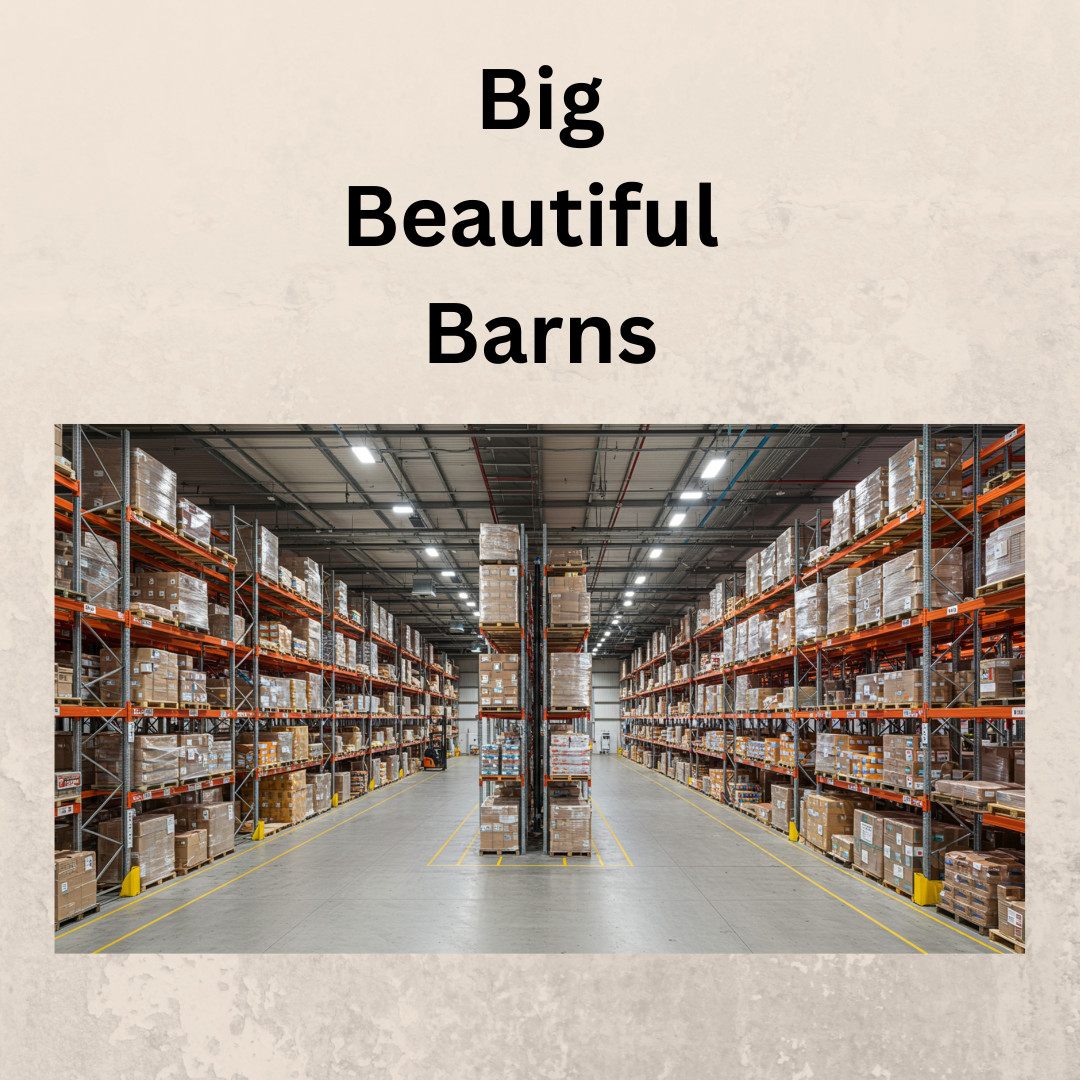
A nation that affirms and encourages continual, never ending striving for more: money, power, control is not the will of God for God’s beloved creation, particularly when the money, power, and control is concentrated in the hands of a few people. A “Big, Beautiful Bill” that concentrates more wealth in the hands of the wealth, and strips away protections for the vulnerable, is our current version of tearing down barns and building bigger barns. The desire for unimaginable wealth and power are resulting in actions that take away access to food assistance, and health care. That terrorize migrants, and people of color and LGBTQ people. That defund and gut entire federal departments concerned with public health, food safety and security, ending aid that saves lives around the world, and we could go on… All designed to concentrate power, money, and control in the hands of a few. Greed.
The United States has never been a perfect nation. But there were times that we did try to do better. Tearing down structures and institutions that have tried to make our nation a “more perfect” nation, are the actions of rich men who don’t realize that they benefited from institutions and systems that they didn’t build. The rich man’s land “produced abundantly”. Look at what the text says. His land produced abundantly. There is no indication that he had much to do with that abundance. Any abundance was the result of the work of others and part of God’s providence for all. And yet, he takes it all as his due.
Jesus’ parable isn’t just about one rich guy. It is about a society where the rich horde more and more. Where the goal is to “relax, eat, drink, [and] be merry” without concern for anyone else. It is about a society where a person worries about an inheritance out of fear or greed, or both because to not have enough leaves him vulnerable. Look at the language of the rich man. “I”, and “my” repeated over and over. Not a word, not a thought for anyone else. It is about a society that is based on greed and fear that results in a society based on accumulating power and money- “winning”.
The parable is clear, they may build big beautiful barns, but it won’t last. God says to the barn builder, “You Fool! This very night your life is being demanded of you. And the things you have prepared, whose will they be?” So it is with those who store up treasures for themselves but are not rich toward God.”
“Fool” is Bible talk for a person who denies or rebels against God3. In this case, concern for accumulating wealth and the power it brings rather than participating in God’s economy where everyone matters and is cared for.
In our country now, the barns are being torn down. Some of them are piles of scrape. Some of them are shaky and teetering. New barns that look like ballrooms and prison camps are being built. We now have barns to store crypto. If you donate enough to the building of new barns, you get access to power and influence. This plundering will, at some point, come to an end, although many have and will suffer from the cruelty.
A system built on fear and greed can’t last. And so then what? What do we build next? What sort of nation do we want to be?
People talk about making America great again. As if greatness will be found in a return to the past. Christian nationalists talk about making America a Christian nation. This means various things to various Christian nationalists. At the very least it means imposing a particular set of values on everyone. And it often means privileging white Christian men over everyone else.
But if we want to talk about Christian values, if we want to define “great” as Jesus did, we need to look at Jesus and what he taught and what he did. He fed people, and healed people without means testing or work requirements. Little children were safe, in every sense of the word, with him. To be great was to serve others, not dominate them. He taught and lived a vision of a world where God’s Shalom was present for everyone, regardless of who they were and regardless of their religious beliefs (or no religious beliefs). And the powers of the world were not happy with him.
Rebuilding a nation is a daunting task. As is doing what we can to stop the slide into the destruction of our most foundational national values. No one of us can do all of it. But we do need to think about what the next barns, the next institutions, and agencies, and schools, and free press could be. What sort of society do we want to live in? Then we each need to discern what is ours to do. None of us can do it all. But each of us can do something. Perhaps it begins with us thinking about what Jesus means when he talks about being “rich toward God”.


 Conversation in Faith
Leave a comment