“Consider the ravens: they neither sow nor reap, they have neither storehouse nor barn, and yet God feeds them. Of how much more value are you than the birds? … Consider the lilies, how they grow: that neither toil nor spin, yet I tell you, even Solomon in all his glory was not clothed like one of these. But if God so clothes the grass of the field, which is alive today and tomorrow is thrown into the oven, how much more will he clothe you, you of little faith! And do not keep seeking what you are to eat and what you are to drink, and do not keep worrying. For it is the nations of the world that seek all these things, and your Father knows that you need them. Instead, seek his kingdom, and these things will be given to you as well.”1
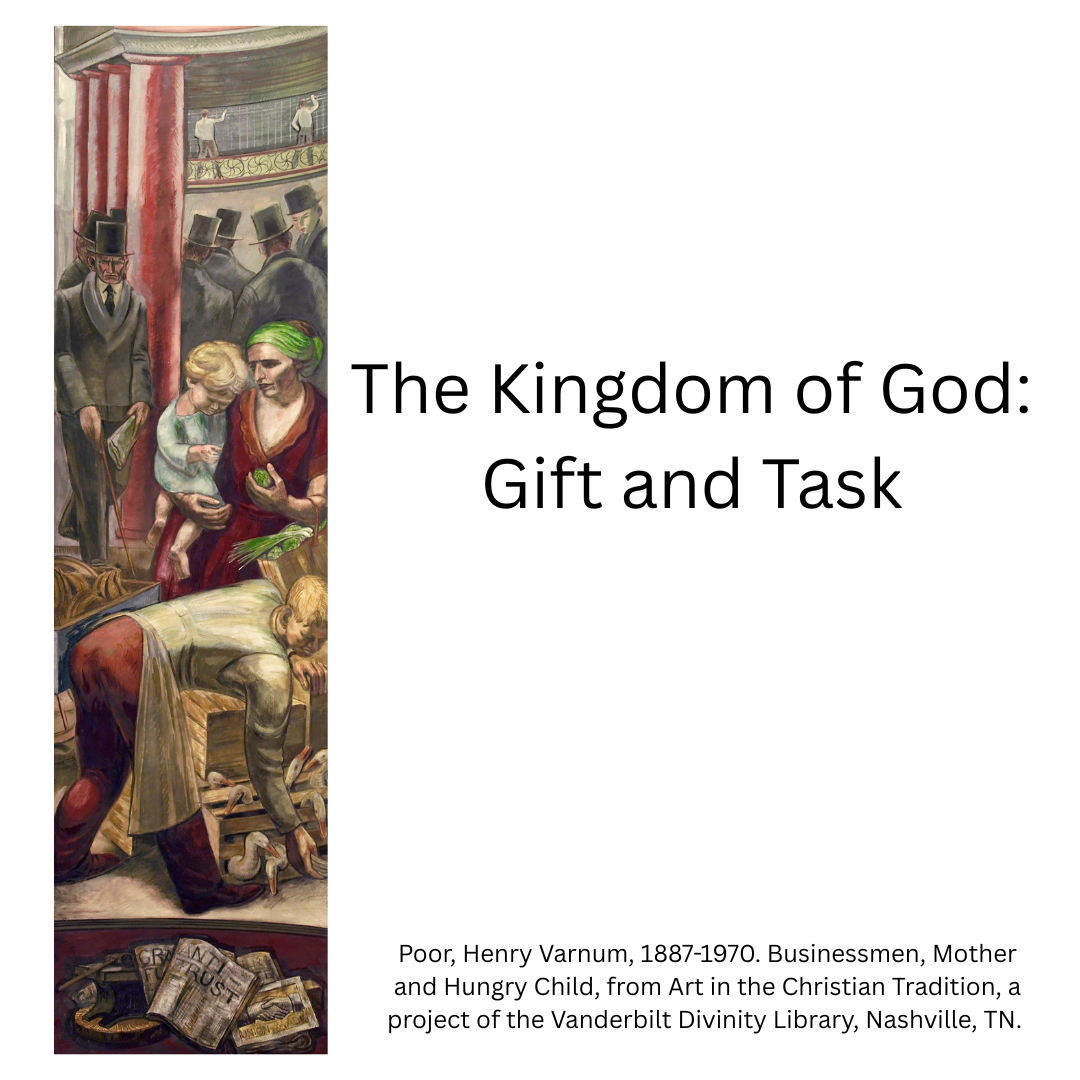
These are fairly familiar verses. How have you heard them used? To encourage you not to worry? Just trust because God would provide? Or was there a hint of judgement, along the lines of, if you had more faith, you wouldn’t be worried. And what about people who actually do not have enough to eat? How could they not be worried? Why does Jesus say these things?
Interestingly, this discussion about not worrying comes directly after Jesus tells the parable about the rich man who tears down his barns and builds bigger barns. And it comes just before a parable about being ready and watching for the master to return from a wedding banquet. Just after that parable, Jesus tells another parable about a delayed master and faithful or unfaithful slaves2.
Then Jesus says this:
Do not be afraid, little flock, for it is your Father’s good pleasure to give you the kingdom. Sell your possessions and give alms. Make purses for yourselves that do not wear out, an unfailing treasure in heaven, where no thief comes near and no moth destroys. For where your treasure is, there you heart will be also.
Be dressed for action and have your lamps lit; be like those who are waiting for their master to return from the wedding banquet, so that they may open the door for him as soon as he comes and knocks. Blessed are those slaves whom the master finds alert when he comes; truly I tell you, he will fasten his belt and have them sit down to eat, and he will come and serve them. If he comes during the middle of the night or near dawn and finds them so, blessed are those slaves.
But know this; if the owner of the house had known at what hour the thief was coming, he would not have let his house be broken into. You must be ready, for the Son of Man is coming at an hour you do not expect. Luke 12:32-40 NRSVue
What does tearing down barns, and being dressed for action have to do with not worrying? If we keep the surrounding parables and “don’t worry” sayings together, what might we discover?
The nations seek after food and clothing and they worry. Jesus tells his listeners that it is God’s “good pleasure to give you the kingdom.” The kingdom of God is not a far off, far away place where Jesus’ followers go after they die. The kingdom of God is where God rules and God’s will happens. People in Jesus’ day expected the Messiah to bring the kingdom of God to earth. Heaven and earth re-joined and re-connected. That’s what the parable is about. It’s not waiting passively to die. Or waiting passively to be whisked away from earth. The master is coming here, bringing the kingdom, right where we are. We need to be dressed for work with our lamps lit ready to receive the master. “[B]e dressed for action with lit lamps is ‘Bible talk’ for us to be on task, working for the kingdom. As NT Wright and Michael Bird write, “Our working hypothesis is that the kingdom of God is not from this world, but it is emphatically for this world.The Church’s kingdom-vocation is not only what is says to the world, but it is what the Church does within and for the sake of the world.3
The Church exists for the sake of the world, working for the kingdom. At a bare minimum in God’s kingdom all people have enough food to eat. They have access to health care. They are physically and emotionally safe. All people have adequate shelter. And of course the kingdom does not stop there. In God’s kingdom we are all cared for as the lilies and ravens are. It’s the nations (Luke 12:30) that seek to control these things. It’s the nations that build bigger barns to hoard and profit. In the Kingdom of God there is no need to control or hoard.
I think what Jesus is asking us to do in these parables and sayings is for us to imagine a better way. Not to feel guilty about our concerns for life’s necessities. We are asked to imagine life in the Kingdom of God and work for it, work toward it. And to, as best we can, disentangle ourselves from the powers and principalities and systems and structures that strive to harm and control people. Can we stop going along? It’s impossible to completely step out of the systems we live in. But can we do better?
In the middle of Jesus’ parable is this line, Blessed are those slaves whom the master finds alert when he comes; truly I tell you, he will fasten his belt and have them sit down to eat, and he will come and serve them. The kingdom of God is never about power over and control over. God comes with food and rest for all. God’s kingdom comes in unexpected ways where the master serves the slaves.
While it’s hard trying to step out of the status quo, there are things we can do. This will look different for each of us. Small acts of resistance add up. Small acts of positive Christian witness add up. Every time we feed hungry people. Every time we stand up for migrants. Every time we stand up for Trans people. Every time we stand up for the environment or public schools or free and fair elections4. Pick your area of concern. Every email, every phone call. Every march. Every city council or school board meeting we attend. Every act of kindness. Every cup of cool water. Every time we do not comply in advance. Every time we look and actually see a service worker, the grocery store clerk and the unhoused person on the street. Every time we refuse to be afraid. Every time we act even though we are afraid. None of us can do all of this. All of us can do some of it. All of it matters.
Then Jesus says what at first glance is an odd thing, “But know this; if the owner of the house had known at what hour the thief was coming, he would not have let his house be broken into. You must be ready, for the Son of Man is coming at an hour you do not expect”.
I don’t think we should assume the “master” and the “owner of the house” are the same person. Think about when the devil tempts Jesus and offers him “all the kingdoms” and offered “all this authority and their glory”.5 The devil claims ownership, but he is not the master. The “master” and the “thief” might be the same person. The people who currently rule the world are doing everything they can to preserve their power and impede the coming kingdom. They are not taking the work of the Spirit and our work for the kingdom seriously because it’s not a power move. And that arrogance of the powerful may just be their downfall.The kingdom of God doesn’t bully or strong arm it’s way into power. It comes in from the margins, from the edges, from below. It rises quietly and hope filled.
Do not be afraid little flock. It is your Father’s good pleasure to give you the kingdom.
- Luke 12: 24, 27-28,29,30 NRSVue ↩︎
- Luke 12:41-48 https://bdev.oremus.org/?ql=621605837 ↩︎
- NT Wright, Michael F. Bird, Jesus and the Powers, Zondervan 2024, page 7 ↩︎
- You might wonder what elections have to do with the kingdom of God. Briefly it’s this, in the Kingdom of God people are not coerced or forced into actions or decisions without their participation and consent. There is no imposed hierarchical power. ↩︎
- Luke 4:5-8 NRSVue ↩︎


Leave a Reply