Imagine being one of the disciples. One Sunday they are entering Jerusalem with Jesus as the crowd shouts “Blessed is the king who comes in the name of the Lord! Peace in heaven, and glory in the highest heaven.” 1 By Friday, the king has been crucified by the empire. By Sunday, his body is missing. I know, Jesus had told them he would be killed. But surely he didn’t mean crucified, dead, and buried? That was simply unthinkable, unimaginable. And so they didn’t think it was possible. Until it happened.
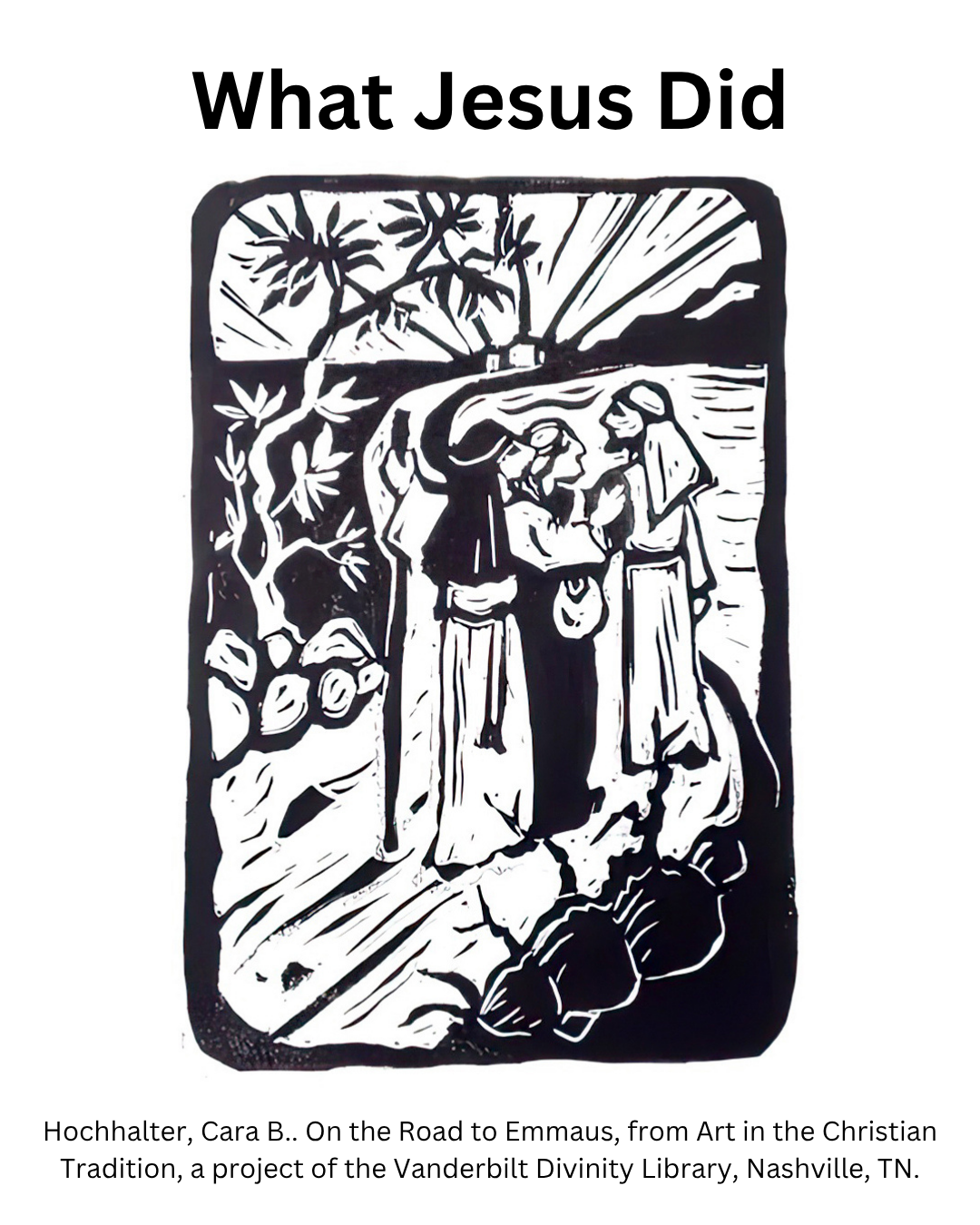
The story about the travelers on the road to Emmaus happened on the same day, Sunday, that the women went to the tomb, taking spices for the body of Jesus. Jesus’ body is not there. Instead they encounter “two men in dazzling clothes”. The women go tell the disciples, “to the eleven and to all the rest.” But the others consider this “an idle tale, and they did not believe them.” Peter goes to see for himself and, as the NIV tells us, “he went away, wondering to himself what had happened”.2
So what do you do? We can imagine how perplexed and confused and upset they must have been. They don’t appear to be expecting to see the resurrected Jesus. 3
So what do you do? Two of them decide to go to Emmaus. We know one is named Cleopus. We don’t know the name of the other person. We don’t know what their relationship was. Were they friends? Were they married? We don’t know anything more about them. We don’t know why they went to Emmaus. Perhaps it was their home and going home seemed like a good idea. Perhaps they thought it wise to get out of Jerusalem while they could. Perhaps they couldn’t bear to be with the other disciples any longer. Perhaps they just needed to do something, anything, and so they started walking. Perhaps they needed space and some privacy to talk through what they had experienced.
As you read the story, you can hear the sorrow and disappointment. While they didn’t recognize Jesus, they evidently recognized him as someone they could trust.
Now on that same day two of them were going to a village called Emmaus, about seven miles from Jerusalem, and talking with each other about all these things that had happened. While they were talking and discussing, Jesus himself came near and went with them, but their eyes were kept from recognizing him. And he said to them, “What are you discussing with each other while you walk along?” They stood still, looking sad.
Then one of them, whose name was Cleopas, answered him, “Are you the only stranger in Jerusalem who does not know the things that have taken place there in these days?” He asked them, “What things?” They replied, “The things about Jesus of Nazareth, who was a prophet mighty in deed and word before God and all the people, and how our chief priests and leaders handed him over to be condemned to death and crucified him. But we had hoped that he was the one to redeem Israel. Yes, and besides all this, it is now the third day since these things took place.
Moreover, some women of our group astounded us. They were at the tomb early this morning, and when they did not find his body there they came back and told us that they had indeed seen a vision of angels who said that he was alive. Some of those who were with us went to the tomb and found it just as the women had said, but they did not see him.” Then he said to them, “Oh, how foolish you are and how slow of heart to believe all that the prophets have declared! Was it not necessary that the Messiah should suffer these things and then enter into his glory?” Then beginning with Moses and all the prophets, he interpreted to them the things about himself in all the scriptures.
As they came near the village to which they were going, he walked ahead as if he were going on. But they urged him strongly, saying, “Stay with us, because it is almost evening and the day is now nearly over.” So he went in to stay with them. When he was at the table with them, he took bread, blessed and broke it, and gave it to them.Then their eyes were opened, and they recognized him, and he vanished from their sight. They said to each other, “Were not our hearts burning within us while he was talking to us on the road, while he was opening the scriptures to us?” That same hour they got up and returned to Jerusalem, and they found the eleven and their companions gathered together. They were saying, “The Lord has risen indeed, and he has appeared to Simon!” Then they told what had happened on the road and how he had been made known to them in the breaking of the bread. Luke 24: 13-35 NRSVue
This is a beautiful story, moving from sorrow to trust in a stranger, to sharing a meal, to recognition, to abruptly returning to Jerusalem to share their joy. There is much to ponder here.
I am fascinated by how Jesus interacts with them. Through Lent and now Easter, I’ve been focusing on how Jesus interacts with people. How Jesus, especially the resurrected Jesus acts, is a significant clue for us about how we are to act in a post resurrection world. The risen Christ does not return in obvious power and glory. He is so humble and lowly that people don’t know who he is. Is he a gardener? Is he a fellow traveler heading out of town?
When Jesus meets these two travelers, he simply asks -what are you talking about? The travelers tell him. Jesus does then give a little admonishment, “Oh, how foolish you are and how slow of heart to believe all that the prophets have declared! Was it not necessary that the Messiah should suffer these things and then enter into his glory?” “Foolish” doesn’t mean stupid or dumb, but rather “obtuse”.4 As so often in the gospels, the disciples have heard but not understood. And once again, Jesus explains things to them.
Notice has happened. He doesn’t tell them they can’t be disciples any more. He doesn’t demand an apology. He doesn’t shame them. He doesn’t castigate them.
He finds them, even as they are leaving town. He joins them, even though they don’t recognize him. He walks with them. He explains, again. If they are not willing to invite him to stay he is prepared to walk on, Fortunately, they do invite him to stay with them and they share a meal. For Luke’s readers, as for us, this meal is a reminder of the sacrament of Communion. But what would Cleopas and their companion have been reminded of? They would have recalled other meals with Jesus- the feeding of the five thousand, where, Jesus takes the five loaves and two fish and “blessed, and broke them and gave them to the disciples to set before the crowd.”5 Just after tha story, Luke tells us that Peter proclaims that Jesus is the Messiah.6 During the Last Supper, Jesus takes bread, gives thanks, broke it, and gave it to the disciples.7
They share a meal. Jesus takes the bread, blesses it, breaks it, and gives it to them. How many meals do you think Jesus had shared with Cleopas and their companion? In this likely familiar event, Cleopas and their companion recognize Jesus.
Then Jesus vanishes. Why? There have been all sorts of ideas about this. Perhaps it is as simple as now there is no reason to stay in Emmaus. Now there is every reason to return to Jerusalem, to return to the community.
And now, we have this story. What do we do?
We, in the US, live in a time when a significant number of Christians believe that the US must be a “Christian nation” and to many of them, this means certain Christians must be in control of the nation, legally and legislatively in control. They believe that what they consider to be Christian values and standards should be imposed, by law, on everyone.8
However, over and over again, Jesus calls us to a completely different way. It is so pervasive in the gospels, that we may not notice, because this way, is just how Jesus acts. It is perhaps most striking in the post resurrection stories.
If we didn’t have these stories, we might expect Jesus to sit enthroned somewhere on earth and expect- even demand- people to come to him. Yet he never does. Story after story, Jesus seeks people out. Jesus goes to them.
If we didn’t know the stories, we might expect Jesus to require people to acknowledge their failure to have remained faithful. But he didn’t. He brought peace to them before they could ask or repent.
If we didn’t have these stories, we might expect Jesus to demand retribution against those who abused him and killed him. But he didn’t. He sends the disciples out to invite, even them, into Jesus’ way of peace.
If we didn’t know the stories, we might expect Jesus to create his own empire through force, domination, or violence. But he didn’t. He chose the path of suffering and death. And then defeats death through the power of an unseen resurrection. A resurrection that reconciles people to God and to each other in a community of love and hospitality, where people are cared for and fed.
Then they told what had happened on the road and how he had been made known to them in the breaking of the bread.
- Luke 19:38 ↩︎
- Luke 24:1-12 ↩︎
- ” …[I]t is striking that the story bears no sign of anyone saying, ‘Ah yes, we should have expected this.’… the discovery of the empty tomb is not presented as the historicizing ‘explanation’ of a belief in Jesus’ resurrection, but as itself a puzzle in search of a solution. It is not that someone believes in Jesus’ resurrection and now finds an empty tomb to confirm that belief; it is, rather, that they have found and empty tomb and are offered the startling and totally unexpected explanation that Jesus has been raised. The resurrection interprets the tomb, not vice versa.” The Resurrection of the Son of God, N.T. Wright, (Fortress Press: Minneapolis) 2003 page 628 ↩︎
- Green, Joel B. The Gospel of Luke, The New International Commentary on the New Testament, William B. Eerdmans Publishing Co, 1997,page 848 ↩︎
- Luke 9:16 ↩︎
- Luke 9:18-20 ↩︎
- Luke 22:19 ↩︎
- The literature on this is large, but begin here, Christians Against Christian Nationalism, and here, A Public Witness, Word & Way. If you want more resources, reach out! ↩︎


Leave a comment