Theologians tell us that God comes to us in ways that we can understand. This happens literally at Pentecost where a diverse crowd of people heard the disciples speak in many different languages. When Christians1 think about Pentecost we often focus on the presence of the Spirit, and the speaking in various languages. Jesus, at his ascension, tells the disciples the Holy Spirit will “come upon” then and that they are to be his “witnesses in Jerusalem, in all Judea and Samaria, and to the ends of the earth.”2 What happens at Pentecost is the beginning of the fulfillment of Jesus’ statement.
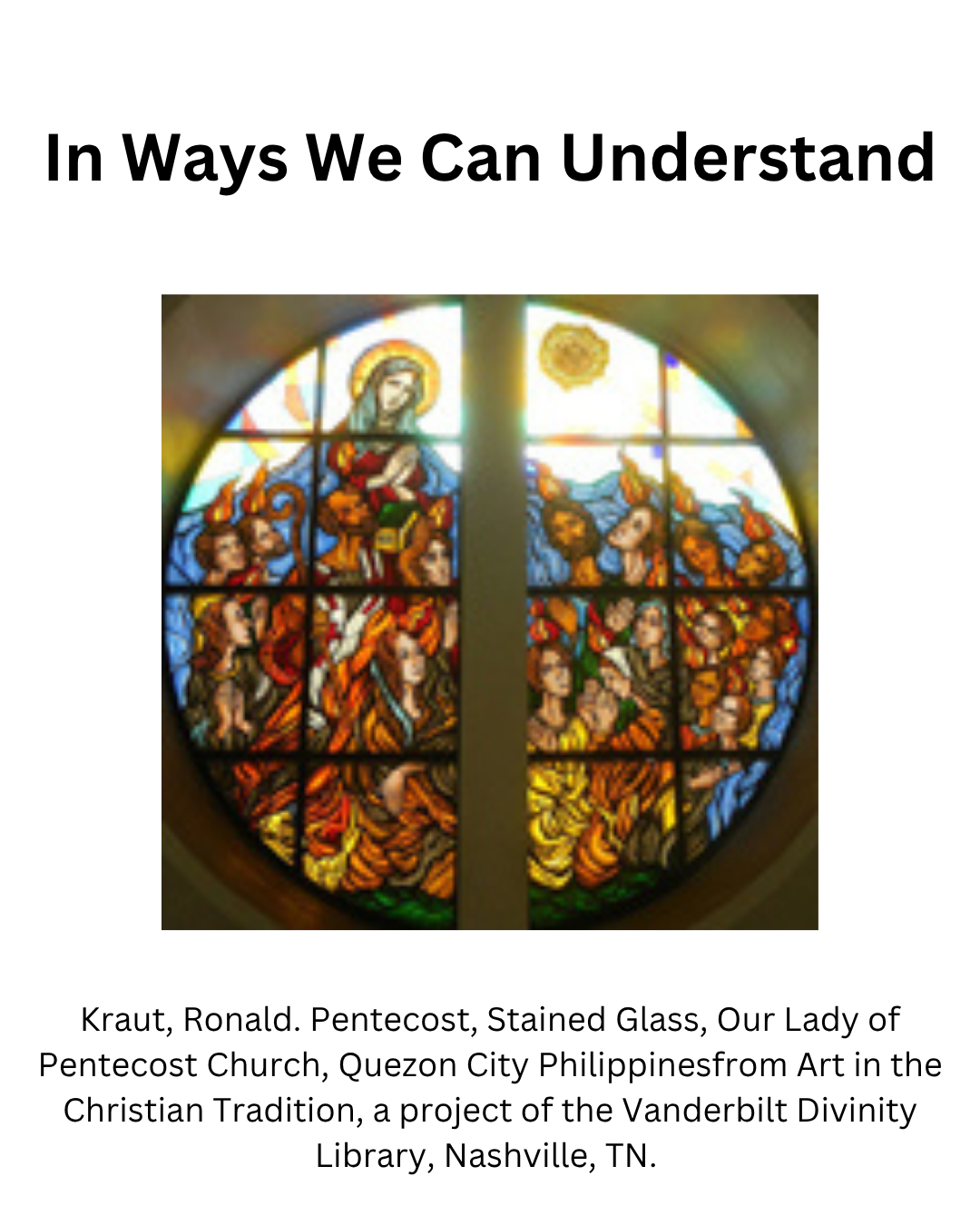
When the day of Pentecost had come, they were all together in one place. And suddenly from heaven there came a sound like the rush of a violent wind, and it filled the entire house where they were sitting. Divided tongues, as of fire, appeared among them, and a tongue rested on each of them. All of them were filled with the Holy Spirit and began to speak in other languages, as the Spirit gave them ability.
Now there were devout Jews from every people under heaven living in Jerusalem. And at this sound the crowd gathered and was bewildered, because each one heard them speaking in the native language of each. Amazed and astonished, they asked, “Are not all these who are speaking Galileans? And how is it that we hear, each of us, in our own native language? Parthians, Medes, Elamites, and residents of Mesopotamia, Judea and Cappadocia, Pontus and Asia, Phrygia and Pamphylia, Egypt and the parts of Libya belonging to Cyrene, and visitors from Rome, both Jews and proselytes, Cretans and Arabs–in our own languages we hear them speaking about God’s deeds of power.” All were amazed and perplexed, saying to one another, “What does this mean?” But others sneered and said, “They are filled with new wine.”
But Peter, standing with the eleven, raised his voice and addressed them, “Fellow Jews and all who live in Jerusalem, let this be known to you, and listen to what I say. Indeed, these are not drunk, as you suppose, for it is only nine o’clock in the morning. No, this is what was spoken through the prophet Joel:
‘In the last days it will be, God declares, that I will pour out my Spirit upon all flesh, and your sons and your daughters shall prophesy, and your young men shall see visions, and your old men shall dream dreams. Even upon my slaves, both men and women, in those days I will pour out my Spirit, and they shall prophesy. And I will show portents in the heaven above and signs on the earth below, blood, and fire, and smoky mist. The sun shall be turned to darkness and the moon to blood, before the coming of the Lord’s great and glorious day. Then everyone who calls on the name of the Lord shall be saved.’ Acts 2:1-21 NRSVue
We often think of this story as being about evangelism. The gospel will be told throughout the world. And it will be told to people in their own languages. That part, the “in their own languages”, is important.
If you have ever studied a different language, you know that language reflects and expresses culture. Our language is how we make sense of and describe the world we live in. For example, some cultures, when talking about how objects or people are positioned use words like “in front”, “beside”, “left” or “right”. Other cultures use directional words. They say, “He is standing to the north of me.”
One language uses location centered on one’s own position and the other uses external geographic location. Other cultures might always orient themselves by a geographic feature, like the ocean or mountains. They might say something is toward the ocean or inland. These different ways of talking about location also say something about how we understand ourselves in relation to the world. This is just one example of how language reflects our culture and understanding of the world.
We might expect that the early followers of Jesus would expect other people to orient themselves to the language and culture of Jesus. All would be welcome to join. But joining would mean leaving their language of origin and adopting the language and culture of the early church. It would be something like the story of Ruth, ” Where you go, I will go; where you lodge, I will lodge, your people shall be my people, and your God my God.”3 Ruth gives up her people, her language, her culture and adopts the language, and culture of Naomi.
If the story in Acts was that when the Galileans spoke, all the other people with their variety of languages understood the Galileans, if everyone heard one language, we would have a different kind of story. A different gospel.
The story we do have is that the Gospel goes to people in ways they can understand. There is not one preferred language, not one way of hearing, not one way of receiving the Gospel. There is one Jesus, one God, one Gospel. But how we hear it, and how we live it happens in our particular cultures and contexts.
The Spirit extends hospitality to all who hear. It makes space for others- other languages, and other cultures- to receive it and make it their own. We are all invited in, because we all are the beloved of God.
The gospel does not require us to all be first century CE Galileans. The Gospel moves, and adjusts. It is living and active. It is not bound by systems and structures- in the first century or now. In the kin dom of God there is space for us to be ourselves. As Jesus said, there are many rooms in the Father’s house.4
First Corinthians reminds us that there are “varieties of gifts but the same Spirit, and there are varieties of services but the same Lord, and there are varieties of activities, but it is the same God who activate all of them in everyone…For just as the body is one and has many members, and all the members of the body, though many, are one body, so it is with Christ.”5 The gospel, the way Jesus, the love of God, is broad and wide and deep enough to hold all the ways we are humans in the world.
The Wesley campus ministry at one of the campuses where I used to work used the words, “Be You, With Us.” to describe their ministry. This also captures the spirit of Pentecost and of the gospel.
There are these days expressions of Christianity that demand uniformity of belief and thought and culture. All are expected to conform to a particular understanding and way of being Christian. You do not need to be a highly trained theologian to realize the problem with this. All you need to be able to do is read the New Testament.6 In Christ we find, welcome, invitation, and acceptance. We discover a unity that does not require uniformity. It honors all the ways we are human.
At Pentecost the Spirit came to people in ways each person could understand. The Triune God continues to invite each of us to, “Be You. With Us.”
- There was and remains a Jewish celebration of Pentecost, usually known as Shavuot. https://en.wikipedia.org/wiki/Shavuot ↩︎
- Acts 1:8 ↩︎
- Ruth 1: 16b ↩︎
- John 14:2 ↩︎
- 1 Cor 12:4-6, 12 ↩︎
- I don’t mean to exclude the Old Testament, it also affirms acceptance in its own way. It also documents the struggle we humans have between inclusion and exclusion. ↩︎


Leave a comment