When I first began reading the Bible, I was surprised by how many stories there were and how few rules. I had always heard that the Bible was a rule book for how to live, well actually the rules for how to get into heaven and avoid hell. But the Bible is mostly stories. Often even the rules are told by way of story.
Stories are important. They help us understand others and ourselves. That, in part, is why the Bible is filled with stories. Stories help us connect to God, to Jesus, to others, and to ourselves.
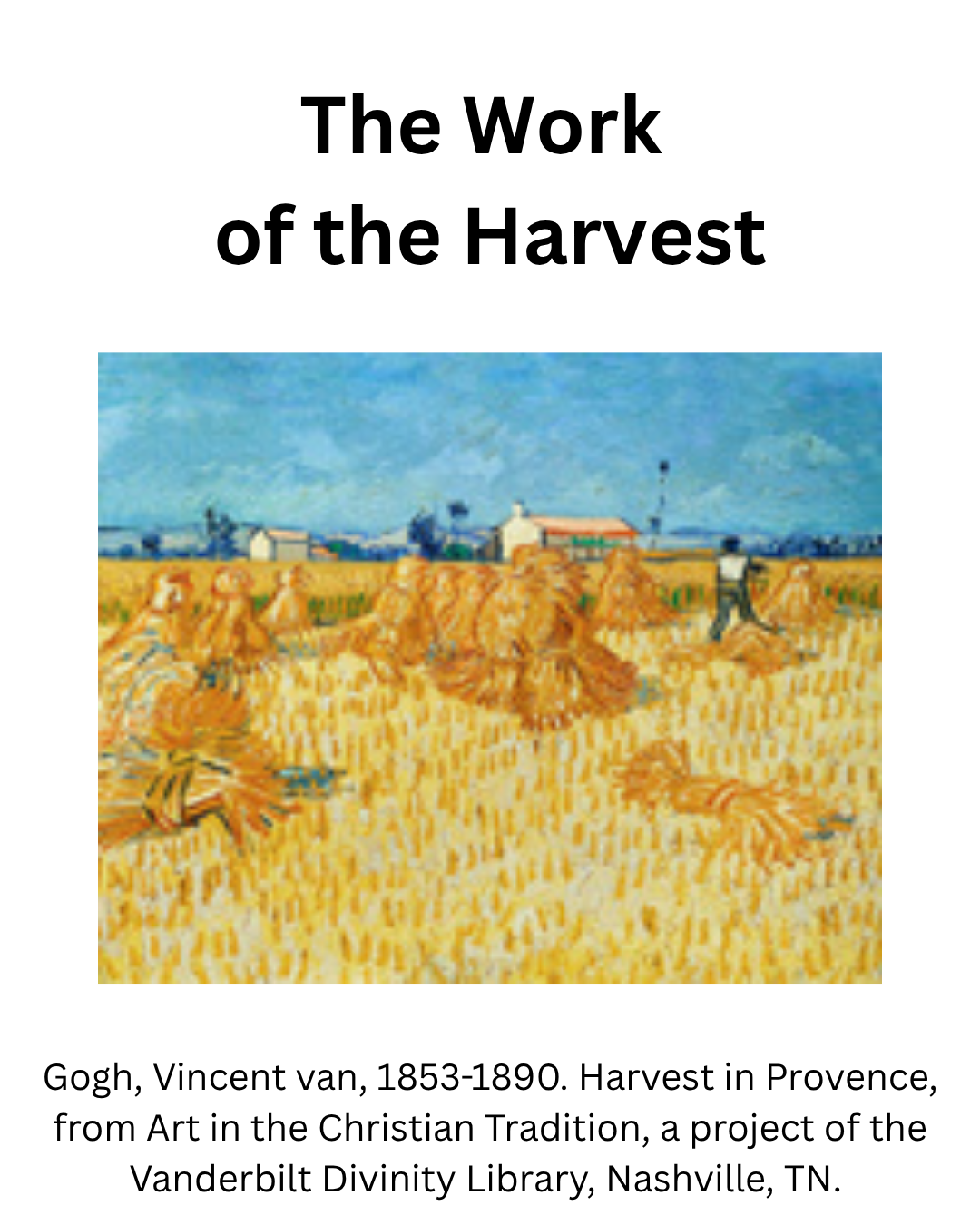
In Matthew’s gospel, in the midst of all the stories we get some statements that summarize what Jesus was up to. This week’s gospel reading starts with one of those. It sums up what has been happening since the Sermon on the Mount.
Just before the Sermon on the Mount there is another summary statement about Jesus’ activities1. Then between the Sermon on the Mount and today’s passage (chapters 8 and 9) there are 9 stories of healing which then conclude with this passage.
Then Jesus went about all the cities and villages, teaching in their synagogues and proclaiming the good news of the kingdom and curing every disease and every sickness. When he saw the crowds, he had compassion for them because they were harassed and helpless, like sheep without a shepherd. Then he said to his disciples, “The harvest is plentiful, but the laborers are few; therefore ask the Lord of the harvest to send out laborers into his harvest.”
Then Jesus summoned his twelve disciples and gave them authority over unclean spirits, to cast them out, and to cure every disease and every sickness. These are the names of the twelve apostles: first, Simon, also known as Peter, and his brother Andrew; James son of Zebedee and his brother John; Philip and Bartholomew; Thomas and Matthew the tax collector; James son of Alphaeus and Thaddaeus; Simon the Cananaean and Judas Iscariot, the one who betrayed him.
These twelve Jesus sent out with the following instructions: “Do not take a road leading to gentiles, and do not enter a Samaritan town, but go rather to the lost sheep of the house of Israel. As you go, proclaim the good news, ‘The kingdom of heaven has come near.’ Cure the sick; raise the dead; cleanse those with a skin disease; cast out demons. You received without payment; give without payment. Take no gold, or silver, or copper in your belts, no bag for your journey, or two tunics, or sandals, or a staff, for laborers deserve their food. Whatever town or village you enter, find out who in it is worthy, and stay there until you leave. As you enter the house, greet it. If the house is worthy, let your peace come upon it, but if it is not worthy, let your peace return to you. If anyone will not welcome you or listen to your words, shake off the dust from your feet as you leave that house or town. Truly I tell you, it will be more tolerable for the land of Sodom and Gomorrah on the day of judgment than for that town. Matthew 9:35- 10:15 NRSVue2
What Jesus says and does, is of course, our model for what to say and do. In the Sermon on the Mount, Jesus tells us how we are to live with each other and with God. Then in Matthew’s gospel,Jesus shows us what that looks like. People are healed. People are fed. Notice what Matthew tells us- “curing every disease and every sickness” Jesus gives the disciples authority over unclean spirits and “to cure every disease and every sickness.” Every. Every. Every. Every. Not some. Not heal the faithful. Or cure the worthy. Heal every sickness. Cure every disease.
Jesus sees all the suffering of all kinds and sends the disciples out to do what he has been doing. “Proclaim the good news, the kingdom of heaven has come near.” Jesus is not talking about people going to heaven after they die. Jesus is talking about the reign of God coming to earth which means replacing the current empire. The reign of God means people are healed, in every way.
Equally important is how the disciples are to act3. They are not to get rich. They are not even to take what seems prudent for travelers. No money. No bag. No change of clothes. They are not to be better off materially than those they are going to help.
They are not to profit from the misfortune of others. They are to stay with whomever is “worthy”, which is not necessarily the powerful or the wealthy or the influential. No vacation homes, no private jets, no mansions for these disciples. They are to live with those they are serving.
The disciples are to live and act in solidarity, in community with those in need. They are to find someone who will house them, and to say and do what they came to say and do. Proclaim the good news, the Kingdom of God has come near. Heal the sick. Raise the dead. Cleanse those with a skin disease. Cast out demons.
What if they are not welcomed? They “shake off the dust” from their feet. If the disciples are not welcomed, if people are not willing or ready to receive the good news, they are to leave. They are to move on. They are not to argue. They are not to take over the synagogue or local government. They are not to call down fire and brimstone. They are not to wage battle, figuratively or literally. Coercion. Violence or threats of violence. Intimidation. Force. Threats. Guilt. None of that is the way of Jesus. Any repercussions belong to God, not the disciples.
The twelve are sent, as are we, to “proclaim the good news”. The kingdom of heaven has come near. Their world, our world, is changing. As Jesus goes on to say in verses 16-23, not everyone is going to be happy to hear the good news. Some have a vested interest in preserving the status quo and will do everything they can to preserve it.
Nevertheless, we have good news to proclaim. We are called to the harvest, to be workers of healing and reconciliation. The kingdom of heaven is at hand.
- Matt 4:23-25 ↩︎
- The Lectionary reading for Sunday June 14 is Matthew 9:35-10:8, and v 9-23 may also be included. I concluded today’s reflection at verse 15. Verses 16-23 tell of the hardships the disciples will encounter. “I am sending you out like sheep into the midst of wolves, so be wise as serpents and innocent as doves.
Beware of them, for they will hand you over to councils and flog you in their synagogues, and you will be dragged before governors and kings because of me, as a testimony to them and the gentiles.
When they hand you over, do not worry about how you are to speak or what you are to say, for what you are to say will be given to you at that time, for it is not you who speak, but the Spirit of your Father speaking through you. Sibling will betray sibling to death and a father his child, and children will rise against parents and have them put to death, and you will be hated by all because of my name. But the one who endures to the end will be saved.
When they persecute you in this town, flee to the next, for truly I tell you, you will not have finished going through all the towns of Israel before the Son of Man comes.” ↩︎ - In verse 5 Jesus sends the disciples explicitly to “the lost sheep of the house of Israel” and tells them to void the gentiles and Samaritans. This specificity is expanded when Jesus heals the Canaanite woman’s daughter and at the end of the gospel when Jesus commissions the disciples, “Go therefore and make disciples of all nations.” (Matt 28:19) I wonder if here, Jesus tells them to focus on Israel, because that is where people are already expecting the kingdom of heaven. It may be the easiest place for them to start their work of discipleship. ↩︎


Leave a comment