Over the next three weeks, the Lectionary gospel texts are parables. I thought a short reminder about parables might be helpful. Matthew has organized his gospel so that Jesus has five “discourses.1 Matthew collects Jesus parables into the third discourse. “Parable” means “something cast beside”, a kind of comparison. There is not a single style of parable. Some are short stories. Some are only one or two lines. Parables may hold a variety of meanings. There is usually not a single correct answer. At the same time, not every possible interpretation is correct. Understanding a parable takes thought and discussion. Parables disclose truth, but often the truth is disruptive. They, by design, challenge our assumptions. By their nature, parables concern a kind of truth that doesn’t lend itself to factual statements.
From time to time, distressing graphs of mainline denominational membership decline surface. This decline has been happening for a few decades. The following images of three mainline (and one non mainline) denominational membership trends are from Ryan Burge.2
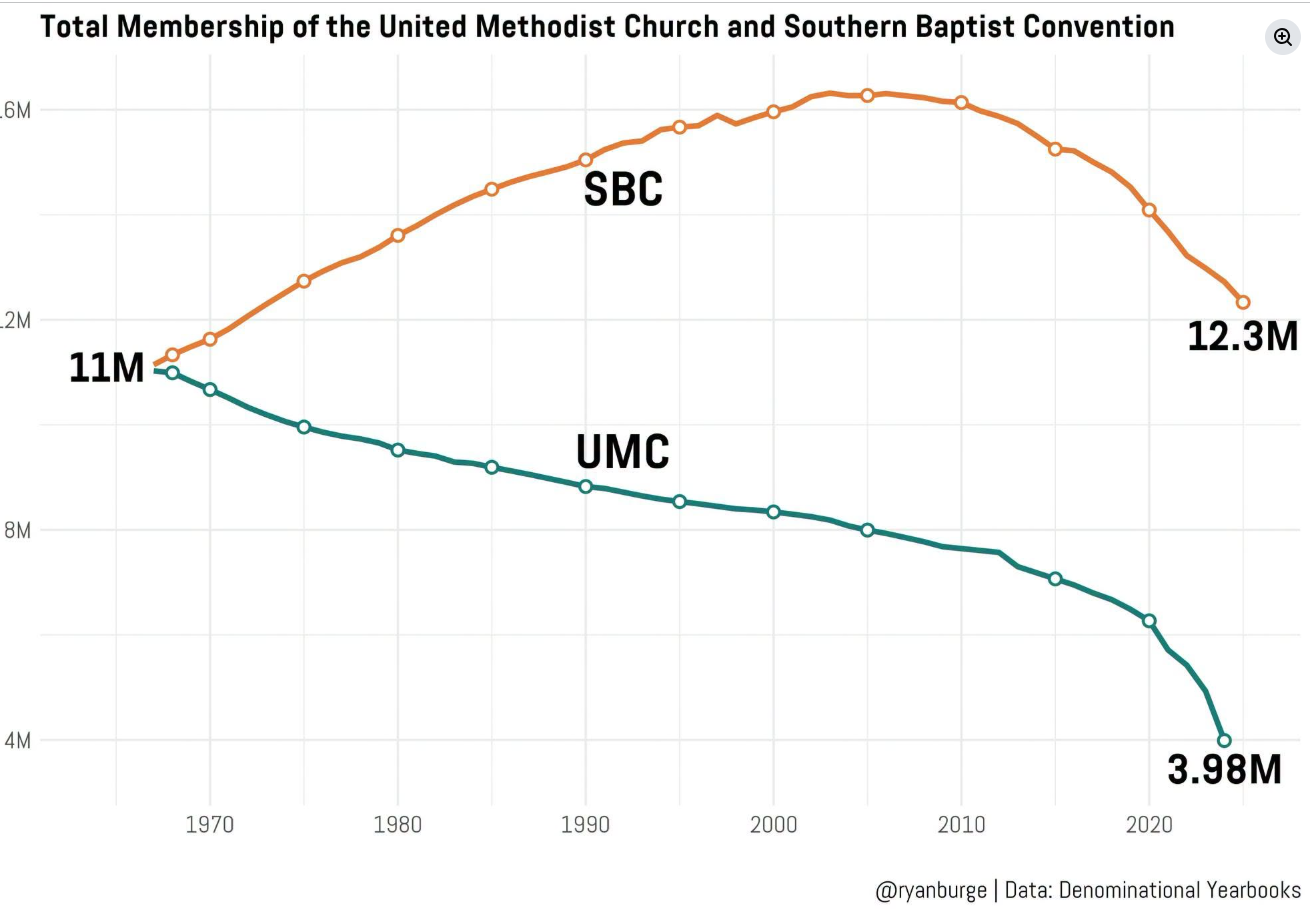

Often the appearance of these graphs is accompanied by worry about the future of a denomination. I get it. There are all sorts of real effects of declining membership.
Our concern about numbers is not restricted to church membership. When I was a campus minister, one of the first things people asked me was, “How many students…?” I get it. We live in a culture that desires and rewards big numbers. Big numbers = winning.
Or does it? Jesus has something to say about this.
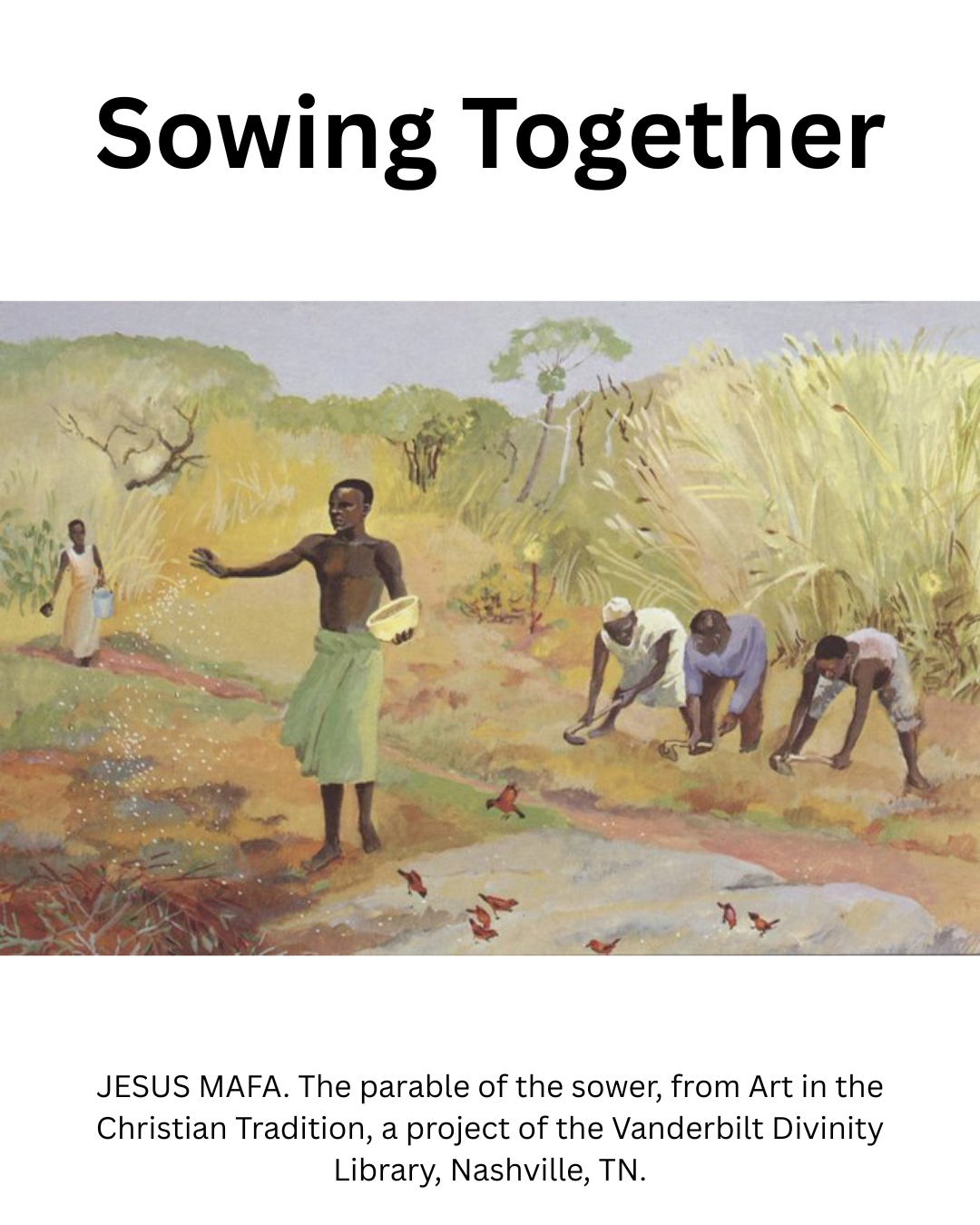
That same day Jesus went out of the house and sat beside the sea. Such great crowds gathered around him that he got into a boat and sat there, while the whole crowd stood on the beach. And he told them many things in parables, saying: “Listen! A sower went out to sow. And as he sowed, some seeds fell on a path, and the birds came and ate them up. Other seeds fell on rocky ground, where they did not have much soil, and they sprang up quickly, since they had no depth of soil. But when the sun rose, they were scorched, and since they had no root, they withered away. Other seeds fell among thorns, and the thorns grew up and choked them. Other seeds fell on good soil and brought forth grain, some a hundredfold, some sixty, some thirty. If you have ears, hear!” Matthew 13: 1-9 NRSVue
Then speaking to the disciples, Jesus said,
“Hear, then, the parable of the sower. When anyone hears the word of the kingdom and does not understand it, the evil one comes and snatches away what is sown in the heart; this is what was sown on the path. As for what was sown on rocky ground, this is the one who hears the word and immediately receives it with joy, yet such a person has no root but endures only for a while, and when trouble or persecution arises on account of the word, that person immediately falls away. As for what was sown among thorns, this is the one who hears the word, but the cares of this age and the lure of wealth choke the word, and it yields nothing. But as for what was sown on good soil, this is the one who hears the word and understands it, who indeed bears fruit and yields in one case a hundredfold, in another sixty, and in another thirty.” Matthew 13:18-23 NRSVue
Remembering that parables can have a variety of meanings. And that they are often intentionally unsettling and disruptive, what does this parable have to tell us? What assumptions does it challenge?
Matthew begins by telling us that “great crowds” gathered to listen to Jesus. Then Jesus tells a parable about how not everyone who hears the word will persist and bear fruit. In effect, Jesus tells the crowd that most of them will not understand and follow. Jesus is not impressed by his ability to draw a crowd. He doesn’t appear to expect everyone to become a model disciple. Is he saying that numbers don’t matter?
Most of us are not farmers these days. We don’t worry about the consequences of a failed crop. For Jesus audience, a failed crop was disastrous. Financial ruin, the loss of your land, and even starvation were possible.
If you have planted a garden you know that not every seed grows. Despite your best efforts, it’s just like Jesus described. Birds eat some of the seeds. Not all the soil is good for growing. It can be too hot or too dry. Weeds and thorns can take over your garden. Jesus offers four ways crops can and do fail.
Yet, some seeds grow. And they, apparently, are enough.
Jesus explains the parable to the disciples (but not the crowd, which is a topic for another day.) Because we have Jesus’ explanation, it may be difficult for us to imagine any other interpretation. But it evidently wasn’t obvious to people what Jesus meant.
This parable could be used to rationalize dwindling numbers. Jesus told us this would happen. What can we do? This is just how things are. We might develop theologies that support the idea of a faithful remnant. Casting ourselves as the few who actually understand and follow Jesus. Not everyone belongs in the Kingdom of God, just those of us who hear and understand.
Is Jesus telling us what is inevitable? Or is he alerting us to what happens if we are careless or inattentive?
To continue with Jesus’ imagery, when I plant a garden, I try to be sure the weeds are pulled, and that there is enough water. I pay attention to soil quality. I use fertilizer when appropriate. I put nets over fruit to keep (most) of the critters away. I don’t simply toss seeds around and hope for the best. My work isn’t done after the seeds are sown. In fact, my work as one who tends the garden, is just beginning.
Similarly, when I look at the reasons people “fall away”, leave the church or lose their faith, it seems to me that it isn’t necessarily inevitable. Just as we have a role and responsibility to help the seeds we plant to grow, we have a responsibility to support each other. What can we do to help each other grow in faith? What can we do to support each other when we are going through difficult times? How can we nourish spiritual formation? How do we help each other grow deep roots and a sturdy faith? How can those of us on slightly better soil, help those around us? And when weeds and thorns emerge in our lives, who will help us? Who will water nurture our faith? Who will support us, like we stake up and support tomato plants?
Still as Jesus explains, not everyone becomes a life long disciple, despite their and our best efforts. People “fall away” for a variety of reasons. Perhaps the “cares of this age and the lure of wealth” is too strong for some. Perhaps evil and trouble are too much for some. The language Jesus uses doesn’t suggest only personal failures. It also suggests systemic and social obstacles.
Nevertheless enough people do bear “fruit”. We should ask ourselves what Jesus means when he talks about bearing fruit. To bear fruit means to live a life consistent with the values of Jesus. That means things like caring for the poor, the hungry, the sick. It means working systemically for a more just and fair society. Once again, as he does throughout the gospels, Jesus tells us that what we do because we are his followers matters.
Perhaps our efforts to live faithfully have more impact than we realize. Could our “fruits” have a positive effect on those who “fall away”?
Those of us who were sown on good soil can make a difference. Not everyone’s “yield” is the same. But we all can bear some good fruit. People garden and farm for themselves, their families, and also their community. Farming in Jesus’ time and until fairly recently in our time was both an individual and community effort. People helped each other clear their fields. People helped each other get the crops harvested. If people didn’t help each other crops failed and everyone suffered.
Jesus asks those of us who are “sown on good soil” to hear and understand and to “bear fruit”. He is asking us to be faithful, which is not the same as being successful.
For a long time my prayer has been to not be successful, but to be faithful. What does being a faithful disciple look like for me?
Sometimes, often, that means being attentive to the rocks and weeds and thorns in my life. And equally, am I working for justice? For peace? For people to have shelter and food? Am I encouraging and supporting people to be fully who God created them to be, helping them grow in faith and love?
“Listen! A sower went out to sow.”
- 1. The Sermon on the Mount, ch 5,6,7. 2. The Missionary discourse, ch 10. 3. A collection of parables, ch 13. 4. The Community discourse, ch 18 and 5. the Judgment discourse, chs 23.24.25. ↩︎
- Ryan Burge, The data comes from denominational yearbooks. accessed July 6, 2026 from https://www.facebook.com/ryanburgewrites ↩︎


Leave a comment