Do you believe in miracles? Sometimes that question is asked as a test of faith. Sometimes it is asked as a test of rational thought. Modern people often consider miracles to be events where something impossible occurs. But is that the only way to think about miracles? Is that how people have always thought about miracles?
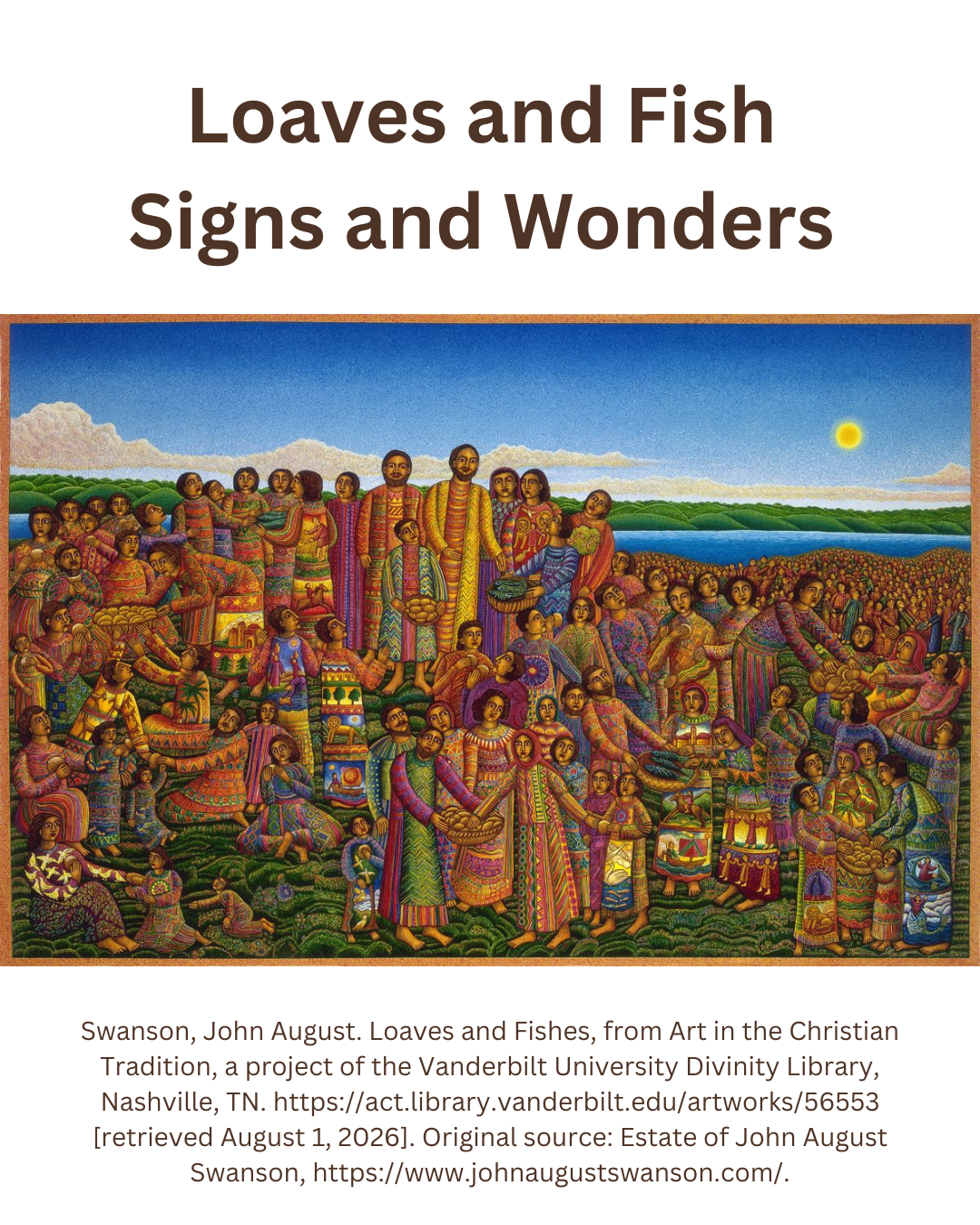
In the Old Testament, the word that is often translated as “miracle” can also mean “wonder”. In the New Testament synoptic gospels, the term for miracle means “power” or “deeds of power”. John’s gospel uses the word “sign”. Jesus does various kinds of miracles which indicate that the reign of God is coming into the world. Jesus’ miracles are acts that show God’s love and compassion. Jesus’ miracles reveal who Jesus is.
Because modern people think about miracles as acts that are contrary to nature and science, people may resist the idea of miracles or they may think that miracles no longer happen. It is helpful for us to remember that in the ancient world, science as we understand it and use it to understand the world wasn’t available as a way of understanding the world. People knew they could act and cause things to happen. If people didn’t cause an event, they believed spiritual powers (or magical powers) caused it. There were spiritual powers “at work that could cause things to happen or enable people to do what they could not have done on their own. Thus, the most common response to miracles in the Bible is not disbelief, but astonishment. Miracles are not regarded as supernatural events, but as extraordinary ones.”1
Sometimes people read the story we call the feeding of the five thousand as a supernatural miracle. Jesus mysteriously and supernaturally creates enough food to feed the large crowd. I’m not interested in arguing you out of that interpretation. But if that way of talking about this story is a problem for you, perhaps thinking about this as an extraordinary event, a wonder, a deed of power and allowing ourselves to be astonished might help.
Now when Jesus heard this, he withdrew from there in a boat to a deserted place by himself. But when the crowds heard it, they followed him on foot from the towns. When he went ashore, he saw a great crowd, and he had compassion for them and cured their sick. When it was evening, the disciples came to him and said, “This is a deserted place, and the hour is now late; send the crowds away so that they may go into the villages and buy food for themselves.” Jesus said to them, “They need not go away; you give them something to eat.” They replied, “We have nothing here but five loaves and two fish.” And he said, “Bring them here to me.” Then he ordered the crowds to sit down on the grass. Taking the five loaves and the two fish, he looked up to heaven and blessed and broke the loaves and gave them to the disciples, and the disciples gave them to the crowds. And all ate and were filled, and they took up what was left over of the broken pieces, twelve baskets full. And those who ate were about five thousand men, besides women and children. Matthew 14:13-21 NRSVue
Just before this story, Matthew tells the story of the death of John the Baptist.2 Briefly, at Herod’s birthday banquet, his daughter dances for the guests. Herod is pleased and promises by oath to give her whatever she asks for. Encouraged by her mother, the daughter asks for the head of John the Baptist (already in prison) on a platter. Herod, orders John’s beheading because of his oath and because he had made this oath in front of his guests. John the Baptist’s disciples go and tell Jesus. Then Jesus goes to a “deserted place by himself”.
We have two stories of meals, one right after the other. A palace banquet in honor of the king with invited guests and entertainment. A deserted place filled with sick people who travel uninvited to be with Jesus. A palace banquet that results in a death. A gathering in a deserted place that results in healing. Herod’s banquet was an exclusive event attended by guests who were wealthy, powerful, and mostly male. Jesus’ meal was attended by who ever showed up, who ever wanted to be near Jesus, people who needed healing. Jesus’ meal was attended by the poor (because most people in those days were poor), and the sick, and included men, women and children. Likely not powerful, and not wealthy. The two meals show the stark contrasts the social world of the first century. The two meals shows the stark contrast between the empires of the world and the kin dom of God.
Jesus, apparently wanted some time alone after learning of the death of John the Baptist. Understandably. They knew each other. Luke’s gospel tells us there were cousins. All the gospels tell us that John baptised Jesus. In addition to grieving the death of John, was Jesus also contemplating the likely end result of his ministry?
Jesus traveled in a boat. The crowds traveled on foot, presumably following the shoreline and they arrive ahead of Jesus. He sees them and “had compassion for them”. He set aside his own desire for solitude.
As the day wears on, the disciples raise a practical concern. These folks need to eat, maybe it’s time for a meal break. Jesus agrees that people need to eat. But he is not on board with the disciples’ suggestion to send everyone into the villages. Jesus tells the disciples to feed the crowd right where they are. “They do not need to go away; you give them something to eat.” The disciples, practical as ever, reply they only have five loaves and two fish. It’s not enough to feed the twelve disciples, let alone the crowd. Yet once Jesus starts distributing this small amount of food, there is enough. There is more than enough.
What happened? Was this a supernatural event with Jesus creating food? Perhaps.
Or did the experience of being with Jesus and sitting together, blessing and sharing that small amount of food, cause people to share what they had brought?
If I were going to a deserted place for an unknown amount of time, I would probably bring some food with me, if I had food to bring. But what would cause me to share with strangers?
What if being with Jesus, hearing him and seeing him changed how people thought about whatever food they had? What if they realized or remembered that in God’s reign, collaboration, sharing, and caring for each other was to be the norm? Torah invites people into a community that cares for each other. The Roman empire was competitive and hierarchical. What if hearing and seeing Jesus reminded them of God’s better way to live? When they share and collaborate and care for each other, there is more than enough.
People in the first century were actually hungry. There was often not enough to eat from crop failures and from an economy that took resources from the people and gave them to the elites. Keeping food for one’s family, limiting with whom you shared food, made a kind of sense. The survival and well being of those closest to you is a powerful motive. Scarcity, real or imagined, is a powerful motive.
But here in this deserted place, people decided to act differently. On this day, in this place people decided to live into the promises of the reign of God. In God’s economy people care for each other, and trust each other. There may be real scarcity, but people decide to work together, to share with each other, to look out for each other.
That Jesus got people to put aside their fears of scarcity and share what they had with others may be the real miracle. A powerful act of persuasion. That people looked around with astonishment and delight at the people sitting next to them and saw neighbors- not competitors is a miracle. It is astonishing. It is extraordinary. It is life in the kin dom.
Overcoming our fear of not having enough is hard. Our culture teaches, encourages, and honors self sufficiency. Recent events have frayed already threadbare safety nets. Setting aside our fears is difficult. Maybe even unwise. The world trains us to hunker down and scan the horizon for threats. We are manipulated into living tense, worried lives.
There are, to be sure, real threats around. There are reasons, real reasons to be tense and worried. And yet, that’s not all there is.
I wonder if we look around for extraordinary events, for wonders and signs, what we might see? By extraordinary events, I don’t necessarily mean large events. The extraordinary may be small, and unnoticed. But what astonishing things are all around us, if we look? What wonders would we see if we had eyes to see? Where is the kin dom of God showing up and breaking in? Perhaps it is a meal. Or an act of kindness. Perhaps it is taking a moment to notice summer flowers. Or appreciating clouds or a breeze. Perhaps it is caring about our neighbors and especially those who believe themselves to be our enemies.
Perhaps the miracle is, at least in part, that we can change. We can believe Jesus. We can follow Jesus. We can act in Jesus-like ways, if we choose to, as individuals and as a society. We can choose to attend the party in the palace with the fancy food and entertainment. Or we can choose to follow Jesus to the deserted place and participate in the miraculous, astonishing life with God.


Leave a comment