Have you seen the memes of Jesus overturning the tables?
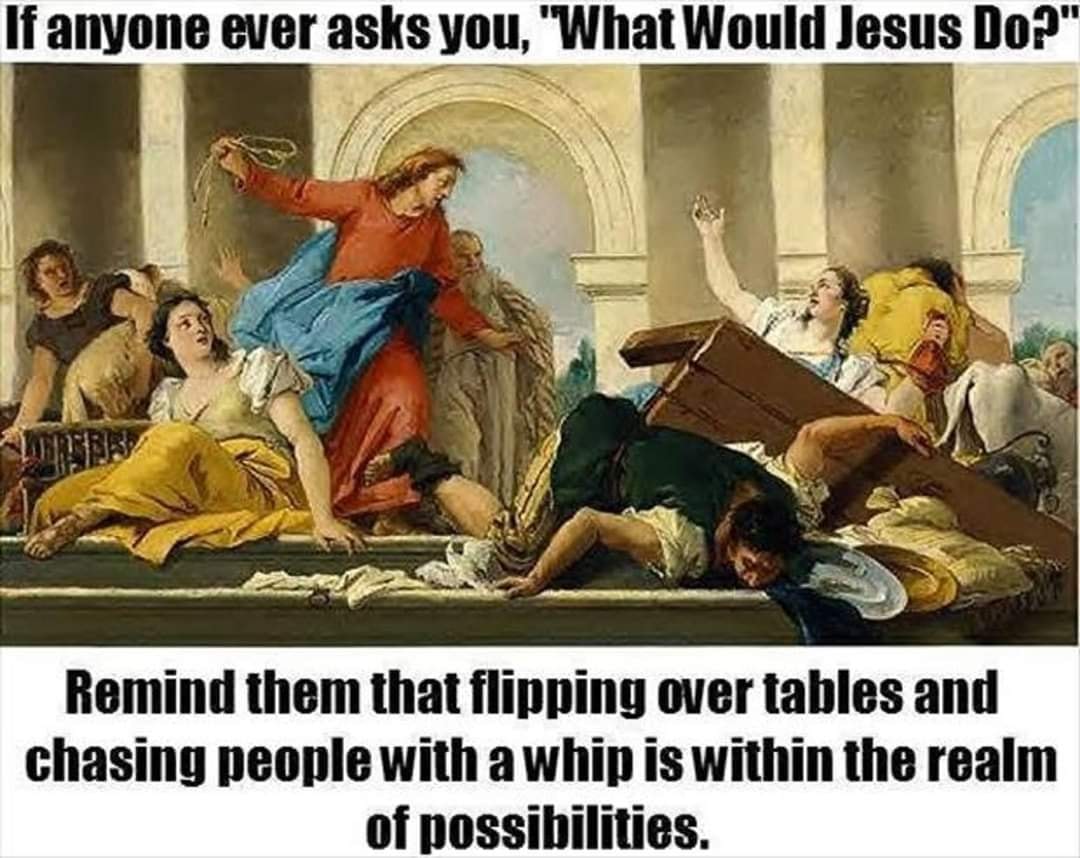
This story is in all four gospels. John’s gospel, not surprisingly, tells the story a little differently. Not surprisingly, this text has been read in some unhelpful ways. People may not have been trying to be deliberately harmful, but a careless or thoughtless reading can still cause harm.
Before we look at the text, I want to offer a quick look at some of the unhelpful ways we have misused this story. This is an easy text to read anti semitically. Christians, without thinking about the role of the Temple in Judaism and the entirety of Jesus life, often assume Jesus’ actions are a repudiation of Judaism. We carelessly assume the worst interpretation of Jewish life and practice.
We can also read this text as giving us permission to act violently. Citing this story is a common rejoinder offered to those who speak of Jesus as a non violent Messiah.
We put ourselves in Jesus’ place, centering ourselves as a hero. “I’m going to be like Jesus and flip some tables and drive the bad people out.”
This list is not exhaustive. So, how might we think about this story?
I think it’s better to think of what Jesus is doing as a prophetic act, a kind of performance art.This isn’t unheard of. Old Testament prophets also did physical, prophetic acts to make a point.1
Take a moment to read John’s account.
“The Passover of the Jews was near, and Jesus went up to Jerusalem. In the temple he found people selling cattle, sheep, and doves, and the money changers seated at their tables. Making a whip of cords, he drove all of them out of the temple, both the sheep and the cattle.2 He also poured out the coins of the money changers and overturned their tables. He told those who were selling the doves, “Take these things out of here! Stop making my Father’s house a marketplace!” His disciples remembered that it was written, “Zeal for your house will consume me.” The Jews said to him, “What sign can you show us for doing this?” Jesus answered them, “Destroy this temple, and in three days I will raise it up.” The Jews then said, “This temple has been under construction for forty-six years, and will you raise it up in three days?” But he was speaking of the temple of his body. After he was raised from the dead, his disciples remembered that he had said this; and they believed the scripture and the word that Jesus had spoken. ” John 2:12-22 NRSV
I want to focus on Jesus’ statement, “Stop making my father’s house a marketplace” You might not remember this saying of Jesus. The other gospels have him saying, “You have made it [ the temple] a den of robbers”.
At first glance this is a confusing statement. People coming to Jerusalem for the Passover needed animals to sacrifice, especially those who traveled a distance to get to the Temple. People also needed the proper currency. What was Jesus doing? Why did he say this?
Like any good parable or performance art, there may be more than one possible response. 3
I wonder if Jesus is objecting to a transactional approach to faith. To be clear I am not saying Judaism is transactional and Christianity isn’t. I don’t think Jesus is condemning all Jews and all of Judaism. I don’t think he is condemning the temple. I think it’s a human tendency, regardless of faith or no faith, to reduce life to a series of transactions. Our culture (not unlike first century Rome) is based on transactions. We work for money. We pay for goods and services. Even if we are doing something kind, we talk about “paying it forward”.
We can, if we’re not careful do the same with faith, reducing it to a transaction. Some tell us to say the “sinner’s prayer” and receive salvation. Think about how we equate good fortune with correct living. Think of all the sermons and articles and books about how to prosper as a result of correct faith practices. When good things happen we have been blessed. Transaction. When bad things happen it’s punishment for bad behavior or action. Transaction. Even answered prayer can be reduced in our thinking to a transaction. How many stewardship talks have you heard when someone says they have been blessed because of their giving?
We all do it. It’s almost impossible not to.
In John’s gospel, Jesus might find all this particularly distressing because everyone is at the Temple for Passover. Passover is the great festival celebrating God’s liberation of Israel from slavery. The Exodus is meant to be a journey into freedom and life giving community with God.
The celebration of liberation turned into marketplace. Community turned into transaction.
We all do it.
A worthwhile question for us, as we read this passage is to think about ourselves, our practices, our churches, our prayers, our actions. Where are the tables Jesus would overturn in our life?
I’m not offering particular examples for us. My hope is that we would spend a little time wondering, what tables in our lives need to be overturned.
We live in a world that is based in marketplace thinking and practice. It is the air we breathe.
What would it look like if we disconnected- at least a bit- from the marketplace? Can we go a day without transactions? I’m not simply talking about buying lunch, or groceries. I’m talking about viewing other people as commodities. I’m talking about commodifying relationships. Every time we consider what someone can do for us, we run the risk of reducing our relationship to a transaction. Is it possible to step away from living in a marketplace?
Edit: March 3, 2024
I don’t normally add to posts once they are published, but this one needs another paragraph. So here it is:
When Jesus drives out the animals and overturns the tables, he is challenging things that were considered normal, necessary and needed. As we consider what things Jesus would overturn in our lives, this reflection may be uncomfortable, and perhaps upsetting. Jesus didn’t call out things that were questioned or commonly held to be unneeded. The practice of selling animals for sacrifice and changing money into the proper kind was considered normal, necessary and needed. So here is the difficult question. And I confess it makes me anxious to think about it. What things in our churches and in our lives that we consider normal, necessary and needed would Jesus drive out and overturn?
- Recall that Old Testament prophets did similar things. Jeremiah breaks a jar, and wears a yoke.(Jer 19 and 27)and Ezekiel lays on each side for a prescribed number of days (Ez 4:4-6) just to name a few. ↩︎
- Read carefully, contrary to the meme we began this post with and the popular ideas about this passage, Jesus uses a whip to drive out the animals, not the people Also, using a whip does not necessarily mean that an animal was struck in a painful way. Whips are used to make a sound to help drive animals. Some whips ( there are different kinds of whips) are used to touch- not strike- as a means to guide. Again, we need to watch our assumptions when we read. ↩︎
- Here are two articles about this text that are worth your time to read.
When Jesus comes with a whip
Unpacking Antisemitic Readings of the “Temple Cleansing” ↩︎

 Conversation in Faith
Leave a reply to seriouslyseekinganswers Cancel reply