The story of “doubting Thomas” is a familiar one. If we make the story to be primarily about Thomas, I think we have missed a major point. As you look at the picture of Ernst Barlach’s1 sculpture, which figure is Jesus and which is Thomas?
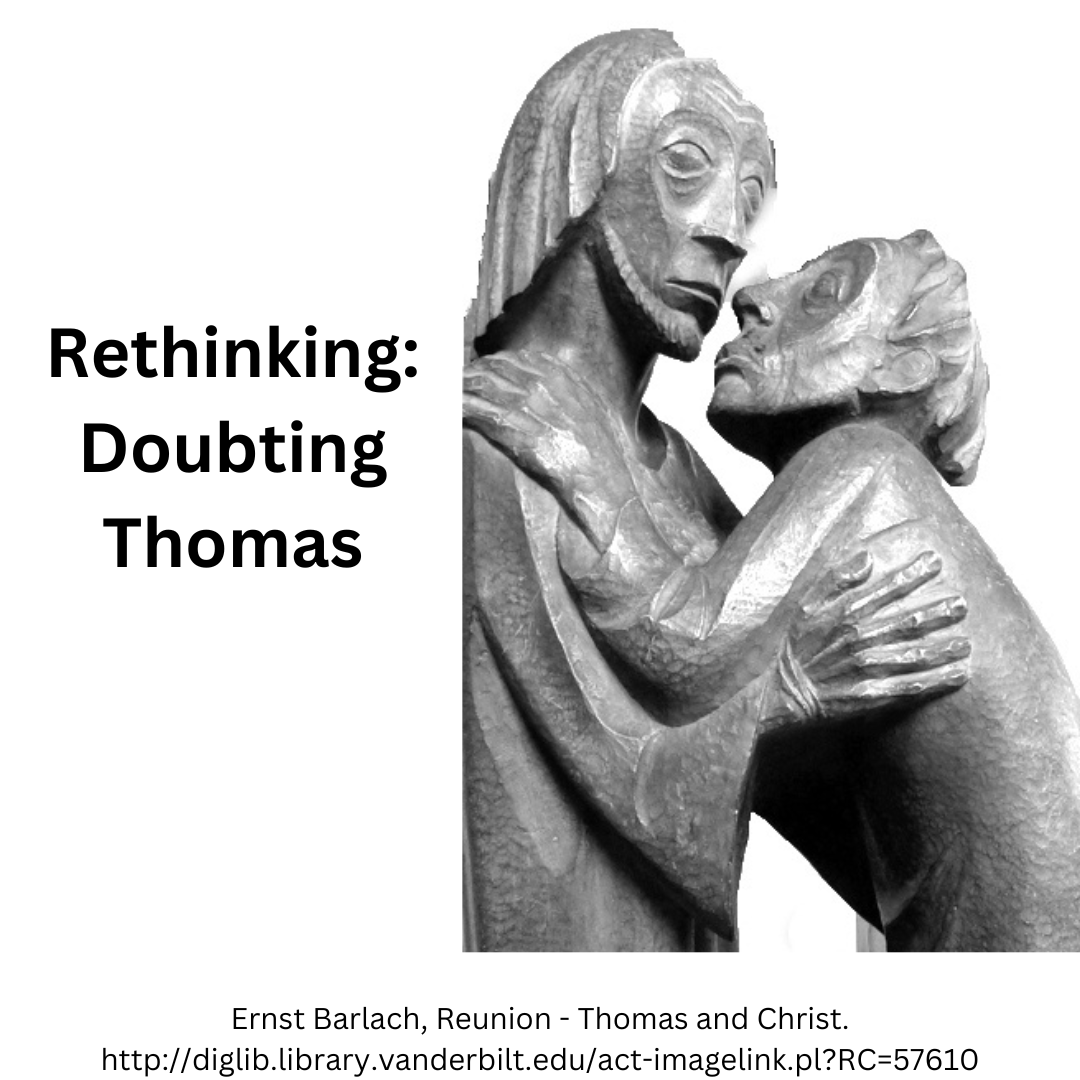
When it was evening on that day, the first day of the week, and the doors of the house were the disciples had met were locked for fear of the Jews, Jesus came and stood among them and said, “Peace be with you.” After he said this, he showed them his hands and his side. Then the disciples rejoiced when they saw the Lord. Jesus said to them again, “Peace be with you. As the Father has sent me, so I send you.” When he had said this, he breathed on them and said to them, “Receive the Holy Spirit. If you forgive the sins of any, they are forgiven them; if you retain the sins of any, they are retrained.”
But Thomas (who was called the Twin), one of the twelve, was not with them when Jesus came. So the other disciples told him, “We have seen the Lord.” But he said to them, “Unless I see the Mark of the nails in his hands, and put my finger in the Mark of the nails and my hand in his side, I will not believe.”2
A week later his disciples were again in the house, and Thomas was with them. Although the doors were shut, Jesus came and stood among them and said, “Peace be with you.” Then he said to Thomas, “Put your finger here and see my hands. Reach out your hand and put it in my side. Do not doubt but believe.” Thomas answered him, “My Lord and my God!” Jesus said to him, “Have you believed because you have seen me? Blessed are those who have not seen and yet have come to believe.
Now Jesus did many other signs in the presence of his disciples, which are not written in this book. But these are written so that you may come to believe that Jesus is the Messiah, the Son of God, and that through believing you may have life in this name.” John 20:19-31, NRSV
Did you notice how these stories(20:19-21 and 20:26-29) mirror each other? In each story we have the disciples in a closed room and Jesus appears and says “Peace be with you.”
In John’s gospel, we should not assume “the disciples” are the twelve male disciples.3 We should consider that there is a larger or at least more diverse group of people in this room. We also need to remind ourselves that the phrase “the Jews” does not mean all Jews. It is John’s way of speaking of Jewish authorities.4
Sometimes we don’t notice that the disciples do not recognize or believe they are seeing Jesus until they see his hands and side- just like Thomas. We can wonder if they did not believe the witness of Mary Magdalene just as Thomas did not believe their witness.
What is interesting are the verses between the two stories (v 21-23).Look at what’s happening here. When we recall Jesus’ final discourse in John’s Gospel, we recognize that repeated here are themes from that discourse; the peace that Jesus gives, the instructions to the disciples sending them into the world to continue Jesus’ work, and all that Jesus had to say about the presence and purpose of the Holy Spirit.5 Jesus breathes on the disciples and says, “receive the Holy Spirit”. This breath of Jesus reminds us of God breathing life into humans at creation6 and in the valley of dry bones7.
Remember in Jesus’ final discourse at the last supper, he says the Holy Spirit will be sent to them. “But the Advocate, the Holy Spirit, whom the Father will send in my name, will teach you everything and remind you of all that I have said to you. Peace I leave with you; my peace I give to you. I do not give to you as the world gives. Do not let your hearts be troubled, and do not let them be afraid.” (John 14:25- 27) It is worth re reading the entire discourse with this resurrection appearance in mind.
Jesus is giving the disciples the Holy Spirit and sending them, “as the Father” had sent Jesus. And then Jesus says, “If you forgive the sins of any, they are forgiven them; if you retain the sins of any, they are retained.” In John’s gospel, sin is not so much a moral category as it is a theological category. One of the themes of the gospels is, who recognizes Jesus for who he is?
Sometimes this phrase, If you forgive the sins….if you retain the sins, is interpreted to mean the church or some people in the church have the power and authority to forgive sins…or not forgive them. Or at least they have the authority to call out sins.
There is a different interpretation we need to consider. Jesus, in the gospels is continually inviting people into life in the kingdom/reign of God, to believe, to entrust themselves to the way of Jesus. The disciples are being sent into the world to continue Jesus’ work of reconciliation and love. They are sent out with a new commandment, to love.
Gail O’Day puts it like this: “By loving one another as Jesus loves, the faith community reveals God to the world; by revealing God to the world, the church makes it possible for the world to enter into relationship with this God of limitless love. It is in choosing or rejecting this relationship with God that sins are forgiven or retained. The faith community’s mission, therefore, is not to be the arbiter of right or wrong, but to bear unceasing witness to the love of God in Jesus.”8
What if the statement “if you forgive the sins of any, they are forgiven them; if you retain the sins of any, they are retained” is not about the church’s power to forgive or not? Surely the ability to forgive in this way belongs to God. What if this is a word of caution, a word of warning to us? For us to bee careful how we give witness to Jesus and God. How we act as Christians can invite people into life in the age of God or we can be a stumbling block and shut people out or drive them away.
And now, holding all this in mind, we are ready to read about Thomas. Remember that “sin” in John’s gospel is a theological category, not a moral category. Also remember that “belief” includes the concept of “entrust”. Jesus comes again into a closed (but not locked) room and speaks to Thomas. A more literal translation would be “Do not be unbelieving but believing.” Or to paraphrase, “Do not withhold trust, entrust yourself to me.”
The risen Christ continues to do what Jesus did. Inviting people into relationship with him. To entrust themselves to him. Jesus does not “retain” Thomas’ sin but calls him to entrust himself to the risen Christ. Now Thomas recognizes Jesus’ relationship with God. Then Thomas makes a powerful confession, the recognition that Jesus is ” My Lord and my God!”.
And finally there is a word for us, the later disciples, “Blessed are those who have not seen and yet have come to believe.” We too, can entrust ourselves to the love of Christ.
- https://en.wikipedia.org/wiki/Ernst_Barlach ↩︎
- I want to remind us that “believe” also contains the idea of “entrust”1. We are invited into more than a mental assent to an idea. Entrusting ourselves is a more robust engagement. Also the traditional translation of Jesus’ statement to Thomas, “Do not doubt, but believe.” can also be translated, somewhat more literally, as do “not be unbelieving but believing”. Unbelieving is not exactly the same as doubt, especially when we think in terms of trust/entrust. ↩︎
- This post is based on the work of Warren Carter’s John: Storyteller, Interpreter, Evangelist and Gail R. O’Day “The Gospel of John” in The New Interpreter’s Bible Volume IX. ↩︎
- Scholars think that John’s gospel was written at a time of conflict between what is becoming Christianity and the Jewish establishment of their time. ↩︎
- See John 14:1-17:26. Notice the repeated themes. ↩︎
- Gen 2:7 ↩︎
- Ezek 37:9 ↩︎
- O’Day, 848. ↩︎


 Conversation in Faith
Leave a reply to Nancy Cancel reply