For a long time, it has been common for Christian churches, ministries and pastors to claim the family is a defining concept in Christianity. There have been many, many websites, books, articles, videos, and sermons on the importance of the family. Language like the family is “the first and most fundamental of all human institutions” and “is central to God’s design” and is “God ordained” is used. Biblically this emphasis on the family comes from texts in Genesis 1 and 2. Part and parcel of this version of family are the ideas of heterosexual marriage, the gender binary, and a patriarchal view of the world.
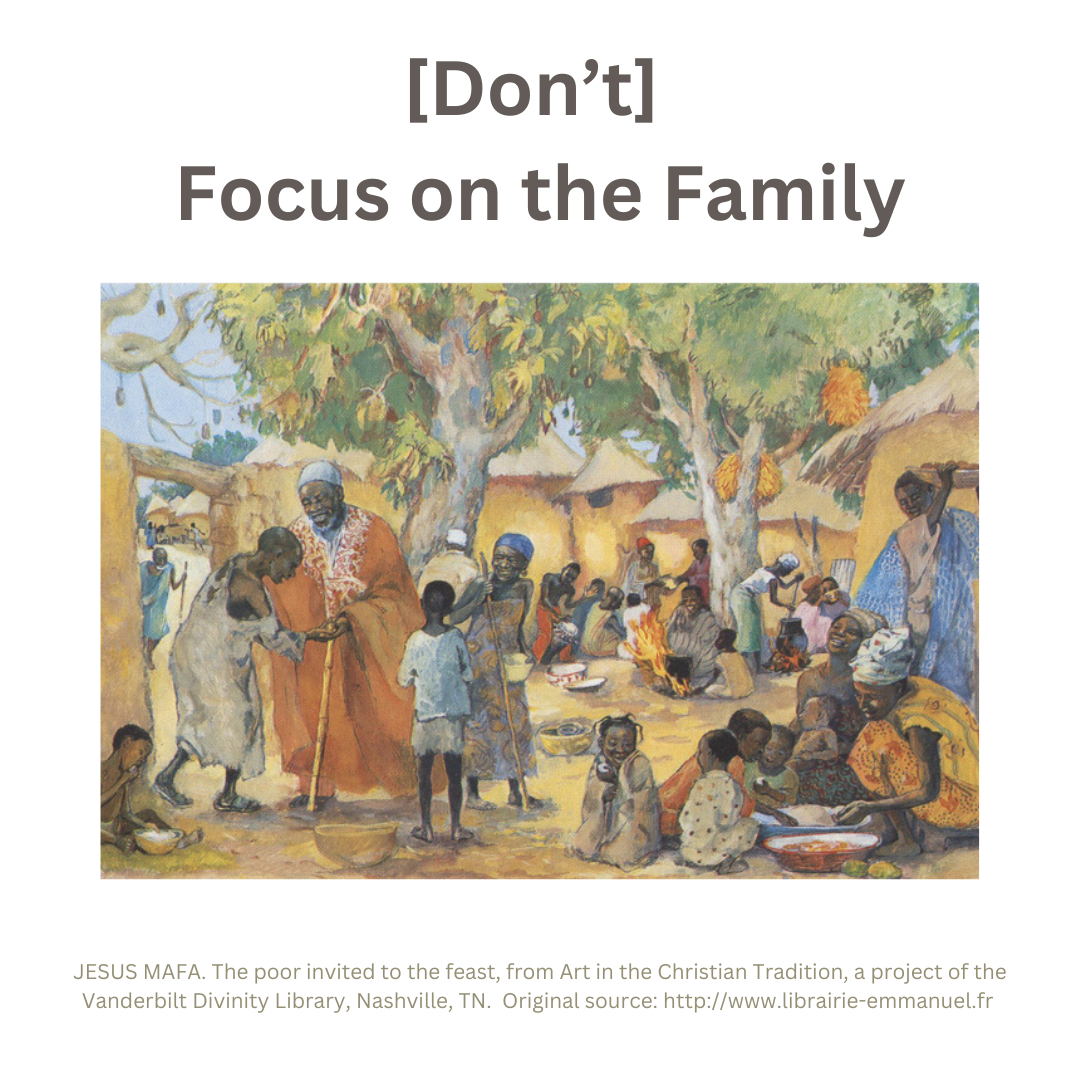
Throughout our society, we see and hear about the importance of “the family”. I’m not going to argue that families are not important, of course they are. But from a Christian perspective, some of us come dangerously close to idolizing “the family”. Heterosexual marriage and children become the main goal of a Christian life, especially for women. The problem for us is, that Jesus doesn’t talk about the family as a goal of life, let alone call it the most important institution.
“…and the crowd came together again, so that they could not even eat. When his [Jesus’] family heard it, they went out to restrain him, for people were saying, ‘He has gone out of his mind.’ … Then his mother and his brothers came; and standing outside, they sent to him and called him. A crowd was sitting around him and they said to him, ‘Your mother and your brothers and sisters are outside, asking for you.’ And he replied, ‘Who are my mother and my brothers?’ And looking at those who sat around him, he said, ‘Here are my mother and my brothers! Whoever does the will of God is my brother and sisters and mother.’ Mark 3:20-21; 31-351 This story is repeated in Matthew 12:46-50 and Luke 8:19-21.
If this was the only time Jesus challenged the religious and societal norms about families, we could perhaps, not worry too much about it. But there’s also this:
“While he was saying this, a woman in the crowd raised her voice and said to him, ‘Blessed is the womb that bore you and the breasts that nursed you!’ But he [Jesus] said, ‘Blessed rather are those who hear the word of God and obey it.’ Luke 11:27-28
and this:
“Another of his disciples said to him, ‘Lord, first let me go and bury my father.’ But Jesus said to him, ‘Follow me, and let the dead bury their own dead.’ Matthew 8: 21-22 also Luke 9:59-62
and this:
“Whoever loves father or mother more than me is not worthy of me; and whoever loves son or daughter more than me is not worthy of me; and whoever does not take up the cross and follow me is not worthy of me” Matt 10:37-38
and this:
“Jesus said, ‘Truly I tell you, there is no one who has left house or father or children or fields, for my sake and for the sake of the good news, who will not receive a hundredfold now in this age- houses, brothers, sisters, mothers and children, and fields, with persecutions- and in the age to come eternal life.’ ” Mark 10:29-30, also Luke 18: 29-30
These statements were in Jesus time, and in ours, shocking and even offensive statements. Because they are shocking statements, we can get things wrong by not taking these words seriously. We can also get things wrong by using them to justify exclusionary behaviors. I am thinking of all the queer people who have been disowned, and excluded from families and churches. And we need to remember Jesus’ frequent use of hyperbole to make his point, lest we over literalize his meaning.2
What is Jesus asking us to do?
These statements, taken along with the other things Jesus said and did, call us into a very different way of understanding relationships and how society should function. We might read these statements as punitive or exclusionary. But perhaps they are calling us forward, into new understandings.
At the very least, these sayings of Jesus should call us to question any rigid thinking about prioritizing a particular family structure over anything else. Jesus rethinking of what family is, moves us beyond a cisgender, heterosexual marriage family unit as the primary social unit. Jesus definition of family is expansive and isn’t based on gender or sexual orientation, or heredity.
Look at the language Jesus uses, “whoever does the will of God”, “blessed rather are those who hear the will of God and obey it”, “Follow me”, “for my sake and for the sake of the good news”. Jesus reconstitutes family around those who follow God, not who we happen to be related to or who we love.
We need to think prayerfully and very carefully about what we think Jesus means by doing the will of God. People who have been or are sure they know what the will of God is have caused a lot of heartache and damage in the world.
We assume that we understand what it means to obey the will of God. Most of us spend time trying to sincerely discern what the will of God is, and that’s a good thing. However, no matter how sure we believe we are, we should also be willing to adjust our understanding of the will of God as we continually listen to the prompting of the Holy Spirit3.
The main mistake we make is thinking that we, you or I, can decide specifically and without error who is doing the will of God. Sometimes we can. But also, sometimes its not “them” its “us” who need to change.
None of Jesus’ statements about family tell us to judge or decide anything about other people. They are for our self reflection. Where is my focus? Who is my family? Whose family am I part of? What Jesus does repeatedly do is invite people into life in the kin dom of God. In the gospel stories, not everyone accepts Jesus invitation. But Jesus doesn’t cut those people off. He leaves the invitation open.4
I think what Jesus is asking us to do is to imagine new ways of being in human community. What if the world wasn’t ordered by status? What if your family situation – widowed or orphaned or first born- didn’t determine your destiny? What if your gender didn’t determine your future? What if who your father was didn’t give ( or not give) you particular advantages in society? What if it didn’t matter where you were born? Or your family’s financial status? What Jesus is asking is so different than our reality, it is almost impossible to imagine.
Could Jesus be inviting us to have eyes to see and ears to hear a new way of living? Are we being invited to imagine a world where God’s will, God’s hope for justice and peace become realities? Where all are valued? Where no one is hungry or unsheltered or despised? What if Jesus isn’t calling us back to the “good old days” of Genesis but is calling us into God’s amazingly good future?
- You can read all of Mark 3:20-35 here ↩︎
- For a more obvious example of Jesus use of hyperbole, see Matthew 5:29,30 where Jesus says people who lust should “tear out” their eye or “cut off” their hand ↩︎
- I am not saying that we can never know God’s will. I am suggesting that we, despite our best efforts, can be mistaken. ↩︎
- If someone was a religious leader, Jesus could have some harsh words about their responsibilities and actions, but he still left the invitation to repent and join him open. ↩︎


 Conversation in Faith
Leave a reply to Nancy Cancel reply