Where does hospitality begin? Where does it come from? How do we know what hospitality is and how to offer it?
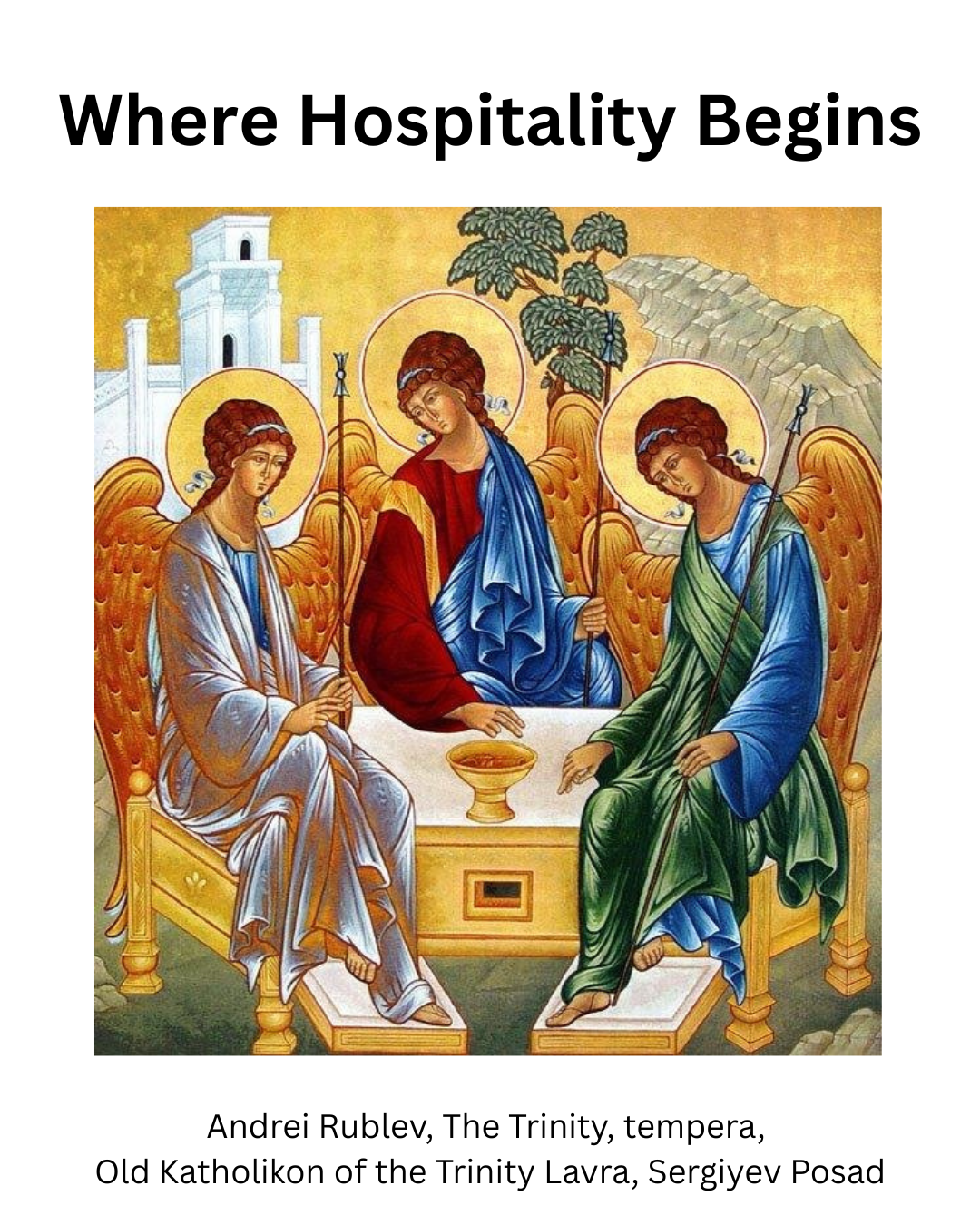
For Christians, hospitality has its source, its orientation, and its goal rooted in our particular understanding and experience of God- Father, Son, and Holy Spirit.
When I speak of hospitality as a Christian practice1, I don’t mean to imply that people who are not Christian cannot offer hospitality. Nor do I mean that non Christians couldn’t think about hospitality as an important habit or custom.
Nevertheless, for Christians there are particular Christian beliefs and ideas that inform our motivation and shape how we think about the practice of hospitality. The Triune nature of God is one of those particularly Christian ideas.
There are a variety of ways to speak about the Trinity besides the traditional language of Father, Son, and Spirit that are good and helpful. The traditional language can be problematic because it has been used to reinforce a patriarchal view of God. Realizing those legitimate concerns, I am using the traditional words because they are a language of relationships.
The relationship between the persons of the Trinity is rich and complex. It is also, in some ways, simple. The persons of the Trinity live and interact with each other in a relationship of love, respect, and mutual care and support. It is a non hierarchical, non patriarchal relationship. This way of abiding is where hospitality begins.
The persons of the Trinity are free to be fully and truly themselves and fully and truly part of each other. They invite us to be fully and truly ourselves and fully and truly part of each other.
The life of the Trinity, the place and space created by the Trinity, invites us into a life of love, respect, care, and support. God inhabits and creates a free space 2. This free space is located nowhere and is found everywhere. It is not bound by time and place and yet it is experienced and discovered in particular places and times.
Hospitality began with creation. God did not and does not create out of need, deficit or lack. God creates out of love. God does not create to control. God creates through relationship and for relationship with us and with all of creation. As physicist, theologian, and priest John Polkinghorne3 said, God created a world that could create itself. God gives creation the space and ability to become itself.
Another time we will look at some of the stories in the Bible using hospitality as our framework. Hospitality is one of the themes of the text from start to finish. Today, I want to briefly talk about, why hospitality matters.
Why focus on hospitality? Because we live in a world that is often fearful, suspicious, and aggressive. On one hand, we intuitively know we don’t have to live this way. On the other hand, we have trouble seeing a way forward. How do we move from hostility to hospitality?
Henri Nouwen wrote about the movement from hostility to hospitality in 1975. His words are as true now as they were then.
“The movement from hostility to hospitality is hard and full of difficulties. Our society seems to be increasingly full of fearful, defensive, aggressive people anxiously clinging to their property and inclined to look at their surrounding world with suspicion, always expecting the enemy to suddenly appear, intrude and do harm. But still- that is our vocation: to convert the hostis into a hospes, the enemy into a guest, and to create the free and fearless space where brotherhood and sisterhood can be formed and fully experienced.”4
If hospitality is our vocation and a Christian practice, how do we do it? What does it look like? As always, we look to Jesus. In his life we can see what the vocation of hospitality looks like. Over and over again, we see Jesus reach out to offer enemies the opportunity to become guests. And then to be invited to move from guest to family.
Jesus tells his disciples we are to love God and to love our neighbor. This was not a new insight, it came from Torah5. One way to think about Torah is that it offered a way for Israel to live together with God, and with their neighbors. Jesus takes these ideas of Torah and expands them. The parable of the Good Samaritan redefines the idea of neighbor, almost beyond belief, to include the stranger, the enemy, the “other”.
In the Sermon on the Mount, which is Jesus’ great resetting and upsetting of society, he tells us plainly. “You have heard that it was said, ‘ You shall love your neighbor and hate your enemy.’ But I say to you: Love your enemies and pray for those who persecute you, so that you may be children of your Father in heaven, for he makes his sun rise on the evil and on the good and sends rain on the righteous and on the unrighteous. For it you love those who love you, what reward do you have? Do not even the tax collectors do the same? And if you greet only your brothers and sisters, what more are you doing than others? Do not even the gentiles do the same? Be perfect, therefore, as your heavenly Father is perfect.”6
Hospitality is made up of personal actions. And hospitality is also a communal effort. It is something we do together. It is our common calling, our common vocation as Christians. This vocation is not to make everyone a particular sort of Christian. It is to offer everyone the space to become themselves. To become who God is inviting them to become. And in the practice of hospitality, we too, become the people God is inviting us to become. People living without fear, living without aggression. People living in love.
- https://conversationinfaith.com/2026/05/02/hospitality-as-a-christian-practice/ ↩︎
- This idea of free space comes from Nouwen, Henri, Reaching Out: The Three Movements of the Spiritual Life, Image Books, Doubleday, 1975, 71-72 ↩︎
- https://en.wikipedia.org/wiki/John_Polkinghorne ↩︎
- Nouwen, Henri, Reaching Out: The Three Movements of the Spiritual Life, Image Books, Doubleday, 1975, 49-50 ↩︎
- The Torah is the first five books of what Christians refer to as the Old Testament. Often dismissed as picky rules or burdensome law, Torah explores what it means to live together as the people of God- fairly and justly. ↩︎
- Matthew 5:43-48 NRSVue ↩︎


Leave a comment