After truly dire warnings or persecution and estrangement, Jesus ends what scholars call his “missionary discourse”1 in Matthew’s gospel with a call to hospitality. Over the course of Jesus’ teaching in this discourse, there has been a shift in audience and emphasis. Jesus began with specific instructions to the twelve disciples- what to take and how to act. Then he gave warnings and consolation to disciples then and now. Jesus moves from speaking just to the twelve in particular about life as missionaries to every disciple.
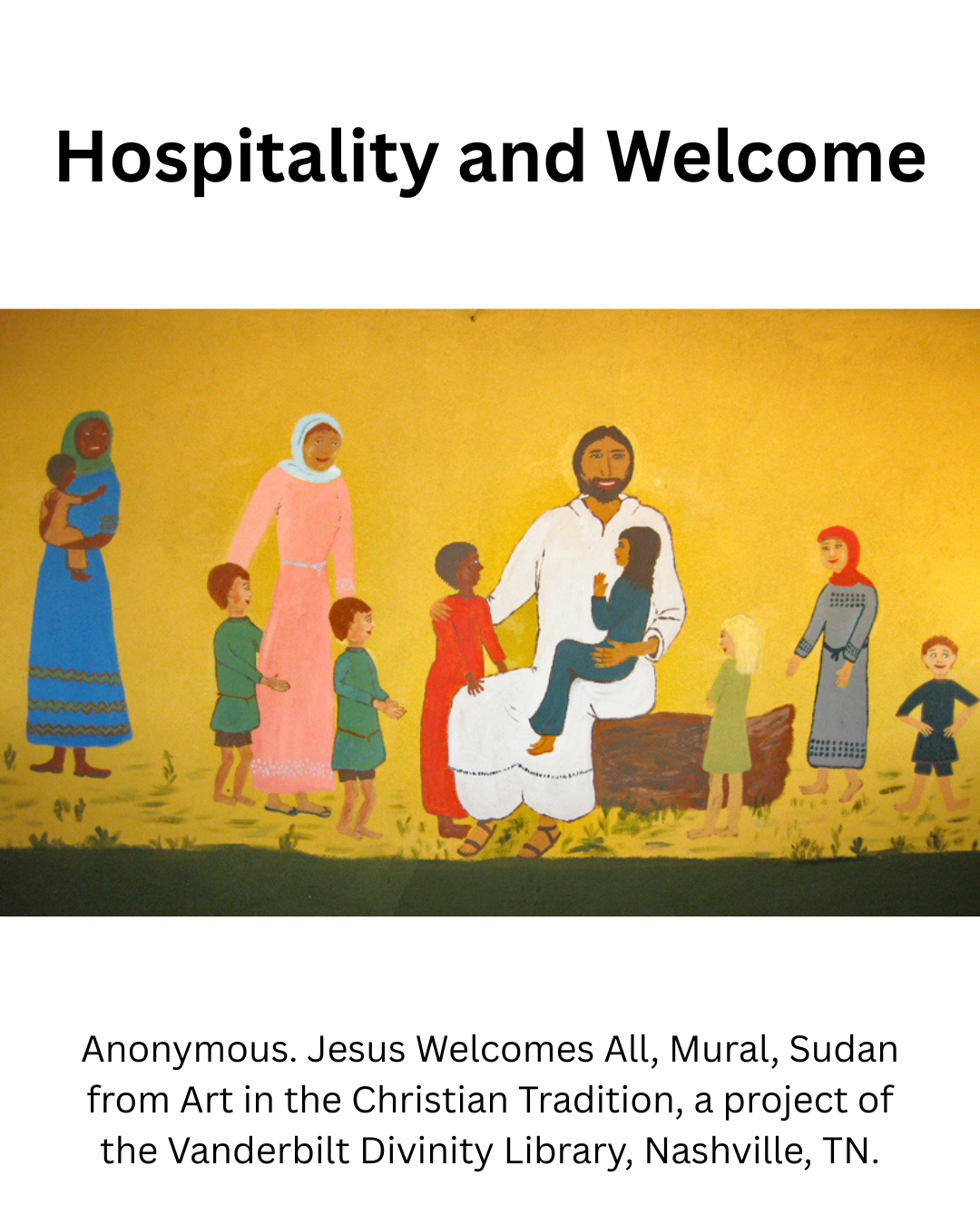
After the instructions and warnings and consolation, Jesus ends with this:
“Whoever welcomes you welcomes me, and whoever welcomes me welcomes the one who sent me. Whoever welcomes a prophet in the name of a prophet will receive a prophet’s reward, and whoever welcomes a righteous person in the name of a righteous person will receive the reward of the righteous, and whoever gives even a cup of cold water to one of these little ones in the name of a disciple — truly I tell you, none of these will lose their reward.” Matthew 10:40-42 NRSVue
To welcome a disciple is to welcome Jesus and to welcome Jesus is to welcome God. This is also a reminder that disciples don’t only represent themselves, Christ’s presence is with them. They and we represent God. Notice who is doing the welcoming’ “whoever”. Not disciples, necessarily. Not those of high status. Not necessarily other believers. Whoever welcomes you…
Then Jesus focus shifts a bit. “Whoever welcomes a prophet…” This “whoever” includes the people Jesus is speaking to. They are welcomed, and they are to welcome others. Prophets, the righteous, and even the “little ones”.
Jesus routinely calls for a non hierarchical society and way of living. His discourse about missionaries reinforces this. Missionaries are not accorded a special welcome or status. Hospitality is not only for important people, like prophets. Nor is it only for worthy people, like the righteous. Hospitality extends to the “little ones”. Followers of Jesus are to welcome everyone with the same kind of hospitality. Prophet, righteous, child, or average, regular disciple, to welcome any of them is to welcome Christ.
Sometimes when Jesus talks about “little ones” he means children. Sometimes he means vulnerable people, who lack wealth and status. Sometimes Jesus talks about disciples as “little ones”.
To be a “little one” is to be part of the marginalized and weak- by circumstance or choice- rather than seek power and authority. In the gospels, Jesus repeatedly tells the disciples to avoid status and honor. They are to serve others. Then as now, servants of any sort were lower on the social hierarchy.
In the difficult and sometimes dangerous life of faith, the disciples are to care for each other, and to offer food and shelter and support- without fear or favor. They are to live lives marked by hospitality.
Jesus will, in due course, explicitly expand the circle of hospitality and welcome that is implied by “whoever” to include everyone, to the ends of the earth. This hospitality and welcome was a mark of the early church. The deep commitment to welcome and hospitality was notable and noticed by others. The early Christians did their best to create hospitable spaces, where the markers of status, of economic status, of gender, of enslavement ceased to exist. In a culture where everyone knew their place and society’s functioning depended upon people not challenging the norms of status and rank; Christians were a concern, a problem, even a threat.
We live in a time of a national decrease of welcome and hospitality, both to citizens and migrants. Stable housing, access to food and medical care, and personal security and freedoms are decreasing for large numbers of people. Hospitality and welcome are both individual and community actions.
We, as Jesus’ disciples in this place and time, need to ask ourselves what does welcome and hospitality involve now? There is not a single answer to this question. Each of us has to answer it for ourselves as individuals- what can I do?
And we have to answer it as part of our communities. What can my neighborhood do? My city? My church? My state? My nation?
This is not about making the United States a “Christian nation”. That is not the call of Jesus. This question is about what it means to live as faithful followers of Jesus. As disciples of Jesus we bring his values of hospitality, of ending hunger, providing health care, stable housing and so on into our shared public life- for the benefit and well being of everyone.
No one of us can fix everything. Each of us can do something. We each have a cup of water to offer. What is your “cup” to offer?
- The author of the Gospel of Matthew has collected Jesus’ teaching into five discourses. The first is the Sermon on the Mount. The second is the Missionary discourse of chapter 10. As we read through Matthew’s gospel we will discover the others. ↩︎


Leave a comment