Some people are never satisfied. No matter what you say or do, they will find fault. Others want you to cater to their whim, to dance to their tune.
“But to what will I compare this generation? It is like children sitting in the marketplaces and calling to one another,
‘We played the flute for you, and you did not dance; we wailed, and you did not mourn.’
“For John came neither eating nor drinking, and they say, ‘He has a demon’; the Son of Man came eating and drinking, and they say, ‘Look, a glutton and a drunkard, a friend of tax collectors and sinners!’ Yet wisdom is vindicated by her deeds.” Matt 11:16-19 NRSVue1
It didn’t really matter what Jesus or John the Baptist did. Whether they fasted or feasted, some were not happy. Some wanted Jesus to play their game- to let them call the shots, dance when we say dance. Mourn when we say to mourn. They wanted a Messiah to cater to their desires and who would perform for the Empire.
Jesus wasn’t playing that game. His focus was on God. He would be vindicated by his actions, by his life, not by popular opinion, not by the dictates of the marketplace.
At that time Jesus said, “I thank you, Father, Lord of heaven and earth, because you have hidden these things from the wise and the intelligent and have revealed them to infants; yes, Father, for such was your gracious will. All things have been handed over to me by my Father, and no one knows the Son except the Father, and no one knows the Father except the Son and anyone to whom the Son chooses to reveal him.
“Come to me, all you who are weary and are carrying heavy burdens, and I will give you rest. Take my yoke upon you, and learn from me, for I am gentle and humble in heart, and you will find rest for your souls. For my yoke is easy, and my burden is light.” Matthew 11: 25-30 NRSVue
Throughout most of history and even today, people tend to think that people in authority, have that authority and the power that comes with it, because they are smarter than the rest of us. The wise and the intelligent understand how the world works. They are uniquely suited to their stations of authority. They decide who dances and who mourns. But they only see the world as it is. They cannot see what is possible with God. They cannot see what the infants know.
Jesus often uses the word “infants” to describe the powerless. The infants are those without influence, whose place is on the margins. The infants are those who suffer most in the world at the hands of the “wise and intelligent”. The infants know something is wrong with the world. It is to the infants and not the wise, that God reveals God’s self. The infants recognize who Jesus is and follow him. Because they know Jesus, the infants know another world is possible.
Then Jesus says some familiar words: “Come to me, all you who are weary and are carrying heavy burdens, and I will give you rest. Take my yoke upon you, and learn from me, for I am gentle and humble in heart, and you will find rest for your souls. For my yoke is easy, and my burden is light.”
Commonly, we interpret these words to mean something like, hand your troubles over to Jesus. Stop struggling. Rest. Yes, we should give our burdens to Jesus. Certainly we should rest. And Jesus is inviting us to something more.
Rest, in the Bible, is not simply a respite or a break. Rest is life in God’s presence. It is life as God intended it to be. Jesus calls us, not to a life of idleness, but to live fully with God. Jesus’ rest is God’s Shalom.
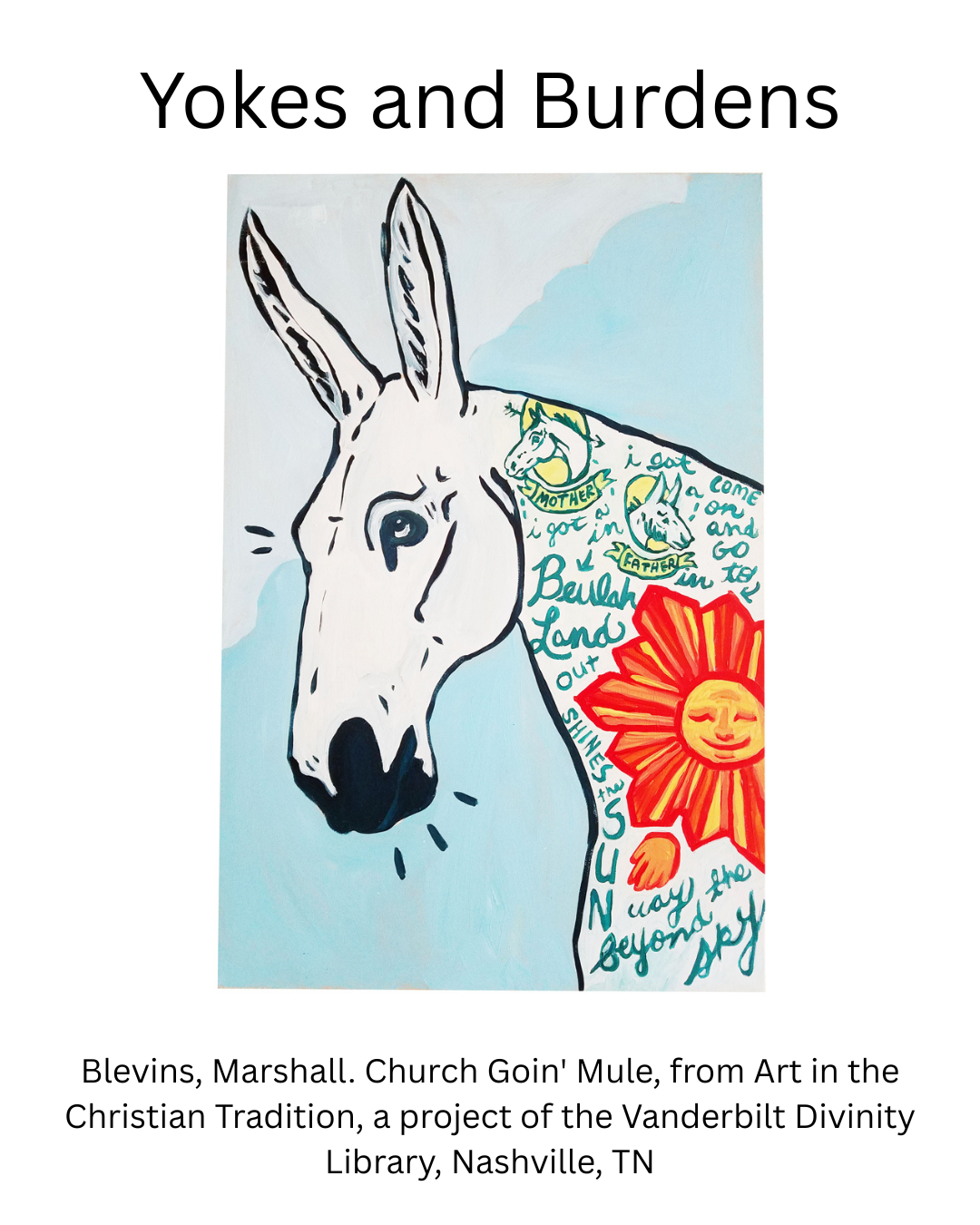
A yoke harnesses mules or oxen (or other animals) together so they can pull equipment like a plow or cart. But the concept of a yoke also “refers to oppressive rulers, and nations including Egypt, Assyria, Babylon, and Rome.”2 Jesus is calling people to reject the heavy and oppressive burden of life in the Empire and live in God’s just Shalom. Disciples take on the yoke of Jesus and learn a new way of life. This is not a yoke of oppression and domination. Jesus is gentle and humble and that makes his yoke easy. The Hebrew word translated here as “easy” is in other places in Scripture translated as “kind” or “good”. In the Septuagint it is used to describe God as kind or good.3 The phrase “my yoke is easy” is perhaps better translated as “My yoke is kind/good”.
Jesus isn’t interested in performing for the whims of the crowd.He isn’t interested in their accolades. He isn’t after the approval of the ruling class. Jesus calls us to take off the poorly fitting, hard yoke of Empire. Instead he calls us to his good and kind yoke. Jesus calls us to abandon the heavy constraints of life in the Empire. Instead he calls us to pick up the light, life giving way of Jesus.
The way the world is now, is not the way the world has to be. Jesus shows us and invites us to a better way. Will we listen to people playing at life in the marketplace? Or will we listen to Jesus? Which yoke, which burden will we choose?
- This week the Lectionary gives us two statements by Jesus. They are related but not continuous in the text. ↩︎
- Carter, Warren, Matthew and the Margins: A Sociopolitical and Religious Reading, Orbis Books, 2001, page 260. Because Jewish teachers referred to the yoke of obeying Torah, some Christian commentators think Jesus is criticizing Judaism, and repudiating the Torah. But Jesus is an observant Jew. While he sometimes called for reform or reinterpretation, he did not reject Torah. ↩︎
- Carter, 261 ↩︎


Leave a comment