I find it reassuring that the disciples are both faithful and clueless. They believe and they don’t trust. They follow and they wander off.
Just before this week’s passage, Peter has declared that Jesus is the Messiah.
” He [Jesus] said to them, But who do you say that I am?” Simon Peter answered, “You are the Messiah, the Son of the living God.”1
Jesus replies, “Blessed are you, Simon son of Jonah! For flesh and blood has not revealed this to you but my Father in heaven. And I tell you, you are Peter, and on this rock I will build my church, and the gates of Hades will not prevail against it. I will give you the keys of the kingdom of heaven, and whatever you bind on earth will be bound in heaven, and whatever you loose on earth will be loosed in heaven.”2
Most commonly scholars believe that the metaphor of binding and loosing refers to interpreting and teaching. Peter and the disciples are to understand and teach what God intends for the world through Jesus’ life and teaching, and by his death and resurrection.
Everything seems to be going well. And then;
From that time on, Jesus began to show his disciples that he must go to Jerusalem and undergo great suffering at the hands of the elders and chief priests and scribes and be killed and on the third day be raised. And Peter took him aside and began to rebuke him, saying, “God forbid it, Lord! This must never happen to you.” But he turned and said to Peter, “Get behind me, Satan! You are a hindrance to me, for you are setting your mind not on divine things but on human things.”
Then Jesus told his disciples, “If any wish to come after me, let them deny themselves and take up their cross and follow me. For those who want to save their life will lose it, and those who lose their life for my sake will find it. For what will it profit them if they gain the whole world but forfeit their life? Or what will they give in return for their life?
“For the Son of Man is to come with his angels in the glory of his Father, and then he will repay everyone for what has been done. Truly I tell you, there are some standing here who will not taste death before they see the Son of Man coming in his kingdom.” 3
Well that didn’t take long. Peter goes from the rock upon which the church will be built, and the one with teaching authority to being called Satan and a hindrance.
That Peter doesn’t want Jesus to die makes sense. He would not want his companion, teacher, and friend to die. Not to mention it was inconceivable that the Messiah would be killed by the authorities. The Messiah was expected to deliver Israel from bondage by being a successful liberator, not by dying at the hands of the authorities.
Like Satan, with his temptations, Peter is tempting Jesus to be the conventionally expected Messiah. He expects Jesus to conform to societal and religious ideas of what a successful Messiah does.
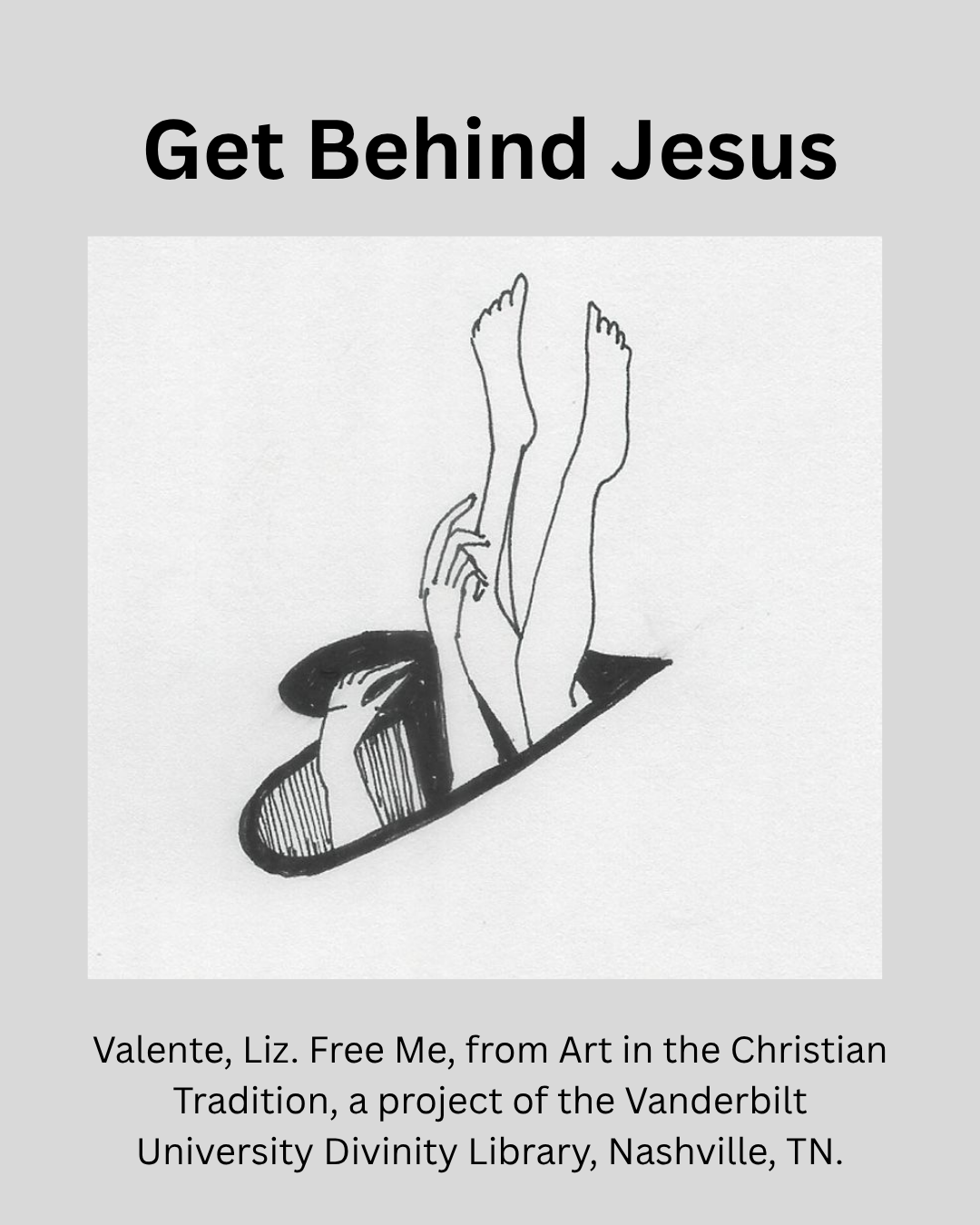
And yet, when Jesus tells Peter to “get behind me” he isn’t dismissing Peter. He is calling Peter to begin again- to listen and learn. Disciples follow behind teachers. They don’t distract them.4
Then Jesus speaks in paradoxes and riddles. “For those who want to save their life will lose it, and those who lose their life for my sake will find it.” For what will it profit them if they gain the whole world but forfeit their life? Or what will they give in return for their life?”
As soon as Peter and the disciples think they understand, they don’t. They miss the point because the point is so unbelievable.
Success is failure. Failure is success. Loss is gain. Survival is death. The poor are rich. The mighty are brought low. The excluded are included. Enemies are loved. Death is not final. Resurrection happens.
As Peter, the original disciples, and every disciple since then has discovered, this is a difficult way to live. If we are honest, it’s impossible. But the fact that it’s impossible doesn’t mean we shouldn’t try. It takes wisdom and courage to resist the call of success, to resist the lure of safety and security, to truly live for others.
This difficult way of living is for us as individuals and as churches. Individuals need the support and encouragement of the church and churches need individuals to remind it of the call of Jesus. Individually and communally we are called to resist the lure of power, wealth, success, and security. We need to seek the constant guidance and support of the Holy Spirit.
This is the point in most essays where the author outlines some ideas about how we do this. But honestly, considering how seldom we… Oops I almost wrote, ‘considering how seldom we are successful..’, and there is the problem. How difficult it is to not think in terms of success or failure. Or to not think in terms of winning versus losing.
My only suggestions are these. Following Jesus means, at least in part, regularly examining our lives and our actions- prayerfully and honestly. We need to cultivate the ability to live in discomfort and anxiety when we do that. We will be uncomfortable and anxious when we seriously think about our priorities, our actions, and our intentions.
We need to think about what living faithfully means. Can we change our criteria from success to faithfulness? What does it mean to lose our life for Jesus’ sake? We, as individuals and communities, have to discern what being faithful to the way of Jesus means in our time.
God is both knowable and unfathomable. We can know some things about God but we cannot know everything. Like Peter, we cannot assume we fully understand God’s will. And like Peter when we miss the mark, we are invited to get behind Jesus, again, as humble, teachable disciples. We are invited to move beyond our desire for praise and status, security and success and live into a life of faithfulness.
- Matthew 16:25-16 NRSVue ↩︎
- Matthew 16:17-19 NRSVue. ↩︎
- Matthew 16:21-28 NRSVue ↩︎
- Carter, Warren, Matthew and the Margins: A Sociopolitical and Religious Reading, Orbis Books 2001, page 343 and Boring, M. Eugene, “The Gospel of Matthew” in The New Interpreter’s Bible Vol VIII, Leander Keck Ed. 1994,Abingdon Press page 349 ↩︎


Leave a comment